


20th Aug 2025. 9.03am
Regency View:
BUY BAE Systems (BA.) Second Tranche
- Growth

Regency View:
BUY BAE Systems (BA.) Second Tranche
BAE Systems: A fresh chance to reload
Back in April, we initiated a first tranche buy recommendation on BAE Systems (BA.). The catalyst was Europe’s €800 billion defence overhaul, a landmark policy designed to boost readiness, close capability gaps and foster an independent industrial base. Investors quickly recognised the scale of this shift, sending BAE’s shares sharply higher into June.
Since then, the stock has eased back, giving up much of its earlier gains and leaving our original position close to flat. On the surface, this may appear disappointing, but the pullback provides the perfect opportunity to build exposure. With fundamentals moving in the right direction and the long-term defence cycle firmly intact, we see this consolidation as a chance to add a second tranche.
Strong first-half delivery
BAE’s half-year results to June 2025 showed a business firing on all cylinders. Sales rose 11% to £14.6 billion, with growth across all divisions. Underlying earnings increased 13% to £1.55 billion, lifting the group’s return on sales to 10.6%. Underlying earnings per share advanced 12% to 34.7 pence, and management raised the interim dividend by 9% to 13.5 pence.
The only blot was a free cash outflow of £368 million, which compared with an inflow of £219 million a year earlier. However, this was largely a function of working capital and customer advance movements, both of which were expected. Management reaffirmed full year free cash flow guidance of more than £1.1 billion, which reassures us that the long-term cash story is unchanged.
Guidance upgraded
Reflecting the strength of the first half, BAE upgraded its full year outlook. Sales are now expected to grow 8 to 10%, compared with earlier guidance of 7 to 9%. Underlying earnings growth is forecast at 9 to 11%, up from 8 to 10% previously. EPS growth guidance remains at 8 to 10% due to a slightly higher tax rate and fewer share buybacks, a consequence of the higher average share price.
The order backlog closed the period at £75.4 billion, down modestly from December but still enough to provide many years of sales visibility. These are multi-decade contracts across air, land, maritime and cyber programmes, embedding long term value into the group. The scale and quality of this backlog is one of the most important strengths of the investment case.
BAE Systems Half Year Results 2025

Strategic positioning
BAE continues to secure strategically important contracts that extend its leadership position. Recent wins include a $1.2 billion contract with the U.S. Space Force for missile tracking satellites, a £1 billion UK government award for sixth generation fighter development alongside Italy and Japan, and fresh orders for Eurofighter jets from Turkey. Together, these highlight the company’s strength across geographies and technologies.
Looking further out, BAE is central to the Global Combat Air Programme, a multi-decade fighter jet development project with Italy and Japan, and the SSN AUKUS submarine programme. These are enormous long-term opportunities that will underpin revenues well into the 2030s and 2040s. Few companies have this degree of visibility.
Sentiment and technicals
The recent dip in BAE’s shares has more to do with sentiment than fundamentals. European defence stocks retreated after President Trump’s meeting with President Zelenskiy raised hopes for peace talks in Ukraine. The STOXX aerospace and defence index fell almost 2% on the day, with names such as Rheinmetall and Leonardo losing more than 4%. BAE declined around 3% in sympathy.
This looks more like profit-taking after a strong run rather than a structural change in the investment case. The sector is sensitive to headlines around peace prospects, but the long-term drivers of modernisation, readiness and NATO’s spending plans remain intact. For investors, that means the pullback is noise, not signal.
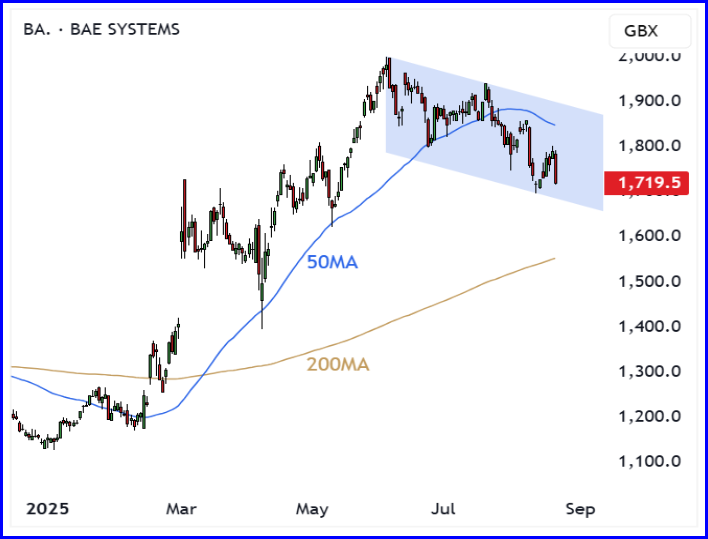
From a technical standpoint, the retracement has helped unwind stretched momentum readings without damaging the broader uptrend. The pullback has taken the form of a descending channel and prices remain well above the 200-day moving average. This is a typical consolidation in a longer-term trend and creates a more attractive entry point for fresh capital.
Valuation stacks up
At the current price of around 1,734 pence, BAE trades on a forward P/E of 22.2 times. With forecast EPS growth of 13.6%, that equates to a PEG ratio of 1.9. The valuation sits at a premium to the wider industrials sector, but this is justified by high visibility of earnings, a record order book, and double digit growth. The forward dividend yield is 2.1%, comfortably covered by free cash flow.
Quality metrics underline the financial strength of the business. Return on equity is running at 17.9% and return on capital employed at 11.1%. These are impressive figures for a defence prime contractor, and well ahead of most European peers. With an EV/EBITDA multiple of 16.8 times and a price to sales ratio of just under two, BAE is valued as a quality compounder with scarce strategic assets.
The case for a second tranche
The investment case for BAE has only strengthened since our first tranche buy in April. The company has delivered robust earnings, upgraded guidance, and continued to secure strategically vital contracts. Defence spending commitments across NATO, the UK and the U.S. provide a long-term structural tailwind. The shares, meanwhile, have pulled back to a level that presents a more attractive entry point.
Adding a second tranche here allows us to average into a high quality name with strong free cash flow, high returns on equity, and an order backlog that stretches decades into the future. BAE remains one of the best positioned defence contractors globally, and the pullback should be viewed as an opportunity rather than a warning sign.
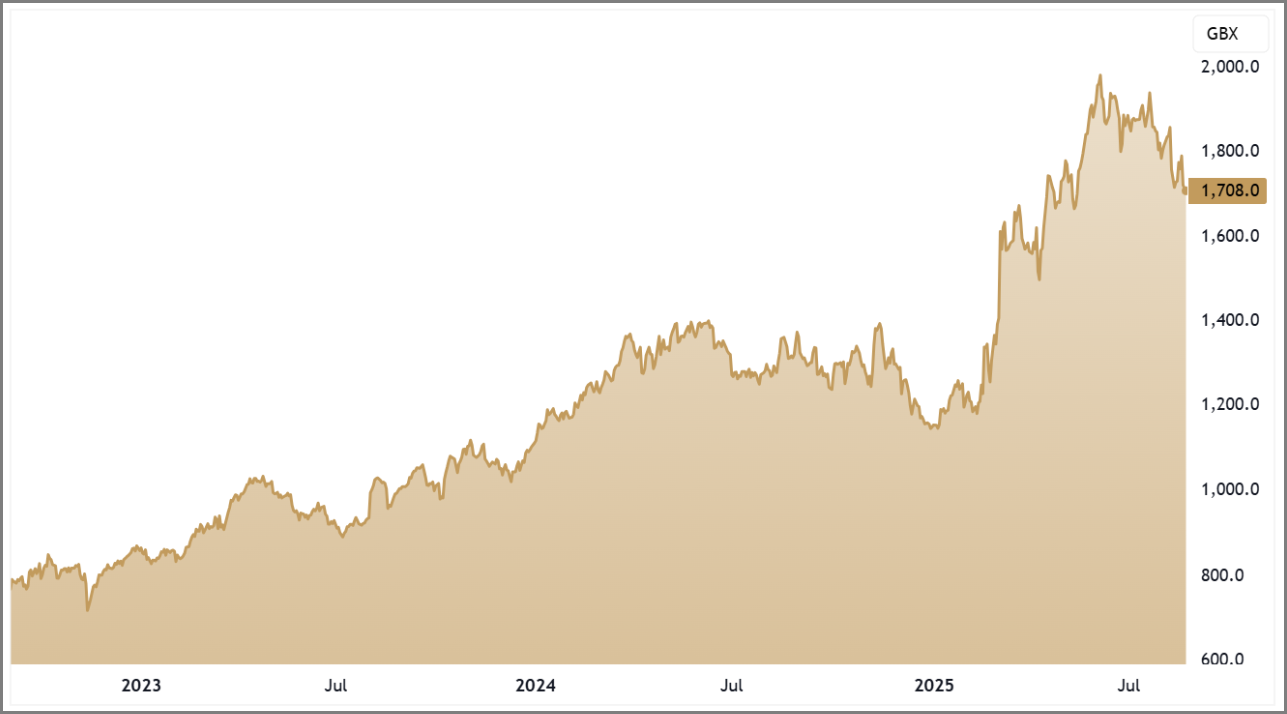
BA. 3-Year Chart
Disclaimer:
All content is provided for general information only and should not be construed as any form of advice or personal recommendation. The provision of this content is not regulated by the Financial Conduct Authority.