


9th Oct 2026. 11.02am
Weekly Briefing Friday 9th October
| Market | Movement this week (%)* |
|---|---|
| FTSE 100 | +0.71% |
| FTSE 250 | +0.27% |
| FTSE All-Share | +0.66% |
| AIM 100 | -0.86% |
| AIM All-Share | -0.81% |
* Price movement from Monday's open at 8am

Regency View:
Weekly Briefing Friday 9th October
Market Overview
Dear Investor,
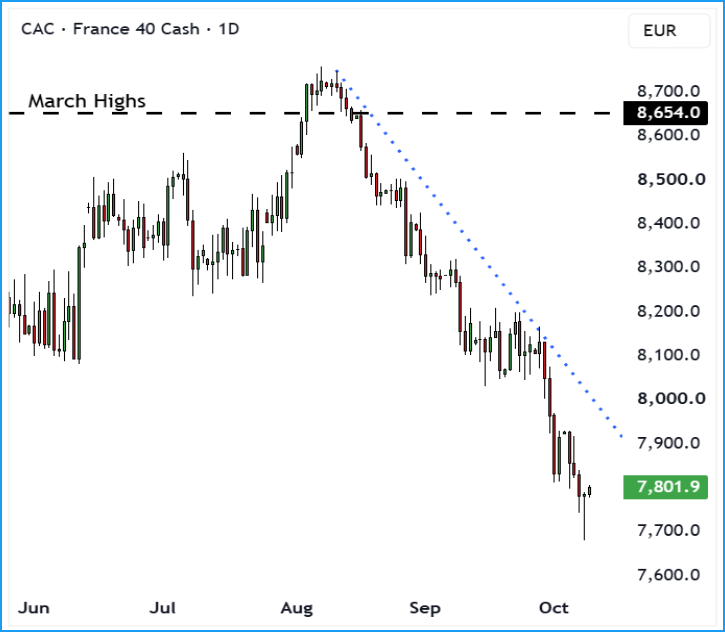
Our friends across the Channel have found themselves at the centre of Europe’s latest bout of market turbulence, with concerns over France’s finances spilling out of the bond market and into equities. The yield on French 10-year government bonds has climbed towards 5%, its highest level in almost 25 years, as investors demand greater compensation for lending to a government carrying around €3.5 trillion of debt. The selling has coincided with a sharp decline in French equities, with the CAC 40 now more than 10% below its August highs and showing few signs of finding its feet.
The problem for France is that borrowing costs are rising at a time when its finances are already under considerable strain. The gap between French and German 10-year bond yields, a useful measure of how investors view the relative risks of lending to the two governments, has widened to around 1.4 percentage points. That is quite a shift in sentiment in the space of a few weeks, particularly for two countries that share the same currency. With a presidential election approaching next April and plenty of uncertainty over the direction of fiscal policy, investors are becoming less willing to give France the benefit of the doubt.
What makes this week’s developments interesting, however, is that not everyone is heading for the exit. The selling has spread beyond French government bonds into other European debt markets, including corporate bonds and the government debt of countries such as Italy. Some large institutional investors have started buying into that weakness, arguing that markets have become a little too enthusiastic about treating Europe’s problems as though they are all the same. France certainly has some difficult decisions ahead, but that doesn’t necessarily mean an Italian government bond or a financially sound European company should be marked down simply for being in the same neighbourhood.
There is also an important distinction between the current situation and the Eurozone debt crisis of the early 2010s. The European Central Bank now has a broader set of tools available to calm disorderly markets, and there is considerably more confidence in the institutional support behind the single currency. That doesn’t mean France can simply expect the ECB to ride to the rescue whenever borrowing costs become uncomfortable. The central bank has already made it clear that sorting out government budgets isn’t part of its job description, which is probably a conversation French politicians would rather not be having quite so close to an election.
For equity investors, the interesting part is how quickly markets can become more selective when confidence starts to deteriorate. Companies carrying too much debt or facing expensive refinancing can come under pressure, but stronger businesses can also get caught up in the selling despite little changing in their underlying performance. Europe’s bond markets are giving investors plenty to worry about this week, although as some of the larger fund managers are already demonstrating, there is a difference between recognising a genuine problem and assuming everything caught up in it deserves the same treatment.
Wishing you a great weekend,
Tom
Thomas Light – Chartered FCSI
Director of Research

Market Movers
On the rise: Tesco (LSE:TSCO) +8.4% on the week
Tesco shares climbed around 4% on Thursday after Britain’s largest supermarket delivered a stronger-than-expected set of half-year results and raised its full-year profit guidance. Adjusted operating profit increased 6.5% to £1.78 billion during the 26 weeks to 29 August, while sales excluding fuel and VAT rose 2% to £33.8 billion. The performance was particularly encouraging given the unusually hot summer, which weighed on grocery sales across the industry, although UK like-for-like growth did moderate from 1.8% in the first quarter to 1.3% in the second.
Management now expects full-year adjusted operating profit of between £3.15 billion and £3.30 billion, lifting the lower end of its previous £3.0 billion to £3.3 billion range. Tesco also increased its share buyback programme by £200 million to £950 million, reflecting continued confidence in its balance sheet and cash generation. Chief executive Ken Murphy struck an upbeat tone ahead of the important Christmas trading period, suggesting the business is entering the second half in good shape despite ongoing uncertainty around consumer spending.

Tesco’s ability to keep growing profits in a fiercely competitive grocery market is becoming an increasingly important part of the investment case. The group continues to command around 28% of the UK market, and while it surrendered a little market share over the summer, that followed particularly strong gains during the equivalent period last year. The shares have performed well in recent months and are trading close to their 52-week high, with the combination of improving profitability, shareholder returns and a forecast dividend yield of around 3.3% continuing to attract investor interest.
Regency View: Tesco is an existing FTSE Investor holding, with its shares having risen more than 87% since our original recommendation, excluding dividends. The latest results provide another opportunity to assess the investment case, including whether the valuation still offers sufficient upside following such a strong run. EXPLORE FTSE INVESTOR
Pennon shares plunged more than 20% on Wednesday, hitting their lowest level in 15 years after the owner of South West Water announced a £550 million rights issue alongside a substantial dividend cut. The fundraising forms part of a wider overhaul under new chief executive Keith Haslett, who took charge in April and is attempting to put the business on a firmer financial footing. Investors were clearly caught off guard by the scale of the announcement, particularly with the new shares being offered at 250p, a 35.5% discount to the theoretical ex-rights price.
The additional capital will help fund around £1 billion of extra investment in Pennon’s water infrastructure, taking planned expenditure to £3.6 billion over the current regulatory period. The company also intends to sell its renewables investment business, Pennon Power, as it looks to reduce a debt burden that has reached approximately £4.5 billion. Meanwhile, the planned reduction in the dividend per share of around 30% is another uncomfortable development for shareholders who have traditionally viewed water utilities as dependable income investments.

The announcement comes at a particularly difficult time for Britain’s water industry, which is facing intense scrutiny over environmental performance, customer bills and the level of investment needed to improve ageing infrastructure. Pennon’s challenge is to rebuild operational performance while funding a considerably larger investment programme without placing further strain on its balance sheet. The rights issue should provide some breathing room, but it also means existing shareholders face significant dilution unless they participate, with the success of the turnaround still dependent on execution and regulatory approvals.
Regency View: Pennon’s decision to raise fresh equity and cut its dividend highlights how quickly the investment case for a traditionally defensive utility can change when debt and capital requirements become difficult to manage. The fundraising should help strengthen the balance sheet, but with substantial investment still required and the operational turnaround in its early stages, there is little reason to assume the sharp fall in the share price automatically represents an attractive buying opportunity.
Sector Snapshot
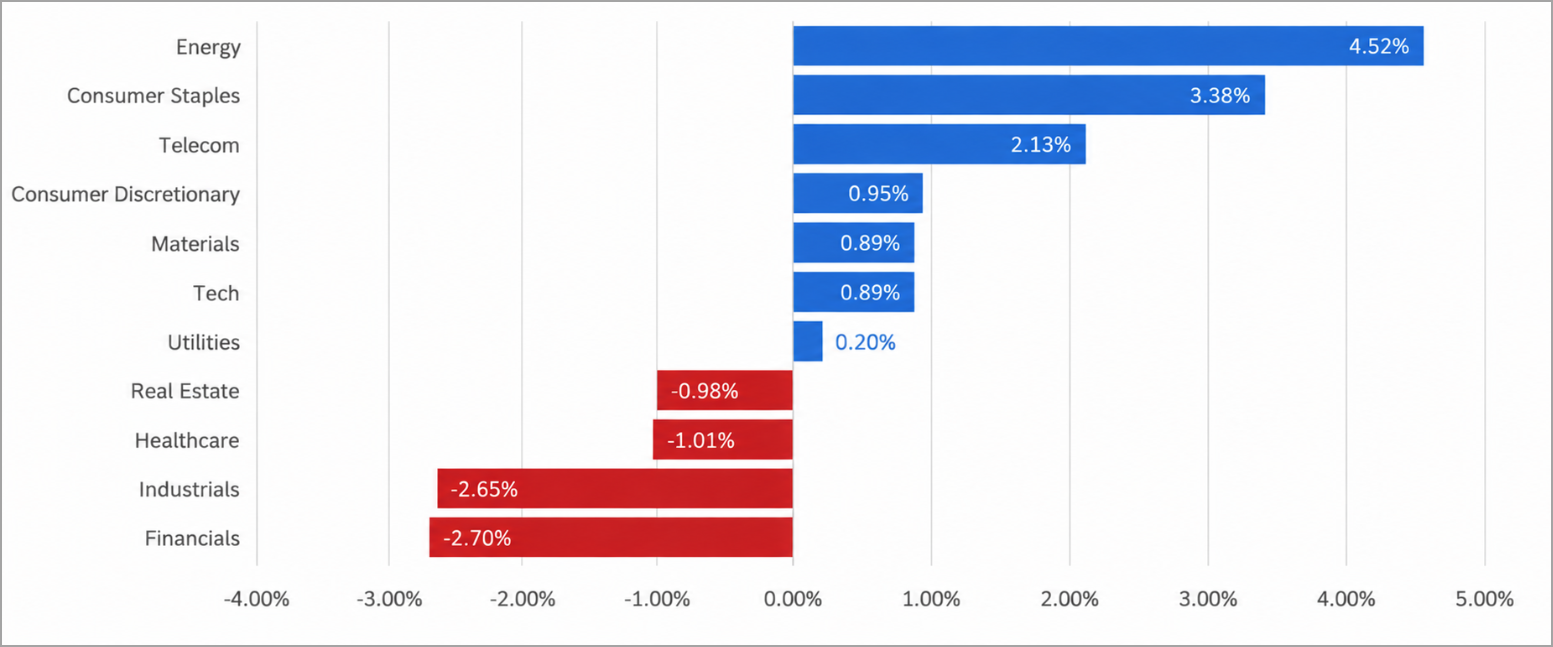
Energy led the way this week, delivering a strong gain and comfortably outperforming the rest of the market. Consumer Staples and Telecom also enjoyed a positive week, while Consumer Discretionary, Materials and Tech recorded more modest advances. Overall, seven of the eleven sectors finished higher, marking a clear improvement in market breadth following the widespread selling seen over the previous two weeks.
However, the recovery was far from uniform, with Financials and Industrials both suffering fairly heavy losses and finishing at the bottom of the table. Healthcare and Real Estate also remained under pressure, although their declines were less pronounced. The contrast between the stronger sectors and those continuing to struggle suggests investors are becoming more selective, with money rotating between different areas of the market rather than a broad recovery taking hold.
UK Sector Performance (7-Days)
UK Price Action
MEMBERS ONLY
Members can read our full analysis and view this week’s annotated FTSE chart, including the key technical levels that could prove important for the next directional move.
UNLOCK THE FULL WEEKLY BRIEFING
Disclaimer:
All content is provided for general information only and should not be construed as any form of advice or personal recommendation. The provision of this content is not regulated by the Financial Conduct Authority.