


4th Sep 2026. 10.58am
Weekly Briefing Friday 4th September
| Market | Movement this week (%)* |
|---|---|
| FTSE 100 | +0.13% |
| FTSE 250 | -1.40% |
| FTSE All-Share | +0.12% |
| AIM 100 | -1.69% |
| AIM All-Share | -1.42% |
* Price movement from Monday's open at 8am

Regency View:
Weekly Briefing Friday 4th September
Market Overview
Dear Investor,
September has begun with energy markets back at the top of the agenda. Brent crude has pushed above $90 a barrel following another escalation in the Middle East, but the more revealing move has been in diesel, where European prices have risen far more aggressively than the underlying cost of crude.
The premium for European diesel over crude briefly climbed above $100 a barrel this week for the first time. Part of that reflects renewed disruption around the Strait of Hormuz, where several tankers have been hit, but Russia’s decision to extend its diesel export ban has made an already tight market tighter still. The result is an unusual situation where the shortage of refined fuel is becoming at least as important as the availability of crude itself.
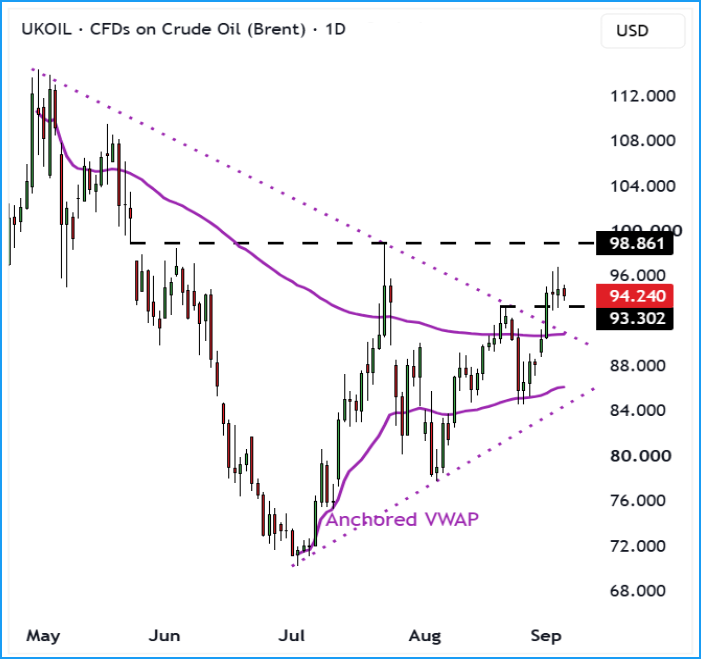
That’s an important distinction for investors. Brent above $90 will inevitably attract the headlines, but diesel is much closer to the price actually paid by large parts of the real economy. Haulage, agriculture, construction and manufacturing all feel higher fuel costs fairly quickly, which means the current squeeze has the potential to feed through into inflation even if crude itself doesn’t return to the extremes seen earlier in the conflict. With European refinery maintenance approaching, there isn’t much spare capacity around to provide an easy release valve either.
That makes the timing rather inconvenient for Andy Burnham’s new government. His first appearance at Prime Minister’s Questions came as 10-year gilt yields climbed above 5.2%, with markets already questioning how much room the government has ahead of October’s Budget. Burnham stressed that fiscal responsibility remains the priority, but higher energy prices create precisely the sort of problem Westminster can do little about: they threaten growth, complicate the inflation outlook and keep pressure on borrowing costs at the same time.
For UK investors, the interesting question is therefore no longer simply whether higher oil prices help BP and Shell. If the squeeze in refined fuels persists, its effects will spread much further through the market, potentially influencing margins, consumer spending, interest-rate expectations and the government’s finances. After several weeks in which markets became increasingly comfortable looking beyond the conflict, energy prices are providing a timely reminder that the economic consequences haven’t gone away.
Wishing you a great weekend,
Tom
Thomas Light – Chartered FCSI
Director of Research

Market Movers
On the rise: Hilton Food Group (LSE: HFG) +10.2% on the week
Hilton Food Group moved sharply higher after its interim results came in ahead of expectations and management raised its full-year profit guidance, despite continued problems within parts of the seafood business.
Adjusted profit before tax from continuing operations fell 5.2% to £32.8 million, but that was better than expected, with the core meat and fresh prepared food businesses performing well. Volumes increased 2.1%, while fresh prepared food volumes in Central Europe jumped 26%. The weaker spot remains seafood, particularly Foppen, where margin pressure and continuing restrictions on exports from Greece to the US contributed to a £2.2 million operating loss for the division.

More importantly, Hilton has raised its full-year adjusted profit guidance from £60-65 million to £66-71 million, reflecting the removal of losses from Dalco following its agreed sale and favourable currency movements. There are also several potential growth drivers beginning to move closer: its Saudi Arabian joint venture is due to open later this year, the new Canadian facility is scheduled for January and both are expected to start contributing to earnings during 2027. Meanwhile, adjusted free cash flow improved to £10.4 million from a £30.8 million outflow a year ago.
Regency View: These weren’t flawless results, but that arguably makes the upgrade more encouraging, with Hilton raising expectations despite Foppen continuing to drag on performance. Simplifying the portfolio while bringing new capacity in Canada and Saudi Arabia online gives the group several ways to improve earnings from here, provided management can get the remaining seafood problems under control.
Rockhopper Exploration came under pressure after Argentine President Javier Milei threatened fresh sanctions against companies involved in developing oil around the Falkland Islands, putting renewed political attention on the Sea Lion project.
Milei said he plans to introduce legislation allowing Argentina to impose tougher penalties not only on Rockhopper and project operator Navitas Petroleum, but potentially on their directors, shareholders and suppliers. Sea Lion, located around 140 miles north of the Falklands, is a sizeable 1.7 billion barrel resource in which Rockhopper holds a 35% interest. Rockhopper responded quickly, pointing to Navitas’s statement that the project operates under licences granted by the Falkland Islands Government with UK government support and that the latest developments are not expected to have a material impact on either development work or the timetable.

The timing helps explain the sharp reaction. Only last week Rockhopper raised around $180 million through a heavily oversubscribed institutional placing at 70p, providing funding as Sea Lion moves closer towards development. The shares subsequently rallied as investors focused on the prospect of finally turning a discovery made more than a decade ago into a producing asset. This week’s intervention hasn’t changed the geology or economics of Sea Lion, but it has abruptly reminded investors that political risk remains part of the valuation.
Regency View: Argentina’s latest intervention creates an unwelcome headline risk, but for now there is little evidence that it changes the practical development of Sea Lion. With the funding position considerably strengthened and Navitas maintaining that the timetable remains intact, the more important question is whether political rhetoric develops into something capable of disrupting the project’s suppliers or financing rather than simply unsettling the share price.
Looking for your next UK stock opportunity?
Our FTSE Investor and AIM Investor members receive our latest stock recommendations, in-depth research and regular updates as the investment case develops.
From growth and value opportunities to income stocks, we do the research, explain what matters and keep members updated on when we believe it’s time to buy more, hold or take profits.
Sector Snapshot
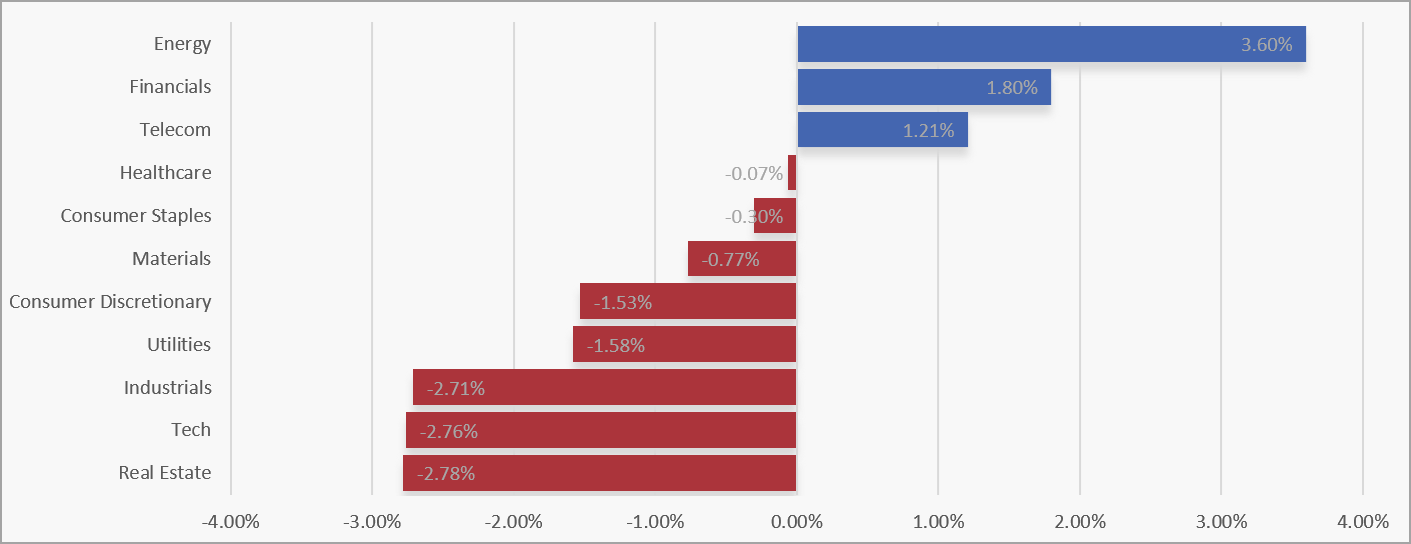
Energy was the clear leader this week, rising 3.60% as the latest escalation in the Middle East pushed oil prices higher. Financials and Telecoms also finished firmly in positive territory, but strength was relatively concentrated, with most sectors losing ground as renewed inflation concerns weighed on the wider market.
Real Estate, Technology and Industrials were the weakest performers, all falling more than 2.5%. The combination of higher energy prices and weakness in rate-sensitive areas such as Real Estate suggests investors are becoming more cautious about the inflation outlook and the potential implications for interest rates.
UK Sector Performance (7-Days)
UK Price Action
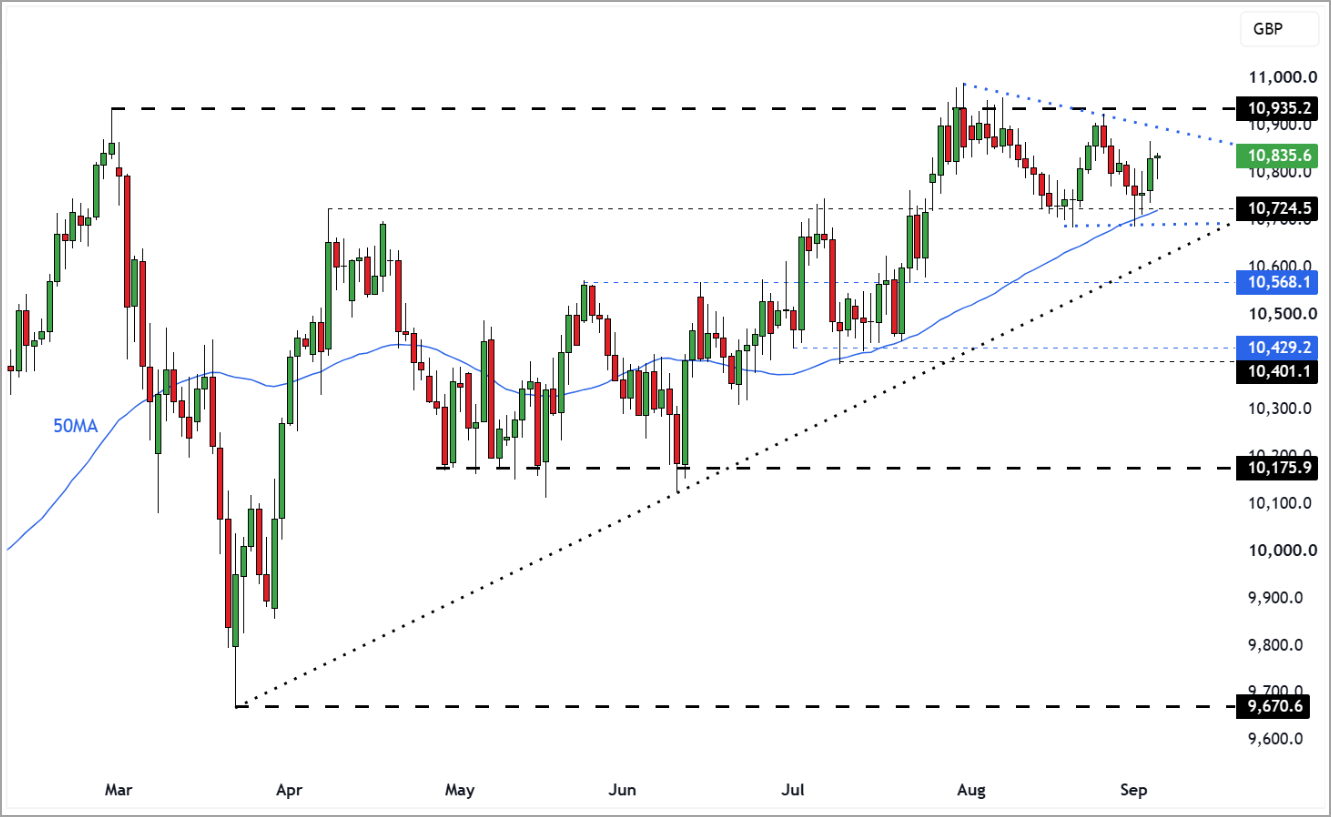
The FTSE has spent another week wrestling with the same key levels. After last week’s lower high, prices found support around 10,700, an area we’ve been highlighting since the July breakout, before bouncing back towards the February highs. The result is an increasingly tight descending triangle taking shape beneath 10,935 resistance, with lower highs pressing down against a relatively flat base. That puts the FTSE in an interesting spot heading into next week: a break above the descending trendline would bring the February highs straight back into focus, while a close below 10,700 would be the first real sign that this period of consolidation is starting to resolve lower.
UK100 Daily Candle Chart
Take your research further
Discover the UK shares we’re currently following across FTSE Investor and AIM Investor.
Disclaimer:
All content is provided for general information only and should not be construed as any form of advice or personal recommendation. The provision of this content is not regulated by the Financial Conduct Authority.