


31st Jul 2026. 9.31am

Weekly Briefing – Friday 31st July
| Market | Movement this week (%)* |
|---|---|
| FTSE 100 | +2.26% |
| FTSE 250 | +1.71% |
| FTSE All-Share | +2.18% |
| AIM 100 | -0.48% |
| AIM All-Share | -0.46% |
* Price movement from Monday's open at 8am
Regency View:
Weekly Briefing – Friday 31st July
Market Overview
Dear Investor,
Central bank weeks often answer one question and create another.
This week, both the Federal Reserve and the Bank of England left interest rates unchanged. On the surface, that sounds uneventful. Yet beneath the headlines, the tone has shifted noticeably.
Only a few months ago, investors were debating how quickly interest rates might fall. Today, the conversation has become whether they may need to rise again.
The catalyst is one we’ve discussed repeatedly over recent weeks: oil. Brent’s sharp rally since the conflict in Iran escalated has forced policymakers to think once again about inflation. Neither central bank believes higher energy prices have yet filtered through into the wider economy, but both made it clear they’re watching closely. The message was remarkably similar on both sides of the Atlantic: policy is restrictive enough for now, but they’re prepared to tighten further if higher energy costs become embedded in broader inflation.
Markets, however, seemed reassured rather than alarmed. Bond yields eased following the Bank of England’s decision as investors concluded policymakers remain cautious about pulling the trigger on another rate rise. It was a subtle reminder that what central banks don’t do can sometimes be just as important as what they do.
As earnings season gathers pace, interest rates and oil prices are becoming increasingly intertwined. If energy costs remain elevated, investors will be listening carefully to management teams for any signs of margin pressure, pricing power or changes in consumer demand. Company results will tell us how businesses have performed over the past six months. Their outlook statements will reveal how they expect to navigate the next six.
Wishing you a great weekend,
Tom
Thomas Light – Chartered FCSI
Director of Research

Market Movers
On the rise: Greggs (LSE: GRG) +23.9% on the week
Greggs moved higher after delivering stronger-than-expected interim results, showing that Britain’s favourite bakery continues to take market share despite subdued consumer confidence.
First-half sales increased 7.2% to £1.1 billion, while operating profit climbed almost 23% to £86.5 million as strong cost control combined with steady sales growth. Like-for-like sales rose 2.1%, but the bigger story was Greggs’ continued expansion. The group opened a net 34 new shops during the first half, taking its estate to 2,773 locations, while management reiterated its long-term ambition to grow to at least 3,500 UK stores. Alongside traditional high street sites, Greggs is increasingly targeting transport hubs, retail parks, supermarkets and airports, broadening the brand’s reach well beyond its historic footprint.
Management also highlighted encouraging progress across several newer growth initiatives. Grocery partnerships with Tesco and Iceland continued to expand, delivery remains an increasingly important sales channel, and smaller-format concepts such as “Greggs Express” and “Bitesize Greggs” are opening up locations that were previously uneconomic. At the same time, investments in new distribution centres and technology should provide the capacity to support the next phase of expansion. While full-year guidance was unchanged, the combination of market share gains, disciplined cost control and multiple avenues for future growth was enough to leave investors satisfied.
Regency View: Greggs increasingly looks less like a mature high street retailer and more like a long-run compound growth story. The valuation reflects much of that optimism, but consistently taking market share while expanding into new formats and locations suggests there is still plenty of runway ahead.
AB Dynamics came under pressure after warning that geopolitical uncertainty and a slowdown in customer decision-making would leave full-year revenue below previous expectations.
The automotive testing specialist said reduced confidence among customers, disruption to global logistics caused by the conflict in the Middle East and delays to vehicle development programmes had all contributed to a tougher second half. While the sales pipeline remains healthy, customers are taking longer to commit to orders, delaying revenue into future periods. The company now expects revenue from continuing operations of between £90 million and £95 million for the year, although management believes it can protect margins through tight cost control. It also confirmed it will exit its underperforming VadoTech testing services business in China following a strategic review.

Importantly, management was keen to stress that the long-term investment case remains intact. The group ended June with net cash of £41.7 million and continues to see strong customer interest, with structural drivers such as vehicle automation, safety regulation and increasingly sophisticated testing requirements continuing to support long-term demand. The problem is not a lack of opportunities, but customers taking longer to sign on the dotted line.
Regency View: Markets rarely wait patiently for delayed orders, even when the long-term outlook remains unchanged. AB Dynamics still benefits from attractive structural growth trends, but this update is a reminder that high-quality businesses are not immune when customers become more cautious about committing capital.
Sector Snapshot
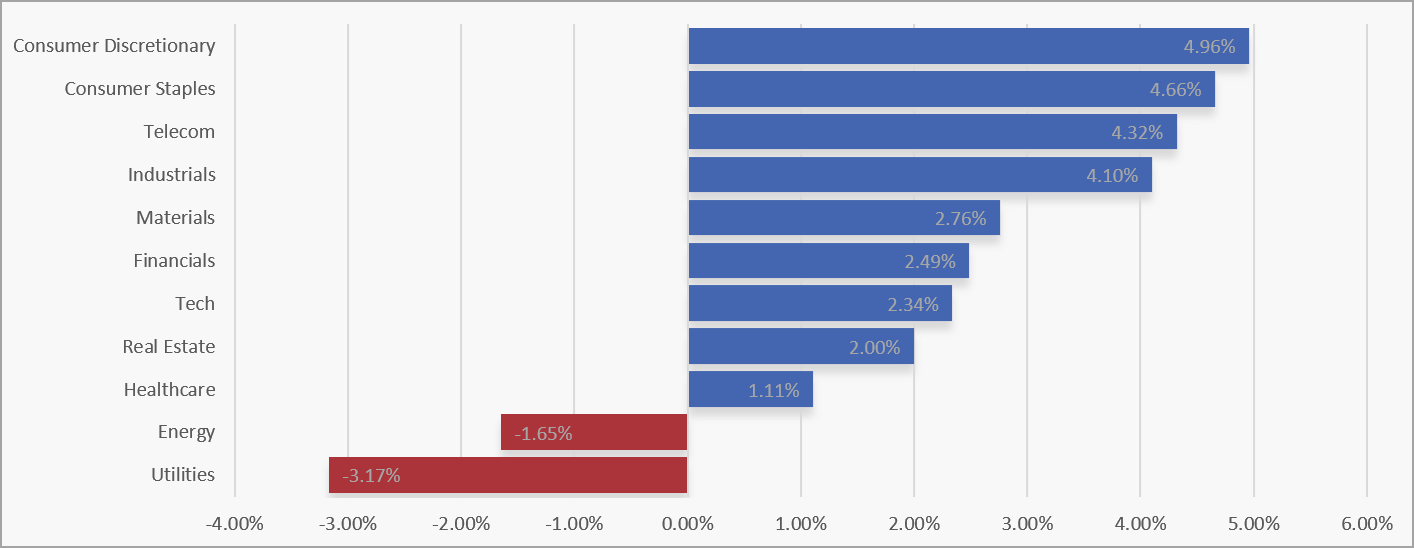
Consumer-facing sectors led the UK market this week, with Consumer Discretionary and Consumer Staples posting the strongest gains. Telecoms and Industrials also enjoyed a positive week, while Materials and Financials added to the broad-based strength across the market.
The only notable areas of weakness came from traditionally defensive sectors. Utilities was the weakest performer, while Energy gave back some recent gains as oil prices softened. Overall, however, the sector performance points to a more risk-on tone, with buying spread across a wide range of economically sensitive industries.
UK Sector Performance (7-Days)
UK Price Action
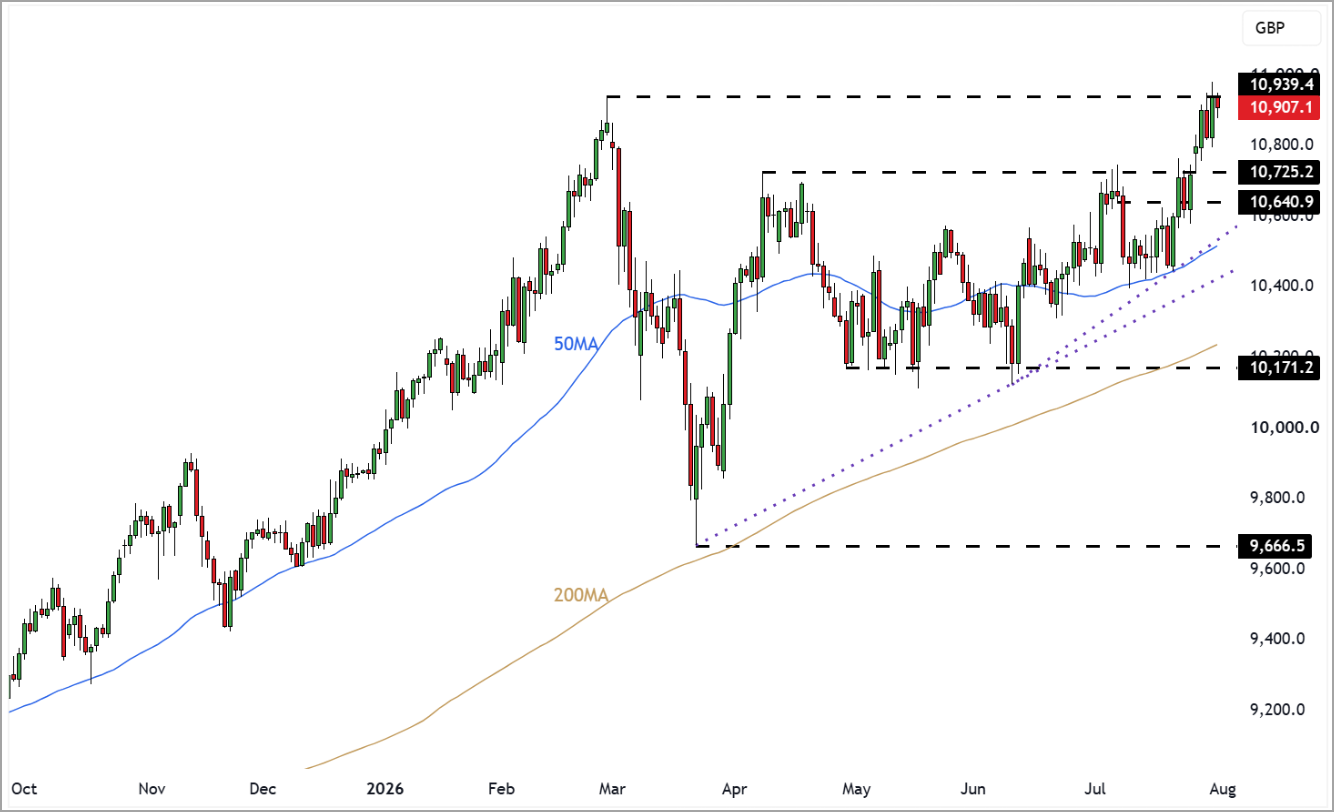
It has been an important week for the FTSE as prices have rallied to retest the February highs reached before the start of the conflict in Iran. While the earlier break above 10,700 cleared an important layer of intermediate resistance, this is the level that really matters. It marks the point where sellers last overwhelmed buyers and triggered the market’s sharp correction. A convincing break and close above the February peak would complete an impressive recovery and put the FTSE back into uncharted territory, while another rejection would show that the market still has work to do before the broader uptrend can resume.
UK100 Daily Candle Chart
Disclaimer:
All content is provided for general information only and should not be construed as any form of advice or personal recommendation. The provision of this content is not regulated by the Financial Conduct Authority.