


30th Jan 2026. 11.12am

Weekly Briefing – Friday 30th January
| Market | Movement this week (%)* |
|---|---|
| FTSE 100 | +0.48% |
| FTSE 250 | -0.21% |
| FTSE All-Share | +0.39% |
| AIM 100 | -1.15% |
| AIM All-Share | -0.64% |
* Price movement from Monday's open at 8am
Regency View:
Weekly Briefing – Friday 30th January
Market Overview
Dear Investor,
With a raft of earnings hitting our screens from some of America’s biggest companies, this week has shown that markets are becoming a little less forgiving. Results from the likes of Tesla, Microsoft and Meta showed that revenues remain strong, but investors are increasingly focused on what those earnings are being spent on, and how quickly that spending can translate into real returns.
That tension has been most visible in the reaction to AI investment. The long-term opportunity remains enormous, but the market is no longer applauding ambition alone. Heavy capital spending is now being met with tougher questions, particularly where growth shows early signs of slowing. The message feels clear: AI still matters, but execution matters more.
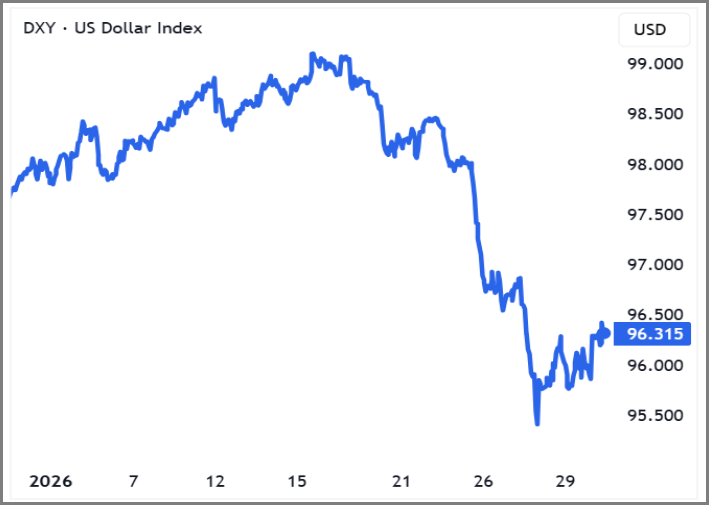
Alongside earnings, currency markets have added another layer to the story. The US dollar has continued to slide, pushing gold to fresh highs and adding fuel to the recent commodities bull run. For UK investors, this has been an important support for the FTSE, where miners and materials have quietly helped the index remain resilient even as risk appetite has tempered.
It is worth stressing that a weaker dollar is not automatically bullish for UK equities. However, it does tend to favour commodity prices, and that plays directly into the structure of the UK market. Strength in metals has done a lot of the heavy lifting this week, offsetting more mixed moves elsewhere.
Stepping back, the early tone of the year feels less about chasing everything that moves and more about choosing carefully. With markets near highs and macro uncertainty never far away, this is shaping up to be an environment where stock selection, discipline and patience matter more than broad momentum.
Wishing you a fantastic weekend,
Tom
Thomas Light – Chartered FCSI
Director of Research

Market Movers
On the rise: Harbour Energy (LSE:HBR) +8.9% on the week
Harbour Energy shares have pushed higher this week, recovering ground after a mixed initial reaction to last week’s trading update. While the update itself landed broadly in line with expectations, the shares have found fresh momentum following an upgrade from Berenberg, which lifted its target price to 225p from 195p and highlighted improving cash generation and balance sheet momentum.
Operationally, the update underlined a year of strong delivery. Production came in at the top end of guidance, unit operating costs fell sharply and free cash flow surprised to the upside despite softer commodity prices. The integration of the Wintershall Dea assets continues to bear fruit, driving scale benefits and cost efficiencies, while leverage fell to 0.6x as net debt declined.

Strategically, Harbour also made tangible progress across its portfolio. High-return short-cycle projects moved into production, major developments in Norway and Argentina advanced, and the company continued to actively reshape its asset base through divestments and disciplined M&A. With hedging in place and a shift towards a payout ratio based distributions policy due to be outlined in March, investor focus has started to move from consolidation to cash returns.
Regency view: Harbour’s valuation still reflects a cautious view on the sector, but the combination of improving cash flow, falling leverage and clearer capital allocation is beginning to shift sentiment. The recent upgrade feels less about the trading update itself and more about growing confidence in what the business can deliver from here.
Burberry shares slipped this week, moving lower in sympathy with a broader sell-off across the luxury sector rather than on any stock-specific misstep. The trigger came from France, where bellwether LVMH’s latest results struck a cautious tone on margins and early signs of demand recovery, particularly in China. That was enough to weigh on sentiment across European luxury names.
While LVMH pointed to continued sales growth in China, the pace was less convincing than investors had hoped, raising fresh questions about how durable the luxury rebound really is. As one analyst put it, the weakness in Burberry felt more like sector read-across than company-specific concern, with investors quick to de-risk exposure to higher-end discretionary spending.

This is notable given Burberry had already delivered better-than-expected sales growth over the recent holiday quarter. However, in a market that is increasingly sensitive to global demand signals, particularly from China, even solid execution can be overshadowed when the sector narrative turns more cautious.
Regency view: Burberry remains a business in transition, and short-term share price moves are likely to remain driven by sentiment towards global luxury rather than company fundamentals alone. Until confidence in demand trends firms up, patience looks essential.
Sector Snapshot
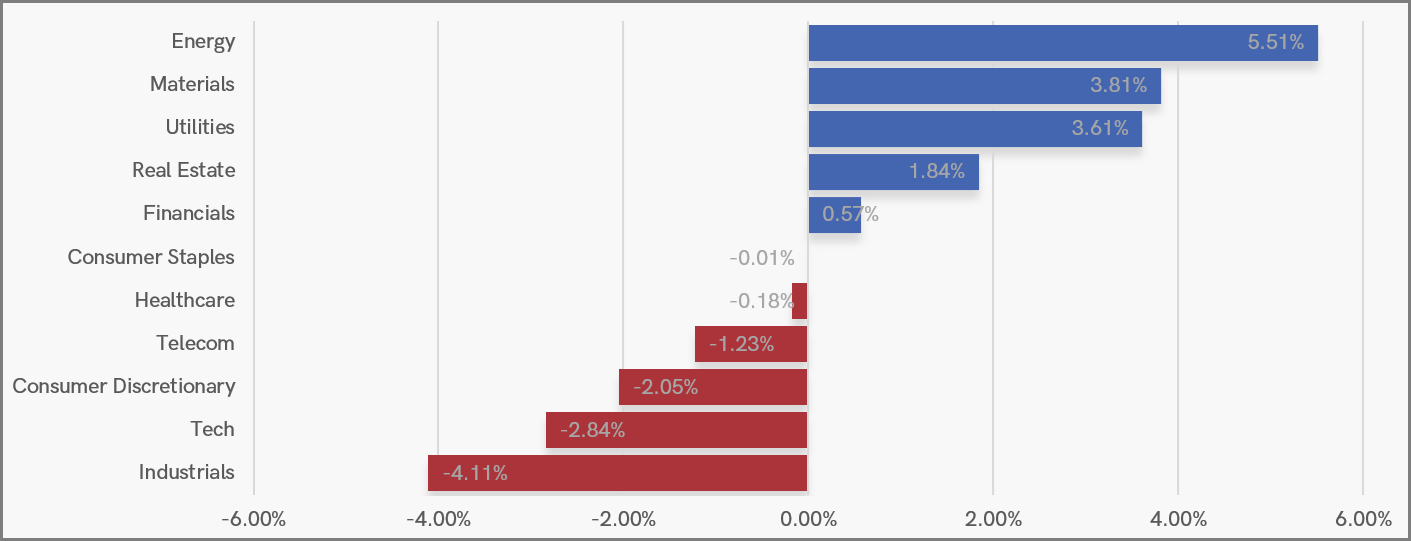
This week saw a very clear divide across the UK market. Energy and Materials led the way, joined by Utilities and Real Estate, as investors favoured sectors linked to hard assets, income and stability. Financials also edged higher, rounding out a group of sectors that benefited from more tangible, cash-generative themes.
On the other side of the ledger, Industrials and Tech struggled, with Consumer Discretionary also firmly lower. Healthcare and Telecom slipped modestly, while Consumer Staples were broadly flat. The pattern highlights a market leaning away from growth and cyclicals, and back towards defensives and asset-backed sectors.
UK Sector Performance (7-Days)
UK Price Action
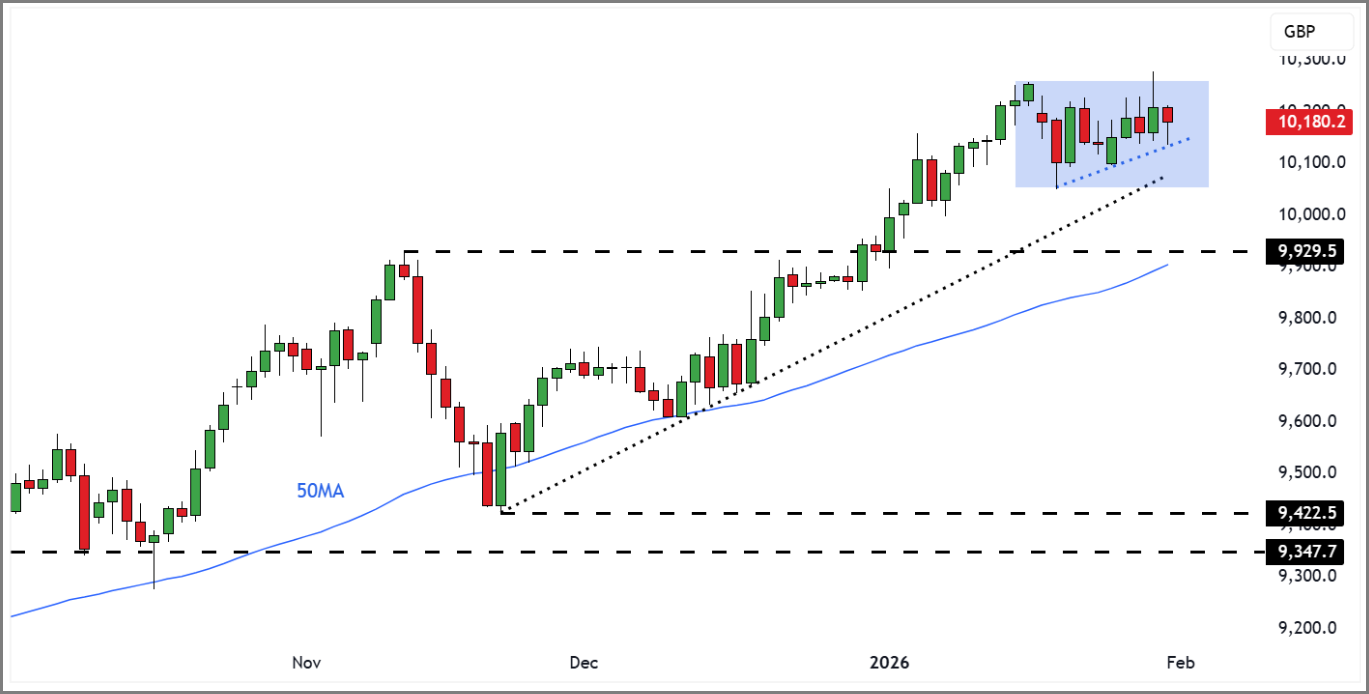
Last week we noted that the FTSE’s pullback looked more like the early stages of consolidation rather than anything more sinister. So far, that view has been validated, with price settling into a tight range near the recent highs rather than accelerating lower.
This kind of sideways action is typical after an extended run, allowing momentum to cool without damaging the underlying trend structure. As long as the index continues to hold above former breakout levels, the broader bullish backdrop remains intact, with consolidation acting as a pause rather than a reversal.
FTSE 100 Rolling Futures (Daily Candle Chart)
Disclaimer:
All content is provided for general information only and should not be construed as any form of advice or personal recommendation. The provision of this content is not regulated by the Financial Conduct Authority.