


26th Sep 2025. 10.53am

Weekly Briefing – Friday 26th September
| Market | Movement this week (%)* |
|---|---|
| FTSE 100 | +0.35% |
| FTSE 250 | +0.05% |
| FTSE All-Share | +0.32% |
| AIM 100 | +0.11% |
| AIM All-Share | +0.13% |
* Price movement from Monday's open at 8am
Regency View:
Weekly Briefing – Friday 26th September
Market Overview
Dear Investor,
We start this week’s update with some exciting news. You can now access our top stock recommendations, updates, sell alerts and premium research with a flexible monthly membership. This gives you more freedom and allows us to keep improving what we offer, from refreshing how portfolios are presented to exploring new markets and asset classes – it’s a step towards making our insights sharper and more practical. Please click here to find out more.
Gold has carried its breakout into fresh highs, climbing towards $3,800 and holding firm after the Federal Reserve’s long-awaited decision to cut rates. What began as a push through $3,500 has developed into a powerful autumn rally, with bullion cementing its role as a barometer of political and economic risk.
The Fed’s move has reinforced the appeal of non yielding assets by lowering the opportunity cost of holding gold. At the same time, concerns over US fiscal policy, sticky inflation and President Trump’s public battles with the central bank continue to undermine confidence in the dollar. Global central banks remain consistent buyers, diversifying their reserves further into gold, which only strengthens the long term demand story.

The investment narrative is also being bolstered by high profile voices. Legendary resource investor Rick Rule, speaking at the 2025 Rule Symposium, suggested gold could potentially triple in price if the dollar were to repeat its 1970s decline. He noted that while gold equities have doubled in recent months, many remain cheap compared with history, framing the current environment as a generational opportunity.
We have already seen how gold’s strength is filtering into equities. Serabi Gold, which we highlighted to AIM Investor clients less than two months ago, has surged more than 30%. It is a timely reminder that gold’s macro strength can translate into specific stock opportunities, and why we continue to monitor these moves closely as part of our research.
Wishing you a fantastic weekend,
Tom
Thomas Light – Chartered FCSI
Director of Research

Market Movers
On the rise: Cloudbreak Discovery (LSE:CDL) +89% on the week
Shares in Cloudbreak Discovery, a London-listed natural resources project generator, surged higher this week following September’s announcement that the company had exercised its option to acquire Phase 1 of the Darlot West Gold Project in Western Australia. The project covers 60.6km² and is located 10km from the Darlot Gold Mine, which has produced 2.8 million ounces of gold to date. In recent weeks, Cloudbreak has collected more than 650 soil and rock chip samples, completed drone mapping of historical workings, and undertaken structural analysis to define potential geological targets.
This move comes after August’s announcement, which also saw the shares move higher, when Cloudbreak expanded the Darlot West project by five times the original land package. The additional ground brought in a further 7km of greenstone belt strike, the same host sequence where surface sampling recently returned grades of up to 28.62g/t Au. The expansion also secured ground containing numerous historic shafts that had not previously been followed up with modern exploration.

Together, the announcements provide Cloudbreak with control of a significant land position around Darlot West, with exploration activities progressing across multiple phases. Work completed so far has focused on mapping, sampling, and geophysical surveys, with assay results pending and high-resolution magnetics planned to refine drill targets. The company has said it is fully funded for the next stages of exploration at the project.
REGENCY VIEW:
Whilst Cloudbreak have been hitting the headlines and topping highest riser charts recently, it’s important for investors to recognise that the company remains pre-revenue and continues to post losses. Key returns metrics such as ROE and ROCE sit deep in negative territory, and cash resources on the balance sheet are limited.
Shares in Tate & Lyle continued to drop this week following a sharp sell-off that saw the stock fall as much as 9%, making it the biggest loser on the FTSE 250. The latest slide came after Morgan Stanley downgraded the food ingredients maker to “underweight” from “equal-weight,” while trimming its price target to 500p from 590p. The broker flagged growing uncertainty over the company’s medium-term growth story, warning that investors may need to reassess the earnings outlook.
Concerns were heightened after Tyson Foods announced it would phase out sucralose from its U.S. branded products, raising fears that other consumer packaged goods companies could take similar action. Sucralose is one of the artificial sweeteners that Tate & Lyle is exposed to through its specialty ingredients division, and a shift away from the additive could undermine volumes and margins in the years ahead. Morgan Stanley’s note suggested that while Tate & Lyle has diversified into plant-based and fibre-enriched products, it remains vulnerable to changing consumer trends in sweeteners.

With the stock already down 27.4% since the start of the year, confidence in management’s mid-term targets has been shaken. The downgrade compounds pressure on a share price that has struggled to find support despite efforts to reposition the business towards higher-growth, health-focused ingredients. Investors will now be looking for clearer signs that Tate & Lyle can offset potential declines in sucralose demand through innovation and expansion in other product lines. Until then, sentiment is likely to remain cautious.
REGENCY VIEW:
Tate & Lyle trades on a low forward P/E with a well-covered 4.5% yield, offering value for income-focused investors. However, weak returns on equity and patchy free cash flow highlight the execution risk in turning its health-focused strategy into consistent profitability.
Sector Snapshot
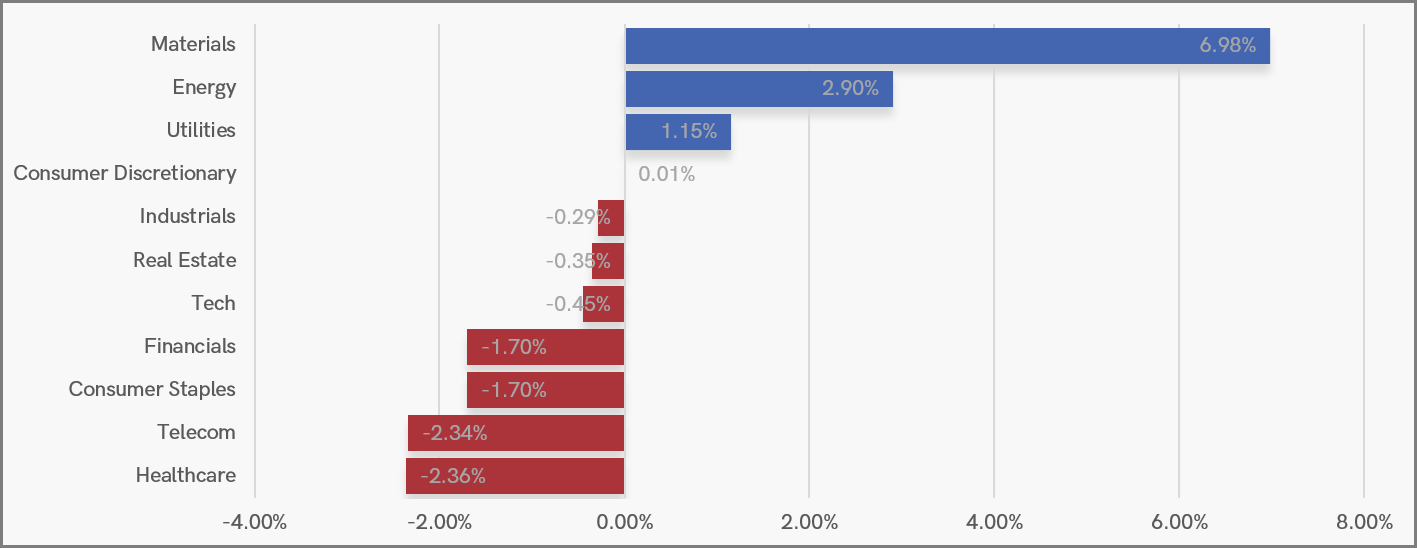
Materials were the clear winners this week, surging ahead and leaving the rest of the market trailing, while Energy and Utilities also finished firmly in positive territory. The gains underline a renewed appetite for commodity-linked and yield-supportive sectors, even as the broader market tone stayed mixed.
At the weaker end, Healthcare and Telecom led the declines, joined by Consumer Staples and Financials in negative territory. Tech and Real Estate also slipped slightly, highlighting a rotation away from defensives and rate-sensitive areas, with leadership concentrated firmly in resources.
UK Sector Performance (7-Days)
UK Price Action
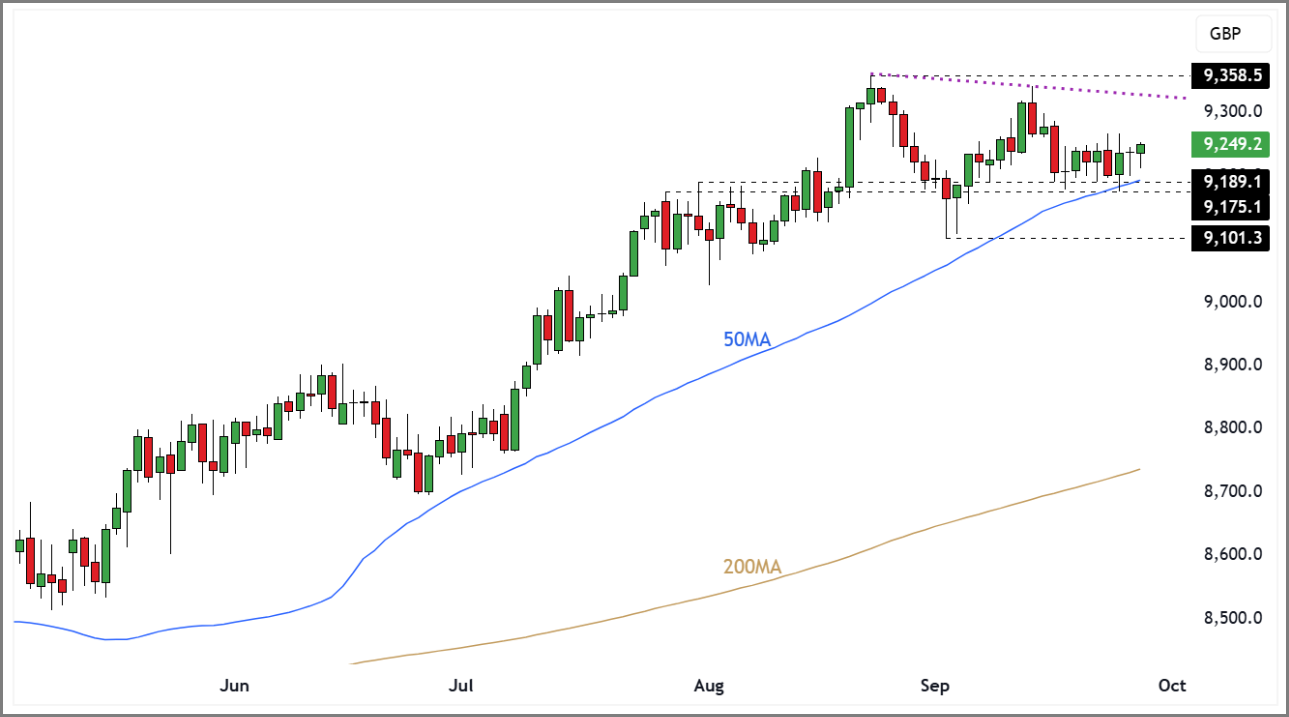
The FTSE spent last week coiling within a tight range, holding above the 50-day moving average and showing resilience despite failing to retest the September highs. This type of price action is classic consolidation, where the market pauses to absorb recent gains before choosing its next directional move.
The key levels remain well defined. Support sits between 9,175 and 9,190, with deeper buyers expected around 9,100. On the upside, resistance is clustered around 9,300–9,358, the zone that capped both August and September rallies. Until either boundary is broken, the index looks set to continue compressing into a wedge formation.
For now, traders should watch for a break beyond this narrowing range. A push above 9,358 would likely reignite the uptrend and open the door to fresh highs, while a drop through 9,100 would warn that a deeper correction is taking shape.
FTSE 100 Rolling Futures (Daily Candle Chart)
Disclaimer:
All content is provided for general information only and should not be construed as any form of advice or personal recommendation. The provision of this content is not regulated by the Financial Conduct Authority.