


25th Sep 2026. 10.31am

Weekly Briefing – Friday 25th September
| Market | Movement this week (%)* |
|---|---|
| FTSE 100 | +0.67% |
| FTSE 250 | +0.53% |
| FTSE All-Share | +0.68% |
| AIM 100 | -1.54% |
| AIM All-Share | -1.27% |
* Price movement from Monday's open at 8am
Regency View:
Weekly Briefing – Friday 25th September
Market Overview
Dear Investor,
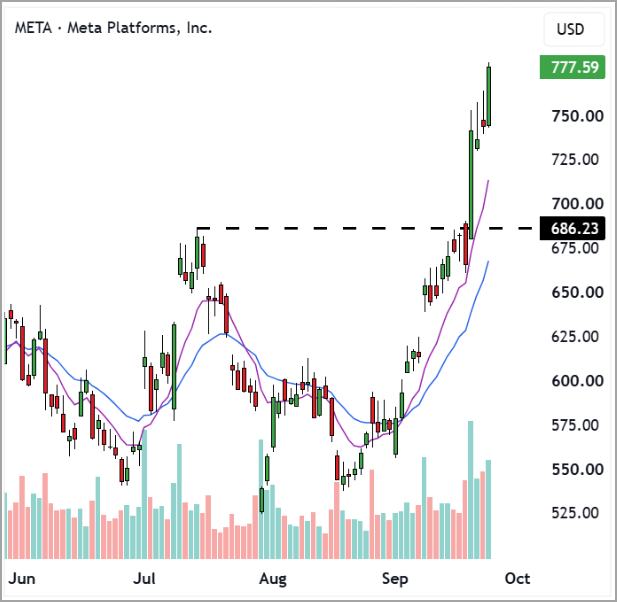
There hasn’t exactly been a shortage of enthusiasm for AI over the past few years, but this week investors found something new to get excited about. Meta’s new Muse AI assistant has raced to the top of both Apple’s and Google’s US app stores, helping propel its shares to record highs and adding around $300 billion to the company’s market value since its launch earlier this month.
That’s quite a turnaround for a company whose enormous AI spending was testing investors’ patience only a few months ago. Businesses have already been adopting AI at pace and many of us now use it as part of the working day, but Meta is making a rather different bet. It wants AI to move much further into everyday consumer life, and the early response to Muse suggests there is plenty of appetite to see what that might look like. Apparently, spending billions on AI becomes rather easier to explain once millions of people start downloading the result.
The important difference is that Muse isn’t simply another chatbot waiting to answer a question. Meta is pushing towards AI that can actually do things on our behalf, using autonomous agents to order groceries, book travel and organise finances. Zuckerberg believes Meta could eventually make money by taking a small cut from transactions carried out through the assistant. With roughly three billion people already using Meta’s existing platforms, he at least has a reasonably sized address book to work with.
This week’s Meta Connect event showed how ambitious that plan has become. Muse is being pushed into smart glasses and Meta also unveiled the Muse Charm, a small AI device that can be attached to a keyring. Whether the world has been waiting for an AI assistant dangling from its keys remains to be seen, but the strategy behind it is considerably more serious. Meta wants its AI to be available throughout the day and across different devices, rather than somewhere users deliberately go when they need it.
That makes the reaction in Meta’s share price particularly interesting. Much of the AI boom so far has been measured by what companies are spending, whether that’s GPUs, data centres, cloud capacity or electricity. Increasingly, investors are going to want evidence of what comes out the other end. Muse is far too new to know whether its early popularity will last, let alone whether Meta can turn it into a meaningful source of profit, and handing an AI agent access to our shopping, calendars and finances introduces a few fairly obvious complications of its own. But this week’s rally suggests the market is becoming just as interested in AI adoption and monetisation as it has been in AI investment, and that could prove an important shift in the next stage of the theme.
Wishing you a great weekend,
Tom
Thomas Light – Chartered FCSI
Director of Research

Market Movers
On the rise: Smiths Group (LSE: SMIN) +11.2% on the week
Smiths Group surged after its full-year results gave investors a clearer view of the business emerging from what has been a fairly dramatic year of change. The group has now completed the sale of Smiths Detection and Smiths Interconnect for a combined enterprise value of £3.3 billion, leaving Smiths focused around John Crane and Flex-Tek and armed with a considerably stronger balance sheet.
The underlying numbers were solid rather than spectacular. Organic revenue increased 1.2%, headline operating profit rose to £399 million and the operating margin edged higher to 20.6%, despite disruption in the Middle East and continued weakness in US residential construction. More importantly, management expects organic growth to accelerate to around 4% this year alongside a further improvement in margins, while retaining its medium-term target of 5-7% organic growth and margins of 21-23%.

There are also some increasingly attractive growth areas underneath those headline numbers. Aerospace delivered double-digit organic growth, John Crane remains well placed to benefit from investment in global energy infrastructure, and the recent DRC Heat Transfer acquisition has pushed Smiths further into data-centre cooling. DRC itself grew more than 20% on a pro-forma basis last year, with Smiths estimating its market could grow 20-25% annually through 2030 as AI and cloud investment drives demand for data-centre capacity.
Regency View: The market appears to be warming to the new-look Smiths, and there is plenty to like about a more focused portfolio combining high-margin engineering businesses with exposure to energy, aerospace and the rapidly expanding data-centre market. The shares are now close to their 52-week high following this week’s rally, but with £1.5 billion still to be returned through buybacks and management targeting faster organic growth, there are several moving parts capable of supporting the next stage of the story.
Resolute Mining fell sharply after another setback at its Syama gold mine in Mali forced the company to cut production guidance and raise its expectations for costs. Syama has continued to struggle with shortages of explosives, delays getting critical equipment and supplies into the country and slower access to higher-grade ore, leaving production well below where management expected it to be.
The scale of the shortfall became particularly clear during July and August, when Syama poured just 15,500 ounces of gold across the two months. Resolute now expects the mine to produce 150,000 to 160,000 ounces this year, while all-in sustaining costs are forecast at $2,300 to $2,400 an ounce. That feeds through to group guidance of 205,000 to 225,000 ounces at an AISC of $2,250 to $2,350 an ounce, although its Mako mine and development projects elsewhere in West Africa remain on track. The guidance cut was also the clear catalyst behind Monday’s share-price reaction.

There are signs that conditions are beginning to improve, with management expecting Syama production to recover during the final quarter as more equipment arrives and an onsite emulsion plant reduces its reliance on imported explosives. The difficulty is that the recovery still depends partly on conditions outside Resolute’s control. The company itself acknowledges that stable performance requires greater certainty around the movement of mining supplies, equipment and contractors within Mali.
Regency View: With gold prices providing about as helpful a backdrop as a miner could ask for, Resolute’s inability to fully capitalise on it makes the problems at Syama particularly frustrating. There is still plenty of value in the wider portfolio and the shares now trade around 27% below their 52-week high, but investors are likely to want evidence that the improvement expected at Syama is actually coming through before giving management too much credit for the promised recovery.
Sector Snapshot
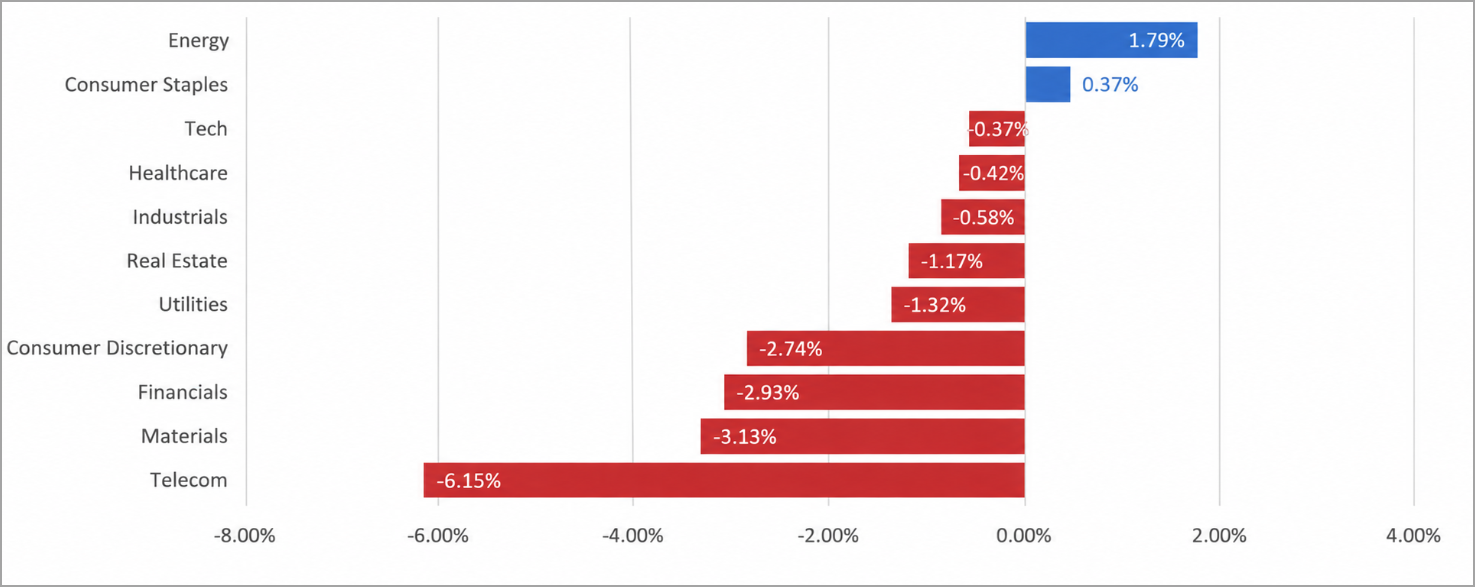
Sector performance was notably weak this week, with only Energy and Consumer Staples managing to finish in positive territory. Energy was the clear standout, while Consumer Staples recorded a much more modest gain. Elsewhere, Tech, Healthcare and Industrials proved relatively resilient, but all three still ended the week lower as selling became increasingly broad based.
The heavier losses were concentrated towards the bottom of the table, with Consumer Discretionary, Financials and Materials all coming under pressure. Telecom was comfortably the weakest sector and an obvious outlier, falling more than twice as much as most of the other major decliners. Overall, this was a much more defensive-looking week for UK equities, with weakness spread across most areas of the market rather than being confined to one or two sectors.
UK Sector Performance (7-Days)
UK Price Action
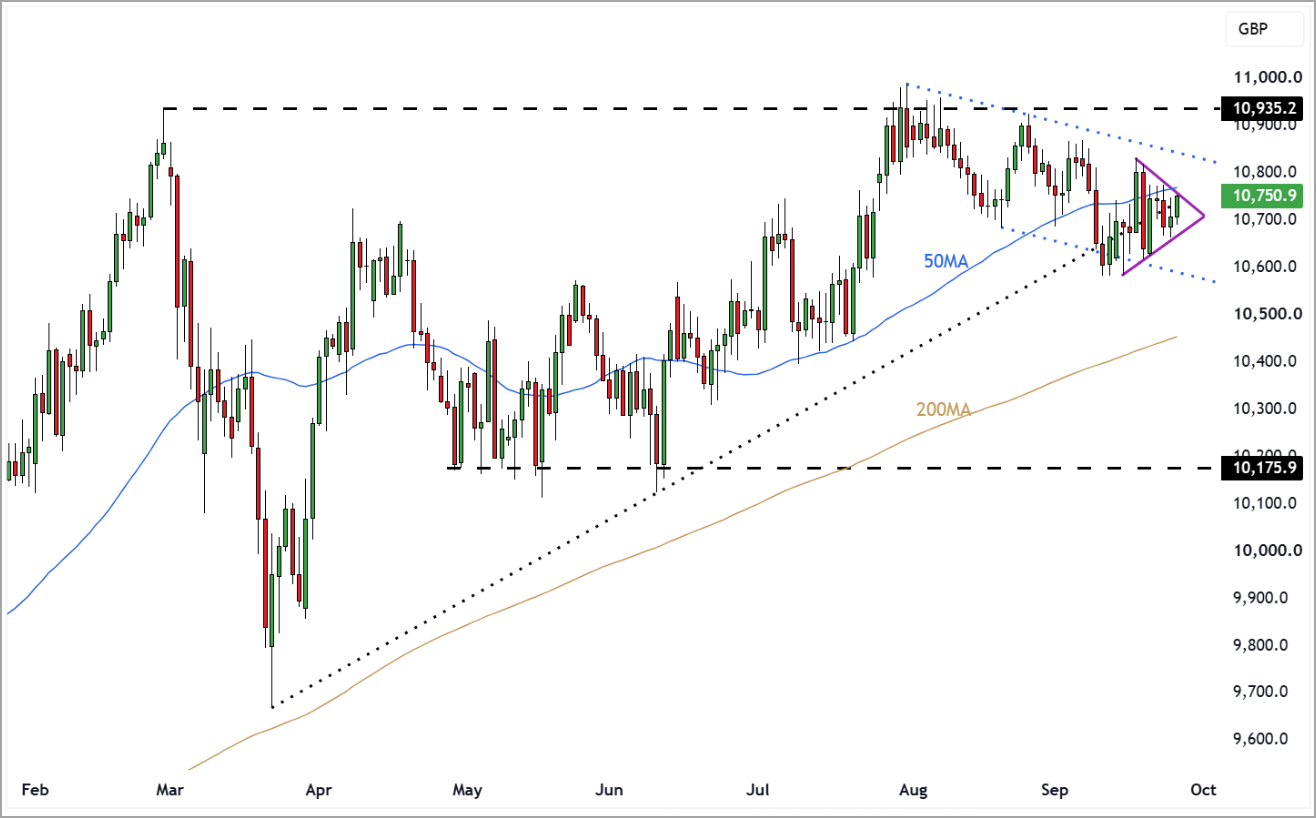
Whilst the FTSE has been consolidating for several weeks, this week has seen that compression intensify. At the time of writing, the index has remained within last week’s range, with a series of tightly clustered daily candles forming as the market becomes increasingly squeezed between the boundaries of its recent descending channel.
Periods of price compression like this are often worth watching because they can precede a more volatile directional move as the balance between buyers and sellers eventually breaks. The important point is that compression itself does not tell us which direction that move will take. For now, the FTSE remains above the rising trendline from the March lows, but with the February highs still capping the market, the eventual break from this increasingly tight range should provide the more useful signal.
UK100 Daily Candle Chart
Disclaimer:
All content is provided for general information only and should not be construed as any form of advice or personal recommendation. The provision of this content is not regulated by the Financial Conduct Authority.