


21st Aug 2026. 10.38am

Weekly Briefing – Friday 21st August
| Market | Movement this week (%)* |
|---|---|
| FTSE 100 | -0.04% |
| FTSE 250 | -1.19% |
| FTSE All-Share | -0.18% |
| AIM 100 | +0.67% |
| AIM All-Share | +0.74% |
* Price movement from Monday's open at 8am
Regency View:
Weekly Briefing – Friday 21st August
Market Overview
Dear Investor,
This week’s most eye-catching move has been in the US dollar, which fell sharply on Wednesday to its lowest level since May. After spending much of August stuck in a fairly tight range, sellers finally took control, adding to what has already been a difficult few months for the world’s reserve currency.
The trigger came from the US bond market. The Treasury announced plans to step up its purchases of longer-dated government debt, helping to bring yields lower after their recent rise. That matters for the dollar because higher US yields have been one of its main sources of support. If investors can earn less from holding US debt, some of the attraction of holding dollars naturally starts to fade.
The timing is interesting because the economic backdrop has also started to shift. July’s jobs report was surprisingly weak and retail sales have cooled, taking some of the urgency out of the argument for another Federal Reserve rate rise. Only a few weeks ago, markets were debating how soon rates might have to go higher. Now the question is increasingly whether the Fed can afford to sit tight for longer.
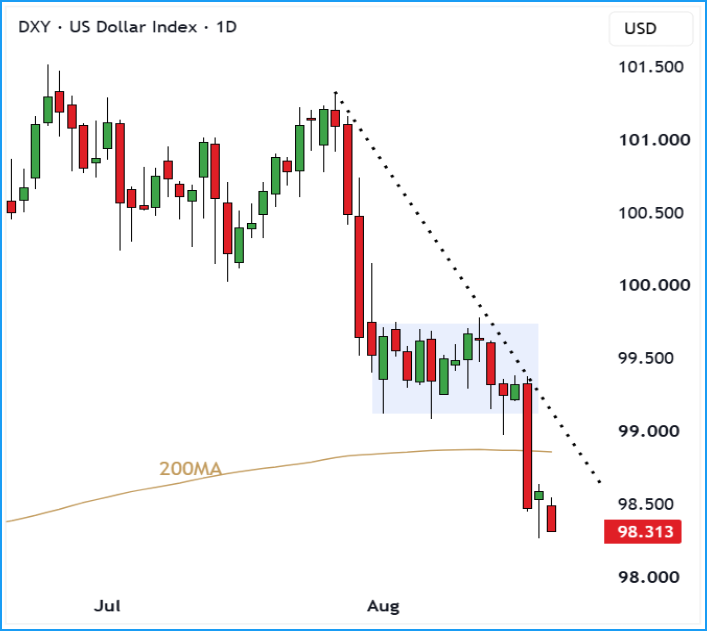
We shouldn’t get too carried away with the idea that America is suddenly heading for a sharp slowdown. The US economy is going through some unusual changes, with the available workforce shrinking at the same time as huge amounts of capital are being directed towards AI investment and government borrowing. But markets don’t need a recession to push the dollar lower. They simply need to become less convinced that US rates and bond yields are heading higher.
For UK investors, this is much more than a story for currency traders. A weaker dollar can support gold and other commodities, strengthen sterling and alter the value of overseas earnings when they’re translated back into pounds. With so many of the FTSE’s biggest companies earning a large proportion of their revenues in dollars, a sustained move lower could become an increasingly important part of the UK market story over the coming months.
Wishing you a great weekend,
Tom
Thomas Light – Chartered FCSI
Director of Research

Market Movers
On the rise: Kainos (LSE: KNOS) +29.9% on the week
Kainos jumped after upgrading its full-year expectations following a stronger-than-expected start to the new financial year. The IT services group now expects both revenue and adjusted profit before tax for the year to March 2027 to come in comfortably ahead of previous market forecasts.
The strength appears broad based. Digital Services continues to grow strongly following several significant contract wins, while both Workday Services and Workday Products have delivered double-digit revenue growth compared with the same period last year. Importantly, this isn’t simply a case of management becoming more optimistic about the months ahead. Kainos entered the year with a record backlog, and further contract wins have added to a sizeable amount of multi-year work already secured.

It’s another sign that momentum has returned following a more difficult period for the business. Revenue grew 17% last year and current forecasts point towards another sizeable step forward this year, while the group’s strong balance sheet and high returns on capital remain attractive qualities. With the shares now trading close to their 52-week high, however, expectations have clearly moved higher alongside the improving outlook.
Regency View: This is exactly the sort of progress we hoped to see when we first recommended Kainos last year, with the shares now more than 77% above our original entry price. The latest upgrade strengthens the case for continuing to hold rather than rushing to bank profits, although after such a strong run we’ll be watching both the valuation and execution increasingly closely from here.
JD Sports came under pressure after cutting its full-year profit guidance as weak consumer demand and a highly promotional footwear market continued to weigh on trading, particularly in North America.
Second-quarter organic sales fell 1.3%, while like-for-like sales declined 3.1%, a slight deterioration from the first quarter. North America was the main area of weakness, with organic sales down 4.5% and like-for-like sales falling 6.8%. Management pointed to pressure on its core customer, softer demand for some of the most sought-after footwear lines and the timing of back-to-school spending. The picture elsewhere was more encouraging, with UK like-for-like sales returning to growth and apparel and accessories performing well across the group. Online sales also grew 2.6%.

The bigger disappointment was the outlook. JD now expects full-year profit before tax and adjusting items of between £700 million and £800 million, down from its previous £750 million to £850 million range. Management warned that the promotional backdrop could persist into the second half, although free cash flow guidance was left unchanged at £460 million to £520 million. The group also remains in a net cash position before lease liabilities and has started the second £100 million tranche of its £200 million annual share buyback programme.
Regency View: JD’s problems look more cyclical than structural, but investors are understandably losing patience with repeated pressure on footwear demand and margins. There are encouraging signs beneath the headline numbers, particularly in the UK, apparel and newer footwear categories, but the downgrade means the shares may need clearer evidence of a recovery in North America before sentiment improves meaningfully.
Sector Snapshot
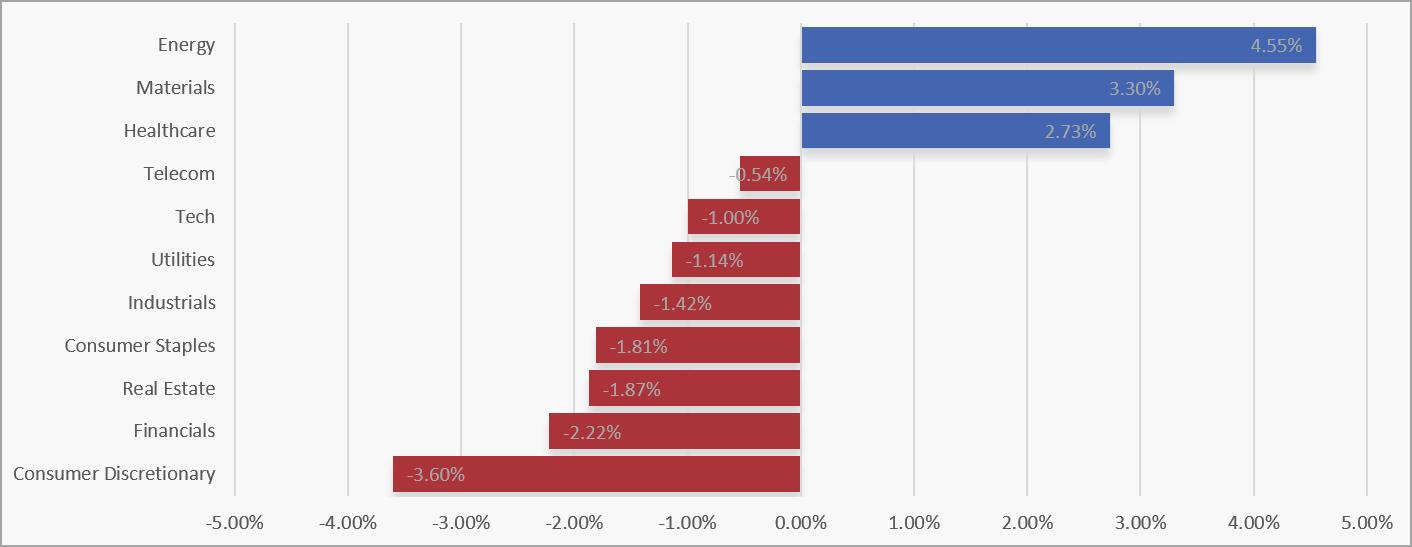
Energy led the UK market this week with a 4.55% gain, followed by Materials at 3.30%, continuing the recent improvement across commodity-linked sectors. Healthcare also stood out with a 2.73% rise, although the strength was relatively concentrated, with the majority of sectors finishing the seven-session snapshot in negative territory.
Consumer Discretionary was the weakest performer, falling 3.60%, while Financials, Real Estate and Consumer Staples also came under pressure. The split between strong commodity sectors and weakness across more domestically exposed areas points to a fairly selective market, with the headline sector leaders masking softer performance across much of the wider UK market.
UK Sector Performance (7-Days)
UK Price Action
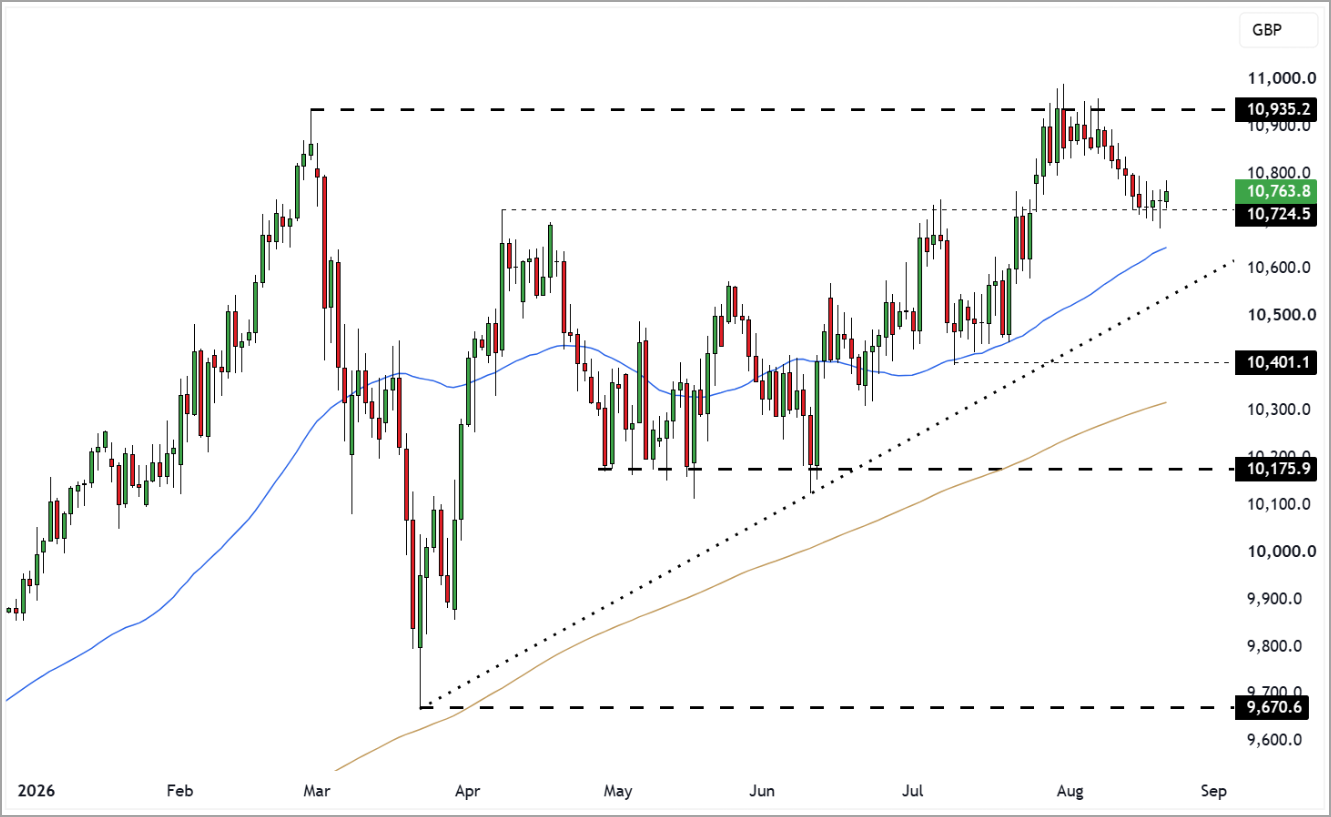
The FTSE has spent the week treading water around the interim support created by the April and July swing highs near 10,700. So far, that former resistance is doing a decent job of turning into support, but the response from buyers has been fairly muted, with prices struggling to put much distance between themselves and the level. That leaves the market in a bit of a waiting game as we head into the weekend. Holding above 10,700 would keep the recent breakout intact and leave the all-time highs within touching distance, while a decisive break below would shift attention towards the rising 50-day moving average and trendline below.
UK100 Daily Candle Chart
Disclaimer:
All content is provided for general information only and should not be construed as any form of advice or personal recommendation. The provision of this content is not regulated by the Financial Conduct Authority.