


18th Sep 2026. 11.17am
Weekly Briefing Friday 18th September
| Market | Movement this week (%)* |
|---|---|
| FTSE 100 | +0.84% |
| FTSE 250 | +1.46% |
| FTSE All-Share | +0.92% |
| AIM 100 | +1.16% |
| AIM All-Share | +0.97% |
* Price movement from Monday's open at 8am

Regency View:
Weekly Briefing Friday 18th September

Market Overview
Dear Investor,
It wasn’t so long ago that investors were trying to work out when interest rates would start coming down. This week provided a rather abrupt reminder that they can still go in the other direction too. The Federal Reserve raised rates for the first time since 2023 on Wednesday, while a day later the Bank of England warned that it may soon have to follow.
The problem facing both central banks is increasingly familiar. Inflation never quite made it back to where policymakers wanted it before the latest surge in energy prices arrived. In the US, the Fed lifted rates by a quarter point and Kevin Warsh warned that inflation remains too high, with most policymakers expecting at least one further increase before the end of the year. Here in Britain, the Bank held rates at 3.75%, but the decision was hardly relaxed. Three members voted to raise immediately and Andrew Bailey warned that policy may have to tighten if higher energy costs continue feeding into inflation.
There is an awkward balancing act here. Central banks can’t produce another barrel of oil or bring geopolitical tensions to an end by changing interest rates. What they can try to prevent is an energy shock spreading through wages and prices and becoming embedded in the wider economy. Raise rates too aggressively and they risk squeezing households and businesses unnecessarily. Wait too long and temporary inflation has an unfortunate habit of becoming rather less temporary.
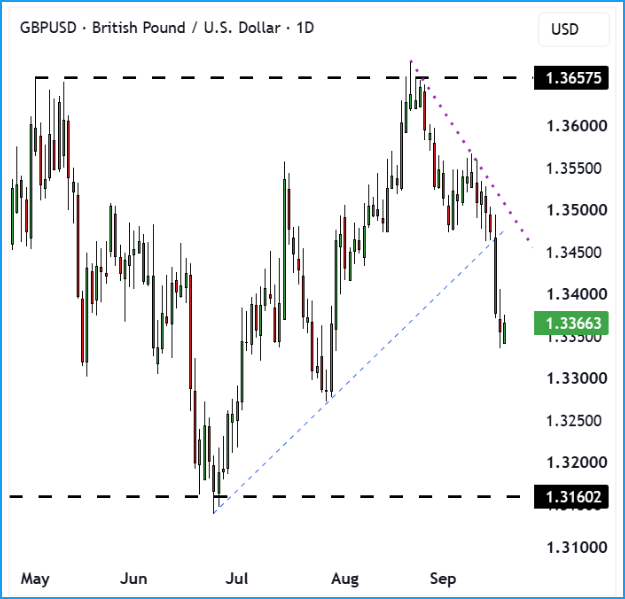
Markets are already adjusting. US Treasury yields moved higher following the Fed’s decision and the dollar strengthened, while sterling has fallen sharply against the greenback. Having tested resistance around $1.366 towards the end of August, GBP/USD has broken its rising trendline and dropped towards $1.336. That doesn’t tell us where sterling goes next, but it does provide a neat illustration of how quickly expectations have shifted as investors reassess the relative outlook for US and UK rates.
For UK investors, the bigger message is that the prospect of steadily falling borrowing costs can no longer be taken for granted. Higher rates affect everything from mortgages and consumer spending to corporate investment and equity valuations, while the Bank also faces the delicate task of tightening policy without adding unnecessarily to pressure on an already expensive gilt market. Last week the bond market was warning that investors had become less comfortable with the inflation outlook. This week’s central bank meetings suggest policymakers are becoming less comfortable with it too.
Wishing you a great weekend,
Tom
Thomas Light – Chartered FCSI
Director of Research

Market Movers
On the rise: Bytes Technology Group (LSE: BYIT) +17.9% on the week
Bytes Technology jumped after a stronger-than-expected first half prompted management to upgrade its full-year guidance, providing further evidence that the improvement we have been seeing across the business is gathering momentum.
Gross Invoiced Income is estimated to have increased by around 19% during the six months to the end of August, with Gross Profit up around 18%. Operating Profit grew at a more modest 6%, reflecting higher tech investment and the return of staff bonuses towards more normal levels. Importantly, the strength wasn’t confined to one part of the business, with management reporting good momentum across both private and public sector customers and continued demand for software, cloud and security solutions.

That has been enough for management to raise its expectations for FY27. Bytes now expects Gross Profit to grow by low to mid-teens for the full year, alongside low to mid single-digit Operating Profit growth. AI is also becoming a more meaningful contributor across its core markets, while the balance sheet remains in excellent shape. Bytes finished the half with around £68 million of net cash despite returning £41.3 million to shareholders through dividends and share buybacks.
Regency View: This is another encouraging step forward for Bytes, with stronger demand now translating into an upgrade to full-year expectations. The shares have recovered strongly and are now approaching their 52-week high, while the business continues to build its exposure to AI, cloud and security.
Trustpilot came under heavy selling pressure after its half-year results left full-year guidance unchanged, proving once again that meeting expectations isn’t always enough when investors have already started pricing in an upgrade.
On the face of it, there was plenty to like. First-half revenue increased 23% to $151.4 million, bookings rose 22% and adjusted EBITDA climbed 46% to $26.3 million. Growth in the US remained particularly strong and Trustpilot continues to see increasing opportunities from AI. The problem was that adjusted EBITDA came in slightly below expectations and management stuck with its existing guidance for high-teens constant-currency revenue growth and a two-to-three percentage point improvement in adjusted EBITDA margin.

That distinction mattered because the shares had rallied around 60% heading into the results, leaving expectations considerably higher than the guidance itself. There was also some noise in the numbers, with Trustpilot reporting a $1.1 million statutory loss following one-off charges including an Italian antitrust fine and provisions relating to historical US sales taxes. None of that fundamentally changes the growth story, but with investors positioned for another upgrade, simply confirming the existing outlook proved a disappointment.
Regency View: Trustpilot’s underlying growth remains impressive, but this week’s reaction is a useful reminder of what can happen when a strong business carries equally strong expectations. With the shares still trading on around 32 times forecast earnings, continued revenue growth and improving margins will need to translate into further earnings progress if the valuation is to regain its previous momentum.
Sector Snapshot
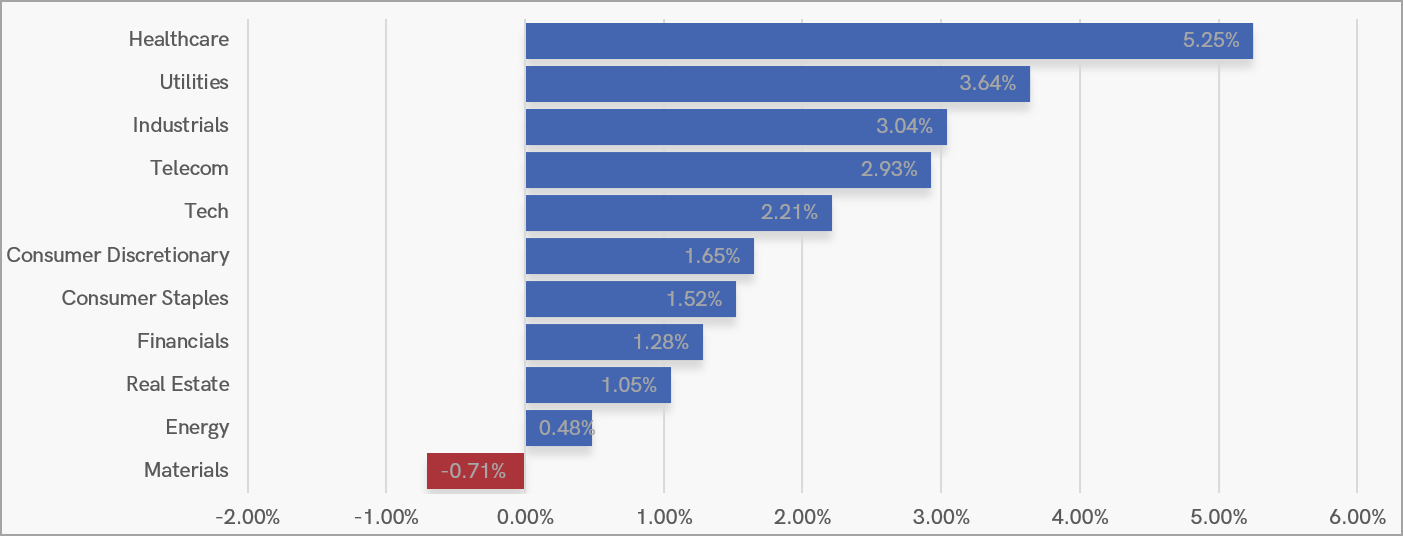
Healthcare led a broad recovery across the UK market this week, with Utilities, Industrials and Telecoms also gaining around 3% or more. Technology joined the advance, while gains across both Consumer sectors, Financials and Real Estate meant the strength extended well beyond a handful of individual areas.
Materials was the only sector to finish lower, slipping 0.71%, while Energy was broadly flat after leading the market in each of the previous two weeks. The more important feature was the breadth of the rebound, with ten of the eleven sectors advancing after last week’s widespread weakness.
UK Sector Performance (7-Days)
UK Price Action
MEMBERS ONLY
The FTSE bounced from an important technical level this week, keeping the broader consolidation beneath the February highs intact.
But with the index continuing to make lower highs, what does the developing pattern tell us about where the next significant move could come from?
Members can read our full analysis and view this week’s annotated FTSE chart, including the key levels we’re watching next.
UNLOCK THE FULL WEEKLY BRIEFING
Disclaimer:
All content is provided for general information only and should not be construed as any form of advice or personal recommendation. The provision of this content is not regulated by the Financial Conduct Authority.