


16th Oct 2026. 10.57am
Weekly Briefing Friday 16th October
| Market | Movement this week (%)* |
|---|---|
| FTSE 100 | +2.58% |
| FTSE 250 | +1.43% |
| FTSE All-Share | +2.44% |
| AIM 100 | -0.45% |
| AIM All-Share | -0.66% |
* Price movement from Monday's open at 8am

Regency View:
Weekly Briefing Friday 16th October
Market Overview
Dear Investor,
It’s been a strange week for global stock markets. Concerns over tech earnings and the enormous sums being spent on AI have unsettled investors, yet the FTSE 100 has shown impressive strength. Our leading index has pushed higher while other markets have struggled, raising an interesting question about just how much growth investors are already expecting from the world’s biggest tech companies.
Some great research from Citigroup, highlighted by the FT this week, puts the issue into perspective. Tech is expected to account for 48% of global earnings growth this year, rising to an extraordinary 68% in 2027. In the US, the sector is forecast to contribute around 78% of earnings growth next year. Historically, the leading sector has accounted for roughly 40% of global earnings growth, so these are unusually concentrated forecasts. It means that even relatively small changes to tech earnings expectations could have a considerable impact on the outlook for global profits.
The concern isn’t so much whether AI will prove commercially valuable, but whether the returns will justify the extraordinary investment going into it. There’s also an important distinction between the companies supplying the chips and infrastructure and those spending billions to build their AI capabilities. The suppliers are benefiting from today’s investment, while the companies footing the bill still need to demonstrate that it will translate into higher profits. If spending begins to slow before those returns become clear, the implications could extend well beyond the companies making the investments.
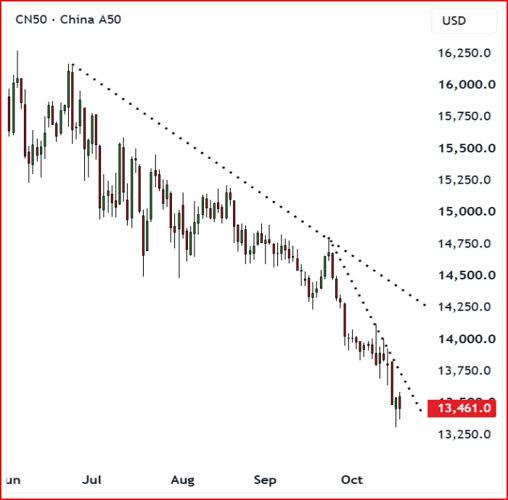
We’re already seeing some of these concerns reflected in other markets. Chinese equities have come under sustained pressure, with the China A50 falling more than 15% from its summer highs. Tech has been particularly weak, with semiconductor stocks down almost 28% over the past three months, although subdued domestic demand and difficulties in the property market have added to the pressure. The chart shows how selling has developed over several months rather than appearing overnight, which is worth keeping in mind when looking for explanations in the latest headlines.
Against this backdrop, the FTSE’s resilience is encouraging. Our market has relatively little direct exposure to the companies at the centre of the AI investment cycle, so it isn’t quite as dependent on those ambitious earnings forecasts being met. That doesn’t make UK equities immune to a broader change in sentiment, but it does highlight the value of having different sources of earnings growth. For investors, the lesson is that strong profits alone aren’t always enough to support a share price. What matters is how those profits compare with expectations, and right now the bar for much of the tech sector is looking exceptionally high.
Wishing you a great weekend,
Tom
Thomas Light – Chartered FCSI
Director of Research

Market Movers
On the rise: Marston’s (LSE: MARS) +25.4% on the week
Marston’s shares jumped more than 10% on Tuesday after the pub operator said full-year underlying pre-tax profit would exceed the top end of market expectations. The stronger performance reflects tighter cost control and the success of its sports-led pub strategy, with the summer’s World Cup and warm weather helping to attract customers. It’s an encouraging result given the difficult backdrop for hospitality, where rising costs and cautious consumer spending continue to squeeze margins.
Marston’s Grandstand sports pub format has been a particular success, with the company planning to increase conversions from 60 pubs this year to at least 100 in 2027. Underlying earnings have now tripled over three years, despite like-for-like sales falling 1.2% over the past year and remaining broadly flat in the final quarter. This suggests much of the improvement is coming from better operational efficiency rather than stronger underlying demand.

Management also plans to announce a shareholder returns programme in November, potentially involving share buybacks. This would be a positive development, although net debt remains substantial at around £1.2 billion. The shares trade on roughly 5.7 times forecast earnings, reflecting both the progress made and the financial risks that remain. With the share price up almost 25% over the past month, investors are clearly taking notice of the turnaround.
Regency View: There’s plenty to like about Marston’s progress, particularly the ability to triple earnings without relying on stronger sales. The prospect of share buybacks adds another interesting dimension, although with £1.2 billion of debt still on the books, we’d like to see more of that cash going towards strengthening the balance sheet.
Antofagasta shares came under heavy selling pressure this week after the Chilean copper miner reported a disappointing production update. Copper output for the first nine months of 2026 fell 8.3% to 436,900 tonnes, largely reflecting lower grades and recoveries at its Centinela operations. There was some improvement in Q3, with production rising 7% from the previous quarter to 151,900 tonnes, but this wasn’t enough to reassure investors, particularly with the shares already trading on a fairly demanding valuation.
Costs have also been moving in the wrong direction. Cash costs before by-product credits rose almost 20% over the first nine months to $2.81 per pound, reflecting lower production volumes and higher prices for key inputs such as diesel and sulphuric acid. Management has consequently raised its full-year cost guidance to $2.60–$2.70 per pound, although copper production guidance remains unchanged at 625,000–655,000 tonnes. With copper prices remaining strong, the pressure on operating costs is an unwelcome development.

Looking further ahead, Antofagasta expects copper production of 630,000–690,000 tonnes in 2027, supported by higher grades at Los Pelambres. Its major expansion projects are also progressing towards completion next year, although the company faces further uncertainty following strike action by unions at Centinela. With net debt having risen to around $3.4 billion and capital expenditure expected to reach $3.4 billion this year, delivering these projects on schedule will be particularly important.
Regency View: Antofagasta is benefiting from a strong copper market, but weaker production and rising costs are making it harder for the company to translate favourable prices into improved operating performance. With the shares still trading on around 22 times forecast earnings, there’s limited room for disappointment, and the focus now shifts to whether next year’s expansion projects can deliver the expected improvement in output.
Sector Snapshot
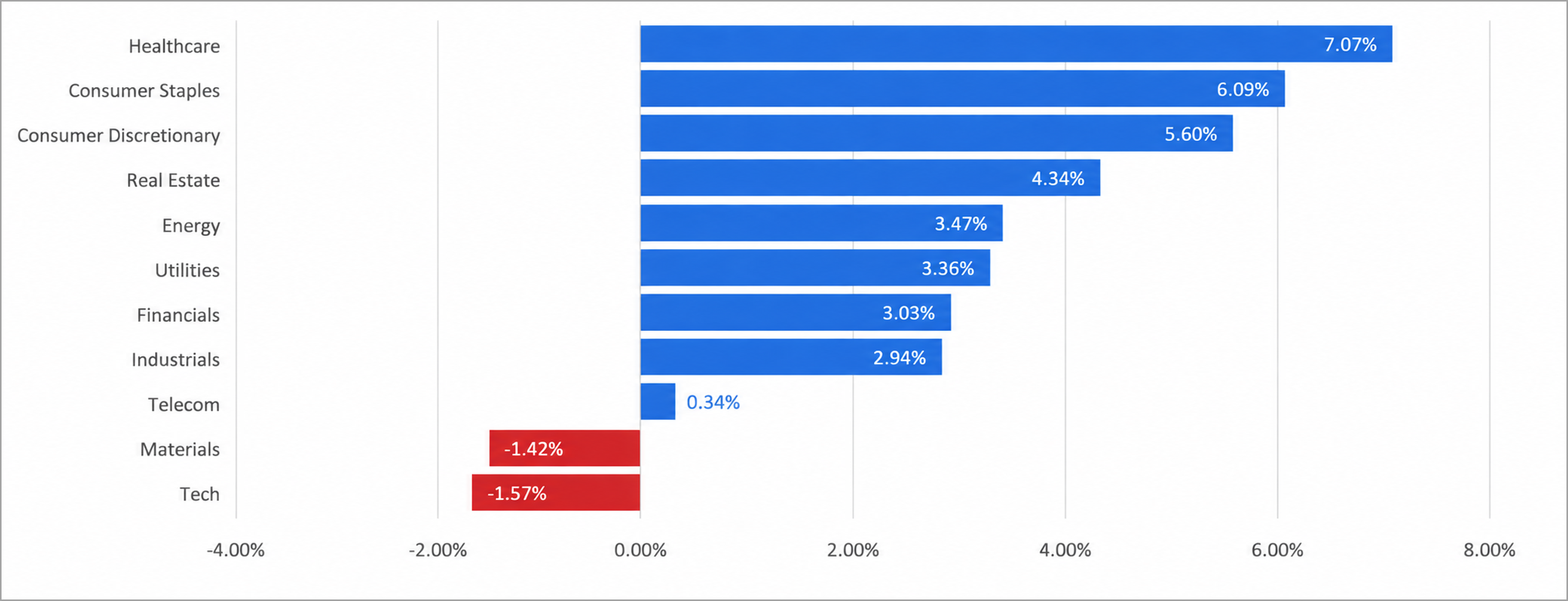
Healthcare and consumer-related stocks led a strong week for UK equities, with Consumer Staples and Consumer Discretionary both delivering impressive gains. Strength was also evident across Real Estate, Energy, Utilities and Financials, giving the rally a notably broad base. The combination of defensive and economically sensitive sectors performing well suggests investors are finding opportunities across different areas of the market.
Tech and Materials were the only sectors to finish lower, providing an interesting contrast to the strength elsewhere. The FTSE’s relatively limited exposure to the AI investment cycle may be working in its favour, particularly as investors reassess expectations surrounding technology spending. More broadly, the sector picture suggests a growing appetite for established businesses with dependable earnings, rather than a rally driven by a narrow group of fashionable stocks.
UK Sector Performance (7-Days)
UK Price Action
MEMBERS ONLY
Members can read our full analysis and view this week’s annotated FTSE chart, including the key resistance zone that could prove important for the next directional move.
UNLOCK THE FULL WEEKLY BRIEFING
Disclaimer:
All content is provided for general information only and should not be construed as any form of advice or personal recommendation. The provision of this content is not regulated by the Financial Conduct Authority.