


14th Aug 2026. 10.15am

Weekly Briefing – Friday 14th August
| Market | Movement this week (%)* |
|---|---|
| FTSE 100 | -1.41% |
| FTSE 250 | -0.07% |
| FTSE All-Share | -1.25% |
| AIM 100 | +0.19% |
| AIM All-Share | +0.34% |
* Price movement from Monday's open at 8am
Regency View:
Weekly Briefing – Friday 14th August
Market Overview
Dear Investor,
After months of disappointing performance, gold is finally beginning to show signs of life. A combination of weaker US economic data, shifting interest rate expectations and renewed geopolitical uncertainty has helped propel the precious metal more than 7% higher in recent days, pushing it back above $4,400 an ounce.
The move is significant for more than just the price. Gold has broken out of a multi-week wedge pattern and is now challenging the long-term downtrend that has capped every rally since February. Whether this proves to be the start of a broader recovery or simply another rally within a larger correction will depend less on gold itself and more on what happens next with interest rates, the US economy and the geopolitical backdrop.
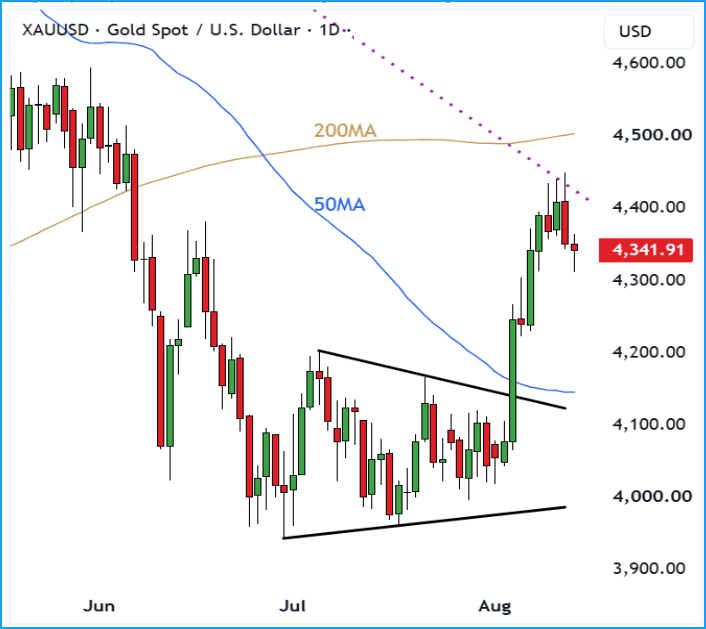
The immediate catalyst was last week’s US jobs report, which came in far weaker than expected. Rather than adding jobs, the US economy unexpectedly shed positions, prompting investors to quickly reassess how much further the Federal Reserve may need to tighten monetary policy. As expectations for another rate rise eased, bond yields fell and the US dollar weakened, removing two of the biggest headwinds that have weighed on gold for much of the year.
At the same time, the geopolitical picture remains far from settled. Tensions surrounding Iran and the Strait of Hormuz continue to keep energy markets on edge, reminding investors that inflation risks have not disappeared altogether. Gold has always occupied an unusual position in markets. It tends to perform best when investors become uncertain whether the biggest threat is slowing growth or rising inflation. At the moment, there is an argument for both.
The technical picture has improved as well. After spending several weeks building a base, buyers forced prices out of a falling wedge formation before carrying the market back towards the long-term descending trendline that has defined the correction since February. That trendline now represents the next important test. A decisive break would suggest the medium-term downtrend is finally beginning to unwind, while another rejection would imply that this remains, for now, a rally within a broader consolidation.
For investors, gold’s recovery is worth watching even if you have no intention of owning the metal itself. Gold often acts as a useful barometer for changing expectations around interest rates, inflation and investor confidence. If the recent move continues, it may tell us that markets are becoming less concerned about higher interest rates and more focused on slowing economic momentum. Either way, after several quiet months, gold has firmly put itself back on the market’s radar.
Wishing you a great weekend,
Tom
Thomas Light – Chartered FCSI
Director of Research

Market Movers
On the rise: Ocado Group (LSE: OCDO) +21.5% on the week
Ocado continued its recent recovery after announcing another major international technology agreement, reinforcing the view that demand for its automated fulfilment platform is beginning to broaden beyond its existing customer base.
The group has secured a deal to build a large automated Customer Fulfilment Centre for a fast-growing European grocery retailer, with the site expected to go live during 2028. The facility will incorporate Ocado’s latest “Re:Imagined” technology suite, including its new 600-series robots, On-Grid Robotic Pick system and fully automated freezer. Importantly, the retailer is expected to transfer existing online volumes into the site from day one, with utilisation already forecast to begin at just over half of full capacity. While the contract is not expected to make a meaningful financial contribution this year, it represents another important validation of Ocado’s technology platform following the Asda agreement announced earlier in 2026.

Investor confidence has also been helped by improving operational momentum. The company recently reiterated its expectation of turning cash flow positive during the second half of this financial year and remaining cash flow positive throughout 2027. After several years in which investors questioned whether Ocado’s technology could consistently attract new customers, the latest contract suggests that large retailers remain willing to invest in automated fulfilment despite a challenging consumer backdrop.
Regency View: The latest contract won’t transform earnings overnight, but it strengthens the investment case that Ocado’s technology business is regaining commercial momentum. With customer wins starting to build and cash flow expected to turn positive, investors are beginning to focus less on what the business has promised and more on what it is starting to deliver.
Imperial Brands came under pressure after reports that the tobacco group is preparing a significant restructuring programme involving thousands of job cuts across its operations in the US and Europe.
According to Bloomberg, the cost-cutting programme will begin with reductions across support functions including finance, procurement, supply chain and human resources before extending into legal and marketing teams. While the company declined to comment on the scale of the planned redundancies, it confirmed that organisational changes would have an impact across its global operations over time. Some roles are also expected to be outsourced as part of the restructuring.

The announcement comes at a time when the tobacco industry continues to navigate structural challenges. Traditional cigarette volumes remain in long-term decline, while higher operating costs and increasing regulatory pressures continue to weigh on the sector. Imperial has also previously warned that disruption linked to the conflict in the Middle East could increase costs across parts of its supply chain. Investors appeared concerned that such an extensive restructuring points to a more challenging operating environment than previously anticipated.
Regency View: Cost reduction programmes are rarely a negative in isolation, particularly for mature businesses focused on protecting margins. However, investors will want evidence that these savings are being made from a position of strategic strength rather than as a response to deteriorating trading conditions. With the shares already trading on a modest valuation and offering an attractive dividend yield, the focus now shifts to whether management can translate lower costs into sustainable earnings growth.
Sector Snapshot
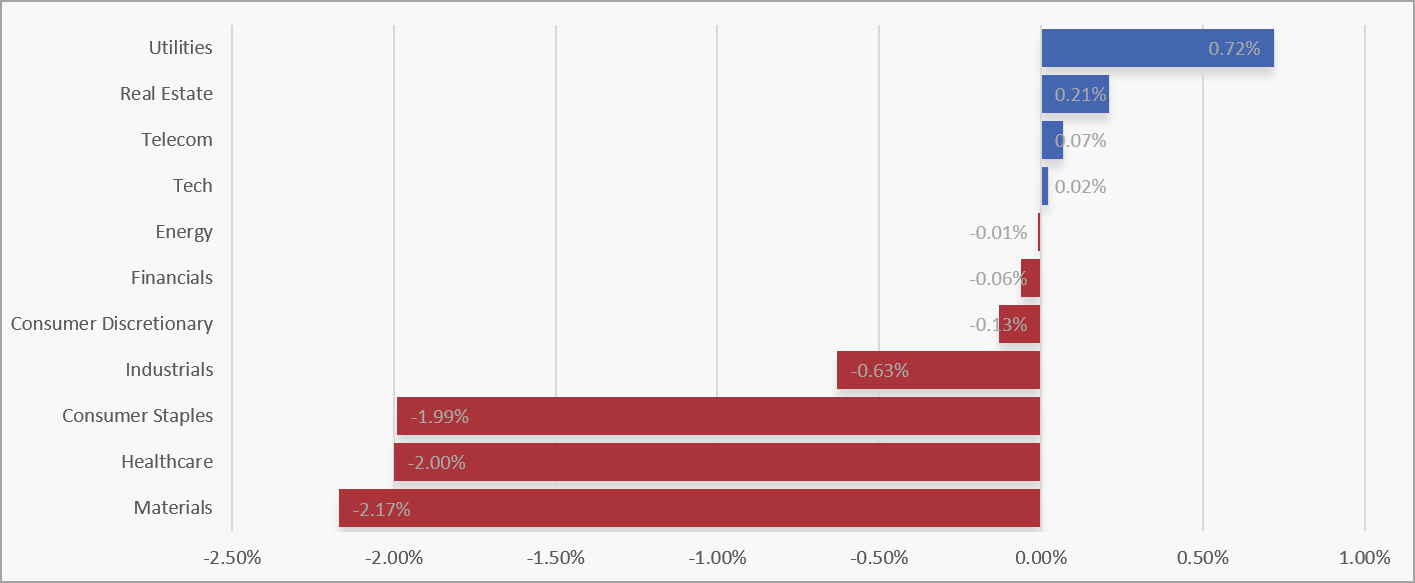
Leadership became much more defensive this week, with Utilities and Real Estate the only sectors to post meaningful gains as the broader market struggled for direction. Technology and Energy were broadly unchanged, suggesting investors were reluctant to make large directional bets despite the FTSE continuing to trade near its recent highs.
At the other end of the table, Materials was the weakest-performing sector, while Healthcare and Consumer Staples also came under pressure. The combination of weaker cyclical sectors alongside underperformance in traditional defensives points to a market lacking clear conviction, with investors becoming increasingly selective rather than embracing a broad-based move higher.
UK Sector Performance (7-Days)
UK Price Action
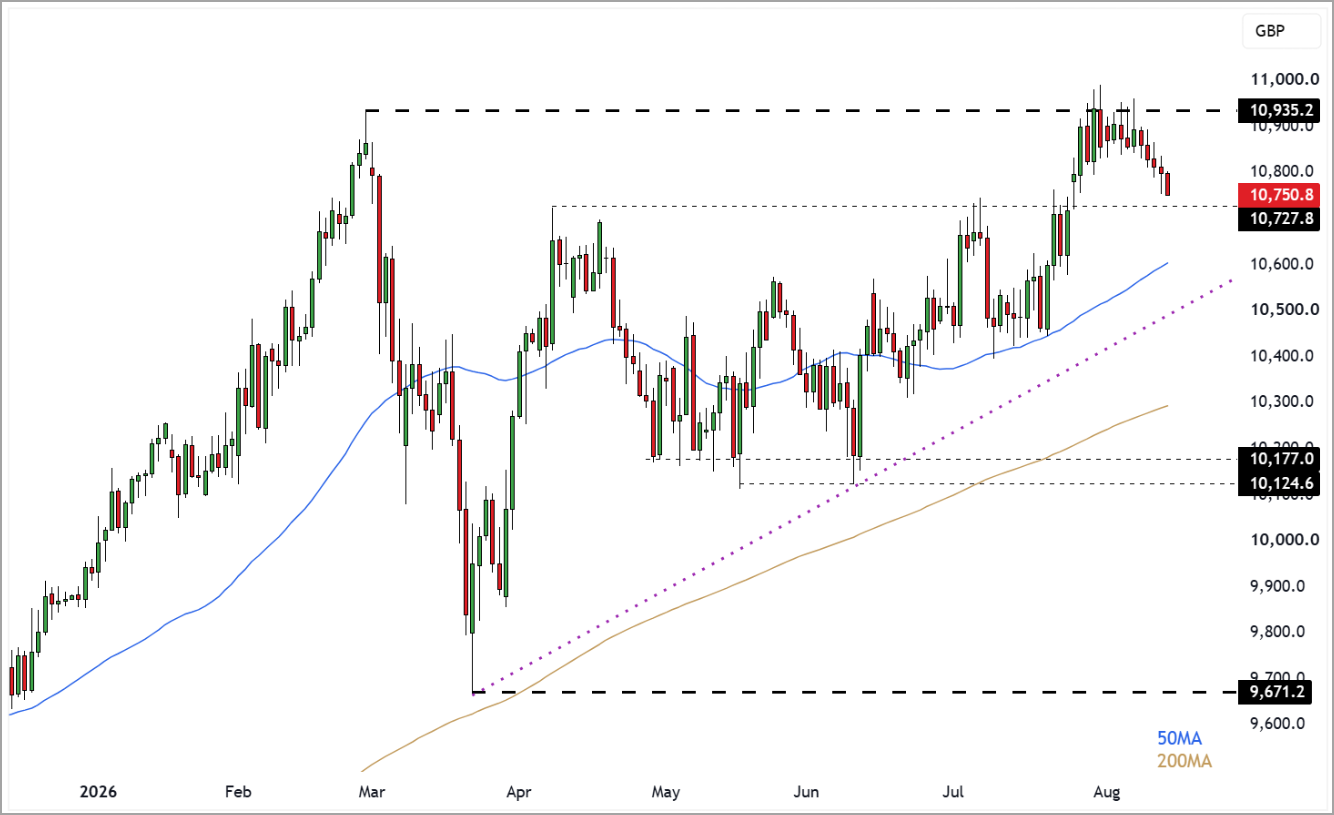
Having coiled beneath the all-time highs last week, the FTSE has wilted in the summer heat. After several sessions of remarkably tight price action, sellers have started to regain the initiative, pushing the market back towards the breakout zone around 10,725. That’s a level worth watching. Strong breakouts are often retested before the trend resumes, so some profit-taking after such a powerful rally shouldn’t come as a surprise. If buyers can step back in around this area, it would reinforce the bullish case. However, a decisive break back below it would suggest the recent breakout has lost momentum and that a deeper pullback may now be underway.
UK100 Daily Candle Chart
Disclaimer:
All content is provided for general information only and should not be construed as any form of advice or personal recommendation. The provision of this content is not regulated by the Financial Conduct Authority.