


12th Dec 2025. 10.48am

Weekly Briefing – Friday 12th December
| Market | Movement this week (%)* |
|---|---|
| FTSE 100 | +0.61% |
| FTSE 250 | -0.38% |
| FTSE All-Share | +0.49% |
| AIM 100 | -0.18% |
| AIM All-Share | -0.01% |
* Price movement from Monday's open at 8am
Regency View:
Weekly Briefing – Friday 12th December
Market Overview
Dear Investor,
Central bankers took centre stage this week as markets reacted to a trio of policy signals from Washington, Frankfurt and London. The Federal Reserve’s latest rate cut, a more upbeat tone from the European Central Bank and growing divisions at the Bank of England drove meaningful moves across equities, bonds and currencies. With policy calls now shaping sentiment more than corporate updates, investors spent the week watching central bank commentary as closely as they watched the data.
The Federal Reserve set the pace by cutting rates by 0.25 percentage points to a range of 3.5% to 3.75%, the lowest level in three years. The move met expectations, yet the degree of internal disagreement caught markets by surprise. Nine members voted for the cut, two preferred to hold and one pushed for a larger move. The split reflected the tension between a cooling labour market and persistent services inflation. Fresh projections point to softer inflation next year, but the wide spread of views left investors debating how predictable the Fed’s next steps really are.
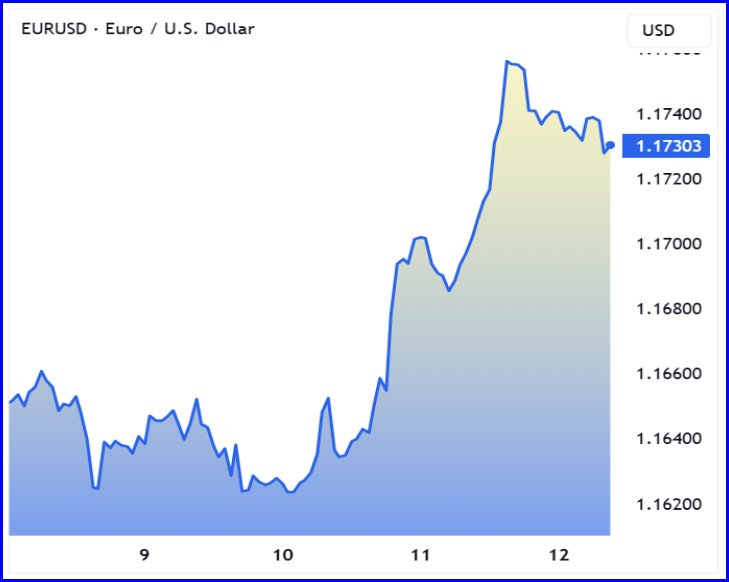
In Europe, the ECB presented a very different tone. Christine Lagarde suggested that policymakers may upgrade their Eurozone growth forecasts next week, highlighting resilience in a region that many analysts had expected to slow sharply under the weight of trade tensions and geopolitical strain. Third quarter GDP rose 0.2% and investment in digital services continues to provide support. Traders now price about a 40% chance of a rate rise next year, signalling a modest but noticeable shift in expectations.
The Bank of England added its own dose of uncertainty. Clare Lombardelli warned this week that rate cuts should proceed cautiously, even though Budget measures could reduce inflation by up to 0.5 percentage points next year. She highlighted upside risks to services inflation and resource pressures in the economy. Other MPC members struck contrasting tones. Catherine Mann questioned how fast inflation can return to target, while Dave Ramsden and Swati Dhingra argued that the slowdown in the labour market gives the bank room to ease. With governor Andrew Bailey yet to signal his stance, next week’s vote remains finely balanced.
For UK investors this marks the start of a more interesting phase. Policy paths are beginning to diverge, and that creates distinct trends in currencies, rates and global capital flows. These shifts will not move all sectors in the same direction, but they will create clear winners and losers at the stock level. With central bankers setting the tempo again, markets are entering a period where thoughtful positioning can make a real difference to returns.
Wishing you a fantastic weekend,
Tom
Thomas Light – Chartered FCSI
Director of Research

Market Movers
On the rise: WPP (LSE:WPP) +10.9% on the week
WPP’s share price pushed higher this week after its media buying arm raised global advertising forecasts for 2025 and 2026. The latest “This Year Next Year” report now expects global ad revenue to grow 8.8% in 2025 to $1.14tn, well above the 6% prediction made in June. The upgrade reflects firmer demand for digital advertising and a calmer outlook following earlier trade tensions.
The report highlighted continued strength across key ad categories. Social media revenue is projected to rise 12.8% to $413bn next year, while search advertising is expected to grow 10.2% to $244.9bn. Commerce media channels are forecast to expand to 15.6% of global ad spending, overtaking total TV advertising for the first time. Traditional TV revenue still grows in absolute terms but continues to lose share of the total market.

WPP’s trading metrics remain mixed. The shares have rallied 13.5% over 1 month but remain down over longer periods, sitting more than 64% below their 52 week high. Valuation measures are low relative to history and peers, with a forward price to earnings ratio of 5.2 and a forecast dividend yield of 7.53%. Analysts expect revenue stability but limited earnings growth this year.
Regency View: Upgrades to global ad spending give WPP a welcome narrative shift after a tough run. With valuations already washed out, even modestly better visibility in digital and search spending can help sentiment begin to mend.
Wishbone Gold drifted lower this week after the company released an extensive exploration update on its Red Setter project in Western Australia. The announcement outlined progress on drilling, core processing and new logistical developments, including an application for a 30km access road linking the project to the Nifty Copper Mine. The road development is expected to simplify future operations but requires licensing and a heritage survey scheduled for April 2026.
Drilling activity continued through the final phase of the 2025 programme. The company has now completed seven Reverse Circulation holes totalling 1,509 metres and six Diamond Drill holes totalling 3,298.7 metres, with a final 300 metre hole underway. Three diamond holes have already been cut and sampled, and assay results for both RC and diamond core are pending. A new Mobile MT survey also covered the northwest extension of the Red Setter Dome, with results still being processed.

The share price reaction reflected the market’s focus on financial risk rather than operational detail. Wishbone remains a £14.5m micro cap with limited revenue and a long lead time to any potential mining decision. Momentum has weakened in recent weeks despite strong gains earlier in the year, and the shares sit more than 79% below their 52 week high.
Regency View: Exploration stories often move in bursts, and Wishbone’s next catalyst will be assay results rather than operational updates. Until investors see the numbers behind the drill core, sentiment is likely to stay cautious.
Sector Snapshot
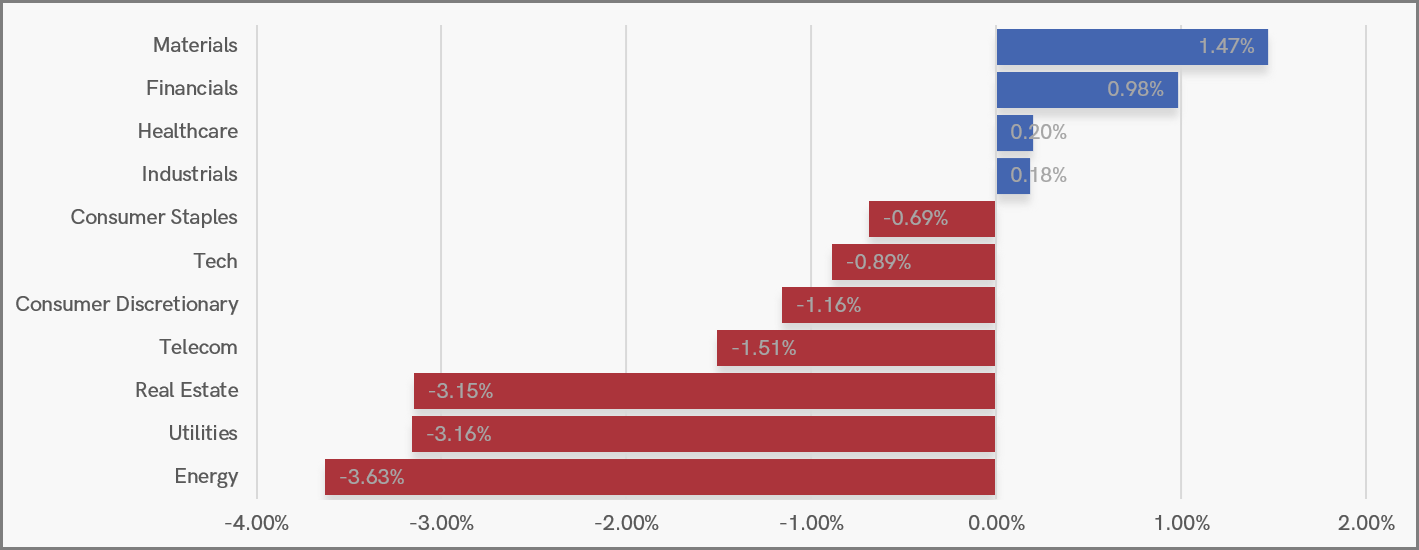
Materials and Financials led a muted week for the market, extending what’s become a recurring theme of selective strength in sectors tied to pricing power and balance sheet resilience. Healthcare and Industrials also managed small gains, helping to offset weakness elsewhere, though overall momentum remained subdued.
On the downside, Energy and Real Estate were the biggest drags, with Utilities and Telecom also slipping as investors continued to steer away from rate-sensitive and income-focused areas. The broader pattern of rotation toward steady, cash-generative sectors suggests investors are becoming more defensive in their optimism, favouring quality over risk.
UK Sector Performance (7-Days)
UK Price Action
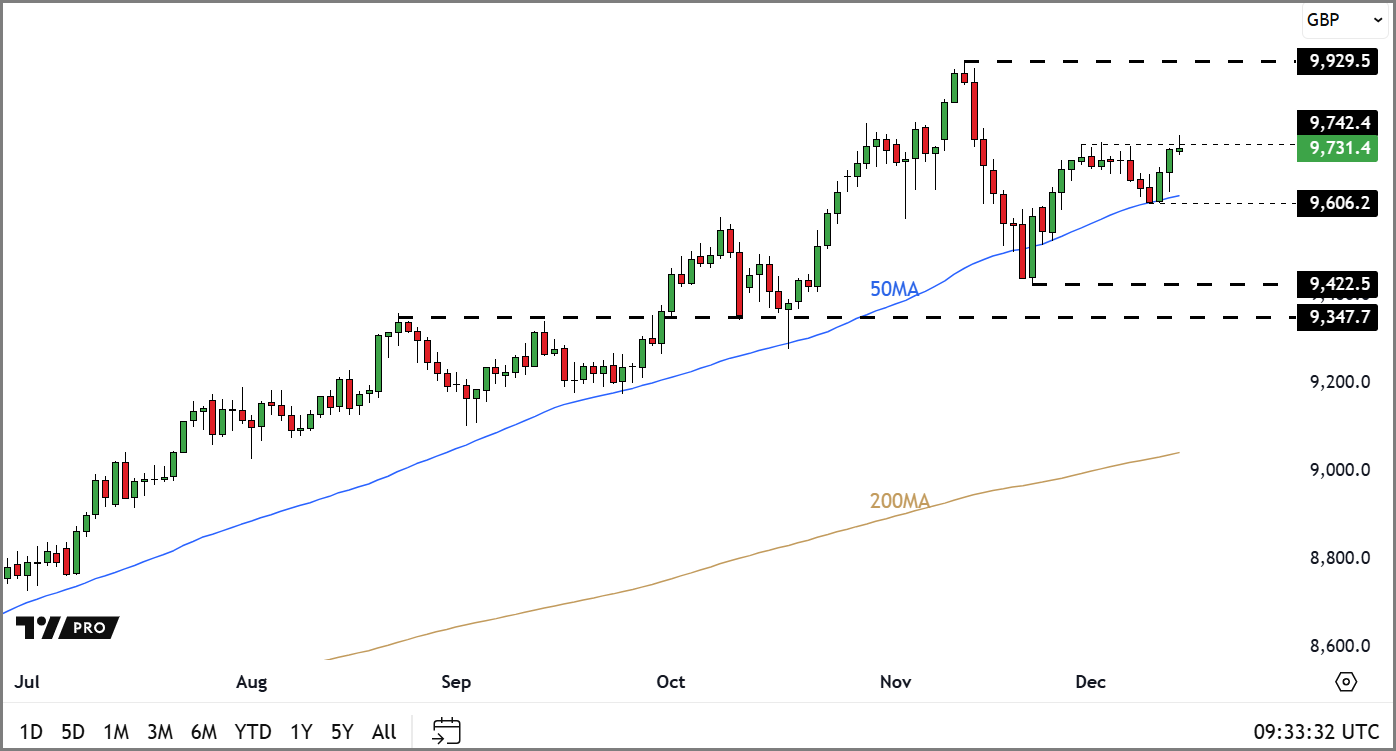
This week’s price action saw the FTSE break lower from the mini range we highlighted last week, only for buyers to step in at the 50 day moving average and drive the market higher. The rebound reinforces the importance of the 50 day line as dynamic support within the broader uptrend.
Prices are now sitting at the short term resistance created by last week’s mini range. A weekly close above this level would strengthen the case for a festive rally and could open the door for a move back towards the trend highs.
FTSE 100 Rolling Futures (Daily Candle Chart)
Disclaimer:
All content is provided for general information only and should not be construed as any form of advice or personal recommendation. The provision of this content is not regulated by the Financial Conduct Authority.