


11th Sep 2026. 10.28am

Weekly Briefing – Friday 11th September
| Market | Movement this week (%)* |
|---|---|
| FTSE 100 | -1.61% |
| FTSE 250 | -2.53% |
| FTSE All-Share | -1.71% |
| AIM 100 | -1.81% |
| AIM All-Share | -1.50% |
* Price movement from Monday's open at 8am
Regency View:
Weekly Briefing – Friday 11th September
Market Overview
Dear Investor,
As equity investors, we’re probably guilty of treating the bond market as the slightly boring relative of the stock market. Not this week. The yield on the US 10-year Treasury has surged towards 5%, its highest level in almost three years, and the message coming from the world’s largest bond market is becoming increasingly difficult to ignore.
Bond investors are a sensitive bunch, although perhaps with good reason. Equity investors spend much of their time thinking about what could go right, while bond investors tend to concentrate on everything that could prevent them getting their money back with the expected return. Right now, they’re worried about inflation, rising energy prices and the amount of debt the US government continues to issue, and they’re demanding a higher return for taking that risk.
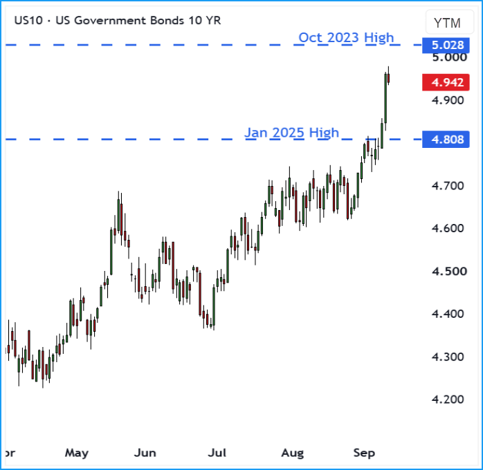
Those concerns have intensified this week. Oil prices have continued to climb as the conflict in the Middle East disrupts energy supplies, while the latest US inflation data provided another reminder that price pressures haven’t disappeared. At the same time, there is little sign that the Trump administration is prepared to tackle the fiscal deficit aggressively. Put it together and investors are questioning an assumption that had become fairly comfortable earlier in the year, that interest rates and long-term borrowing costs were ultimately heading lower.
The US Treasury’s latest attempt to steady the market didn’t provide much reassurance either. Scott Bessent announced a $6 billion buyback of older government bonds, an increase on previous operations but less than some investors had expected, and yields initially moved higher anyway. The programme is designed primarily to improve liquidity in the Treasury market, but the reaction was telling. Investors appear less interested in short-term measures to support the market than in the longer-term question of how Washington intends to deal with persistent deficits, inflation and an ever-growing supply of government debt.
For equity investors, this matters because government bonds don’t exist in a separate universe. If investors can earn close to 5% from lending to the US government for ten years, the hurdle becomes higher for everything else, from expensive growth stocks to property and corporate investment. The FTSE’s mix of energy companies, banks and mature dividend payers leaves it somewhat differently exposed than America’s tech-heavy market, but persistently high borrowing costs eventually make life more difficult for almost everyone. Last week energy markets were warning that inflation could prove troublesome again. This week, the bond market appears to have been listening.
Wishing you a great weekend,
Tom
Thomas Light – Chartered FCSI
Director of Research

Market Movers
On the rise: Everplay Group (AIM: EVPL) +17.6% on the week
Everplay Group jumped after Wardogs, the latest title published by its Team17 division, passed one million copies sold on its first day following release into Steam Early Access. The 100-player tactical shooter also attracted more than 340,000 concurrent players on Steam, giving Everplay an unusually strong start for one of its new releases.
The significance goes beyond a good opening day’s sales. Wardogs was developed by Bulkhead, where Everplay has exposure through its strategic partnership and stake in Super Media Group, and published by Team17. That means the success provides some early evidence that the group’s strategy of combining its established publishing operation with partnerships and investments in independent developers can produce meaningful new franchises.

There is still plenty to prove. Early Access launches can generate enormous initial interest before activity settles back, so the next test will be whether Wardogs can retain players and build on its opening momentum. Even so, selling one million copies in a day gives Everplay a considerably better starting point than most new releases manage. The timing is useful too, with interim results due next Tuesday, when investors should get a clearer idea of what the launch could mean for expectations.
Regency View: One day’s sales don’t make a franchise, but more than one million copies and 340,000 concurrent players is the sort of opening that deserves attention. With Everplay still trading well below last year’s highs and on a relatively modest forward valuation, sustained momentum from Wardogs could give investors a reason to reassess the earnings potential of the wider group.
Dunelm suffered a sharp sell-off after unveiling an ambitious three-year growth plan alongside its full-year results, with investors focusing less on the promise of faster growth and rather more on what it will cost to get there.
The existing business remains in decent shape. Sales increased 3.1% to £1.83 billion during FY26, while profit before tax held steady at £211 million and free cash flow improved from £127 million to £155 million. The problem came with the outlook. An extended spell of hot weather resulted in significantly weaker trading during the first six weeks of the new financial year, and Dunelm now expects FY27 adjusted profit before tax to be broadly in line with the £211 million delivered last year.

Management is also asking investors to take a longer view. Its new Winning Hearts & Homes strategy targets a return to sustainable mid-to-high single-digit sales growth, supported by up to ten new stores a year, more than 50 store refurbishments and further digital investment. Dunelm plans to remove around £100 million of costs by FY29, but those savings will be reinvested into growth. The programme also requires £30-40 million of non-recurring expenditure and around £125 million of additional capital expenditure over the next three years. With special dividends potentially taking a back seat while that investment is made, investors have been given several reasons to lower their expectations for near-term returns.
Regency View: There is nothing fundamentally wrong with Dunelm’s ambition, but investors are being asked to accept heavier investment and little near-term profit growth today in exchange for the prospect of faster growth tomorrow. After this week’s fall the shares trade on less than ten times forecast earnings with a prospective dividend yield above 7%, which suggests a fair amount of disappointment is already reflected in the price, although management now needs to show that its investment programme can deliver the growth being promised.
Sector Snapshot
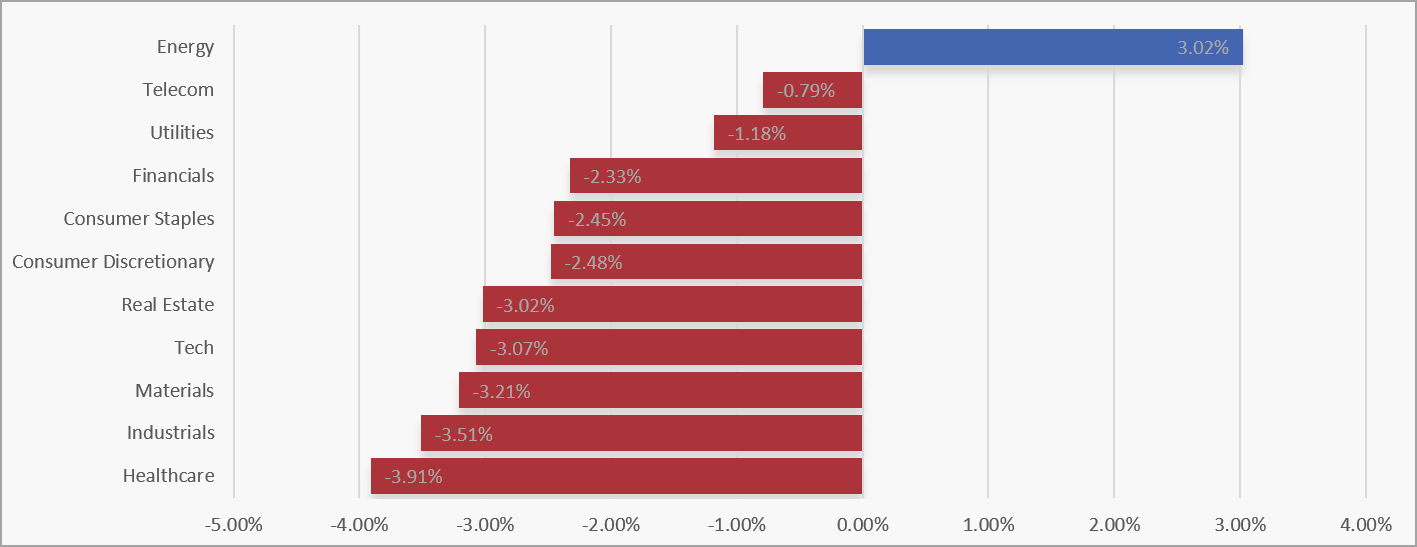
Energy was the only sector to make meaningful headway this week, rising 3.02% while every other major UK sector finished lower. The contrast was particularly stark given last week’s similar pattern, with Energy once again benefiting from the backdrop of elevated oil prices while weakness spread across the rest of the market.
Healthcare was the weakest performer, falling 3.91%, closely followed by Industrials, Materials and Technology. With Financials, Consumer Discretionary and Real Estate also down more than 2%, this was a notably broad-based retreat beneath the surface, leaving Energy increasingly isolated at the top of the sector rankings.
UK Sector Performance (7-Days)
UK Price Action
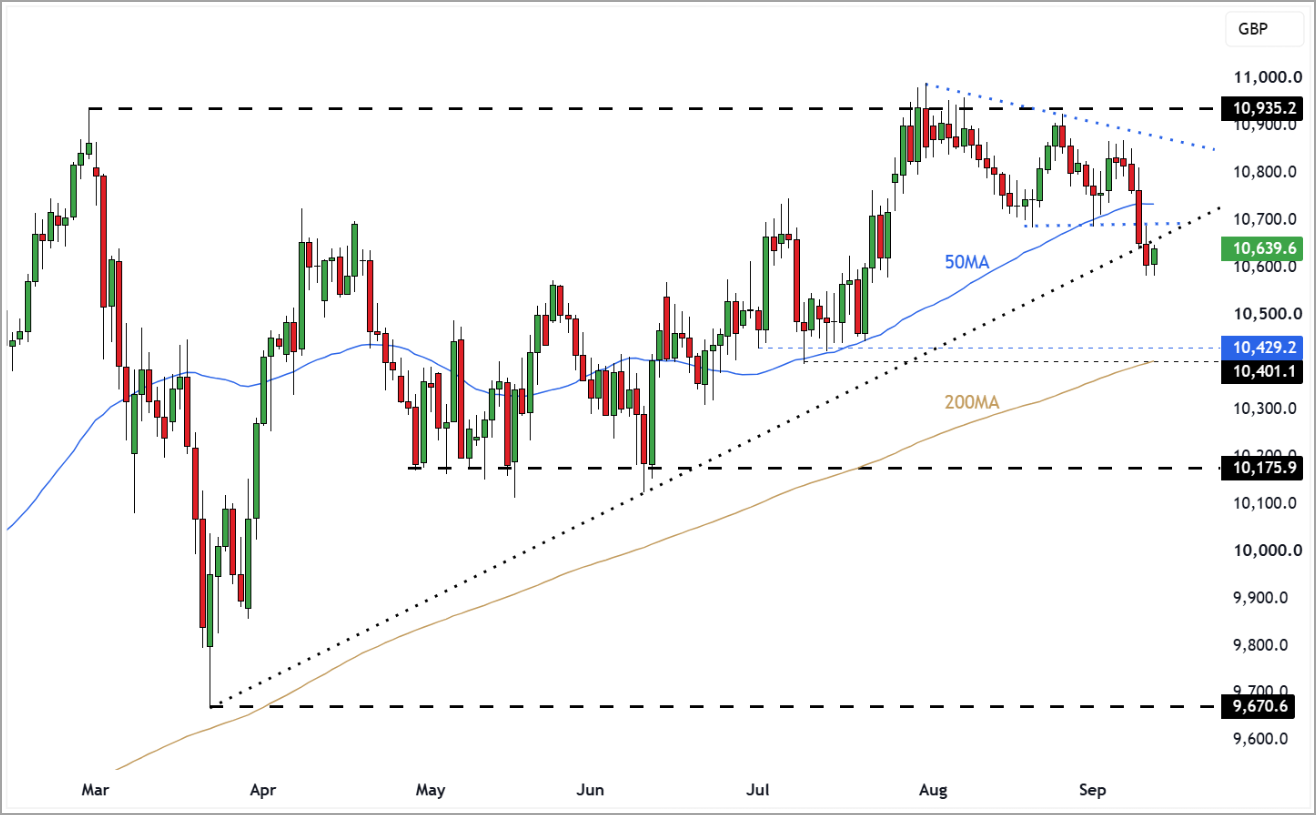
It has been a more decisive week for the FTSE, with several short-term technical supports giving way at once. After forming another lower swing high beneath the February peak, the index broke below the 50-day moving average, the 10,700 area that had been providing support, and the rising trendline drawn from the March lows.
Taken together, that marks a clear deterioration in the short-term price structure. The FTSE remains comfortably above its rising 200-day moving average, so the longer-term picture has not been overturned, but the repeated failure to break the February highs is beginning to matter. The next question is whether this week’s breakdown develops into a deeper pullback or proves to be another false move in what has been a remarkably resilient market.
UK100 Daily Candle Chart
Disclaimer:
All content is provided for general information only and should not be construed as any form of advice or personal recommendation. The provision of this content is not regulated by the Financial Conduct Authority.