


10th Jul 2026. 10.49am

Weekly Briefing – Friday 10th July
| Market | Movement this week (%)* |
|---|---|
| FTSE 100 | -1.95% |
| FTSE 250 | -1.18% |
| FTSE All-Share | -1.85% |
| AIM 100 | -1.77% |
| AIM All-Share | -1.67% |
* Price movement from Monday's open at 8am
Regency View:
Weekly Briefing – Friday 10th July
Market Overview
Dear Investor,
The summer earnings season gets underway this week. On the surface, it’s simply a parade of profit figures. In reality, it’s where a year’s worth of narratives either survive first contact with reality… or don’t.
What’s particularly interesting this time is that investors on each side of the Atlantic are asking completely different questions.
In the US, the issue isn’t whether earnings will be good. Expectations are already exceptionally high. After two years of relentless AI enthusiasm, investors are no longer prepared to applaud every announcement of another multi-billion-dollar data centre. They want to see those investments beginning to show up where it matters most: revenues, margins and cash flow. This earnings season feels like the point where “AI potential” starts becoming “AI proof”.
Europe faces almost the opposite challenge. Headline earnings growth should look respectable, but much of the heavy lifting has come from energy and commodity producers following the sharp swings in oil prices earlier this year. Strip those sectors away and the picture becomes considerably less flattering. Management commentary around pricing power, industrial demand and margins may end up telling us more than the earnings per share figures themselves.
The UK occupies an interesting middle ground. We don’t have America’s technology giants or Europe’s dependence on commodities. Instead, the FTSE remains a collection of globally diversified businesses that quietly get on with making money. Banks continue to enjoy the benefits of higher interest rates, defence companies are sitting on record order books, while industrial leaders such as Rolls-Royce are benefiting from structural themes that should outlast the current economic cycle.
That difference is worth remembering over the coming weeks. Strong numbers from Nvidia or Microsoft can lift sentiment across global markets, but they won’t tell you much about the health of a British bank. Equally, disappointing results from a European chemicals company shouldn’t automatically change your view on a UK defence contractor. Earnings season works best when you remember that not every market is playing the same game.
As always, the numbers themselves are only half the story. The outlook statements and conference calls are often where the real clues are hidden.
Wishing you a great weekend,
Tom
Thomas Light – Chartered FCSI
Director of Research

Market Movers
On the rise: Keller Group (KLR:) +24.9% on the week
Keller Group climbed to fresh highs this week after upgrading full-year expectations, with booming demand for data centres and infrastructure projects helping drive another period of impressive trading.
The geotechnical engineering specialist said momentum accelerated through the second quarter, with its North American business materially outperforming management’s expectations. Record project volumes and strong customer demand for major infrastructure schemes and data centres more than offset weakness in parts of the US residential market. Elsewhere, trading remained resilient across Europe, the Middle East and Asia-Pacific, while the group’s order book continues to sit at a record £1.9 billion.

Importantly, this isn’t simply a case of favourable end markets doing the heavy lifting. Management highlighted its disciplined approach to project selection and margin control, allowing the business to translate higher demand into stronger profitability rather than simply chasing revenue. As a result, both revenue and underlying operating profit are now expected to come in materially ahead of current market forecasts.
Regency View: Keller is quietly becoming one of the UK’s highest-quality industrial businesses. Trading on around 14 times forward earnings despite record margins, a record order book and exposure to long-term themes such as infrastructure renewal and AI-driven data centre construction, the shares still don’t look obviously overextended.
AstraZeneca came under pressure this week after a late-stage clinical trial for Wainua, its treatment for transthyretin-mediated amyloid cardiomyopathy (ATTR-CM), failed to meet its primary endpoint.
The Phase III CARDIO-TTRansform study tested whether adding Wainua to the current standard of care could reduce cardiovascular deaths and recurring heart-related events. While the treatment was well tolerated, the trial failed to demonstrate a statistically significant benefit across the overall patient population. AstraZeneca said it will now conduct a full analysis of the data before presenting the results at the European Society of Cardiology Congress next month.

Disappointing trial results are an inevitable part of pharmaceutical investing, particularly for companies developing treatments across multiple disease areas. Although subgroup analysis hinted at potential benefits for certain patients, investors had been hoping Wainua could become another meaningful growth driver within AstraZeneca’s expanding cardiovascular franchise. The setback therefore prompted some profit-taking in a stock that has performed strongly over the past year.
Regency View: No investor likes to see a late-stage trial disappoint, but it is important to keep the result in perspective. AstraZeneca remains one of the highest-quality pharmaceutical companies in Europe, with a broad portfolio, deep pipeline and multiple growth drivers, so while this is clearly a setback, it does little to alter our long-term investment case.
Sector Snapshot
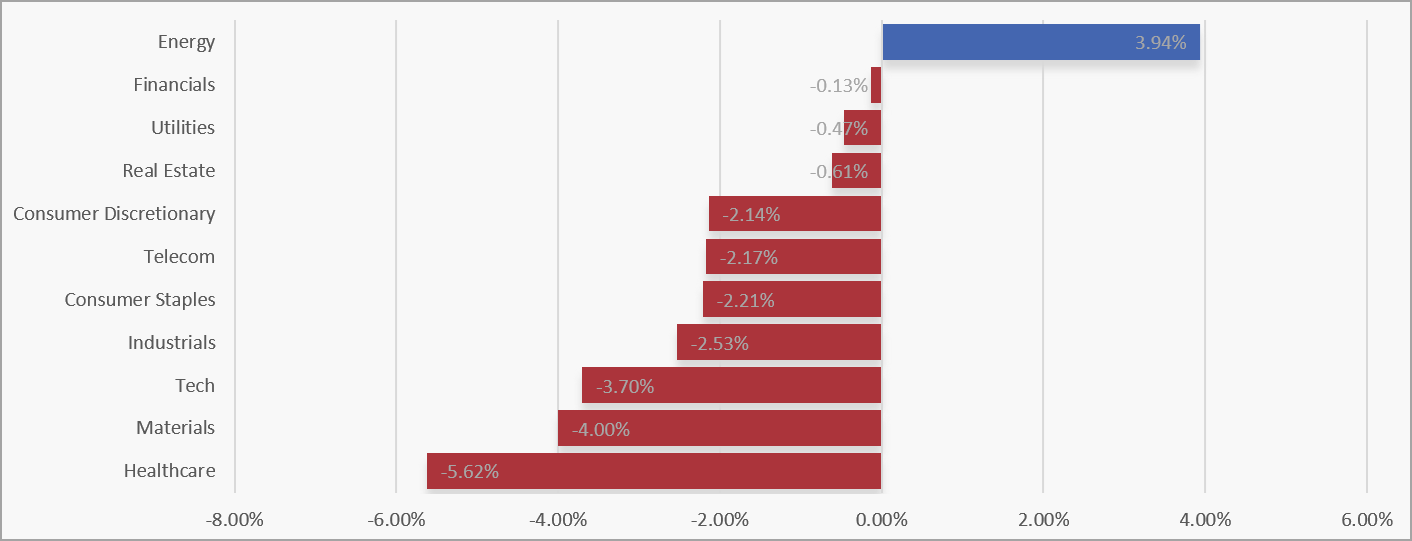
Energy was the only sector to finish the week in positive territory, benefiting from renewed strength in oil prices while the rest of the market came under pressure. Financials, Utilities and Real Estate held up relatively well with only modest declines, but overall there were very few places for investors to hide.
Healthcare endured the heaviest selling, followed by Materials and Tech, with Industrials also firmly lower. Consumer Staples, Telecoms and Consumer Discretionary all weakened, highlighting the breadth of the move. Unlike previous weeks, where leadership rotated between sectors, this week’s performance was dominated by a broad risk-off tone, with Energy standing out as the sole exception.
UK Sector Performance (7-Days)
UK Price Action
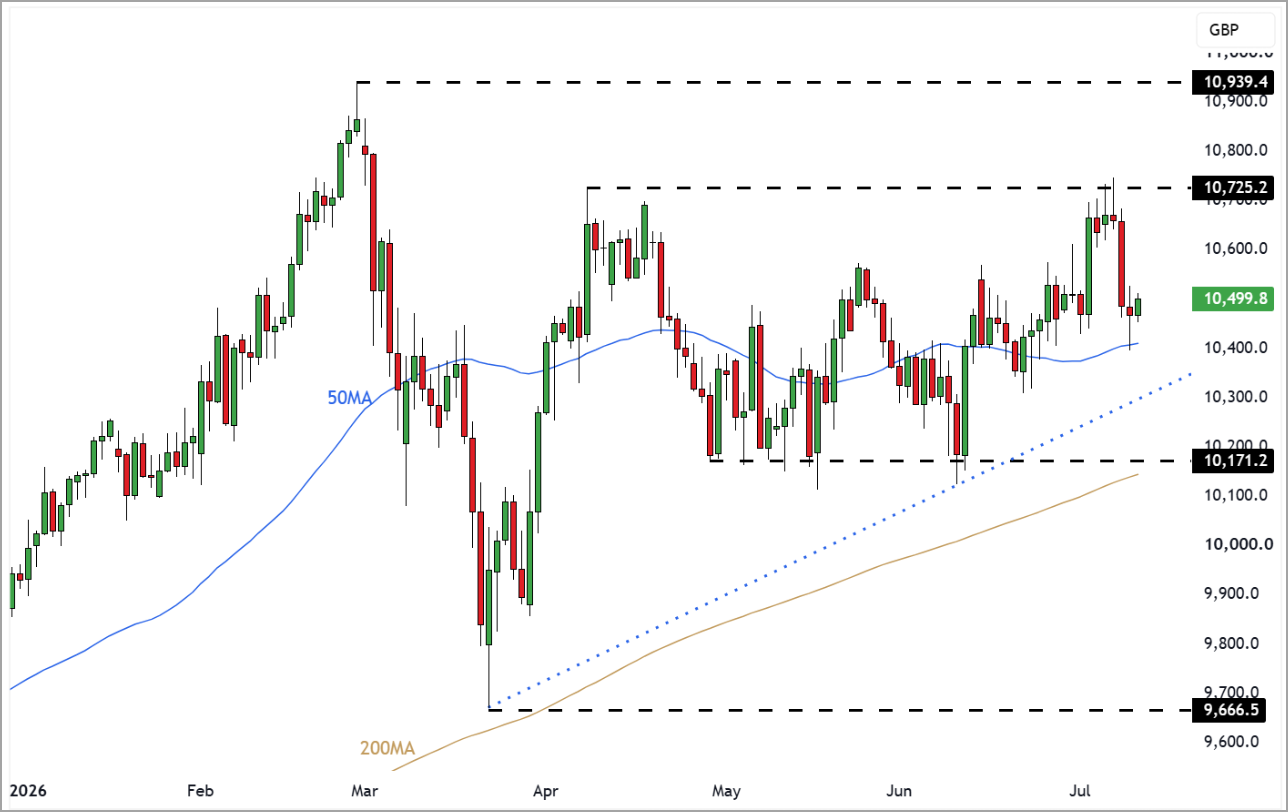
Last week we noted that the FTSE needed to build on its breakout above resistance, but it stumbled at the first hurdle. The April highs proved a step too far, with Wednesday’s heavy sell-off quickly erasing the breakout and dragging the market back towards the 50 day moving average. After several weeks of improving price action, this serves as a reminder that the longer term range has not yet been fully left behind.
UK100 Daily Candle Chart
Disclaimer:
All content is provided for general information only and should not be construed as any form of advice or personal recommendation. The provision of this content is not regulated by the Financial Conduct Authority.