16th Sep 2026. 8.54am

Regency View:
BUY Victrex (VCT)
- Growth

Regency View:
BUY Victrex (VCT)
Victrex: Building Momentum
After several years of subdued earnings, Victrex (VCT) is moving firmly in the other direction, with improving volumes and a leaner cost base already pushing profit expectations higher.
Momentum has strengthened as the year has progressed, culminating in an upgrade to full-year profit expectations earlier this month, while a programme to simplify the business should begin making a more meaningful contribution to earnings from next year.
That combination has already caught the market’s attention, but there could be more to come. Victrex is preparing to set out its medium-term growth plans at a Capital Markets Event next week, when investors should get a clearer idea of what improving demand, a leaner operating model and a growing pipeline of high-value applications could mean for profitability. After several years in which the business struggled to convert its considerable technical strengths into earnings growth, the pieces are beginning to fit together rather better.
A material difference
Victrex is the world leader in PEEK and PAEK high-performance polymers, materials designed for jobs where ordinary plastics aren’t up to the task. They combine properties including strength, light weight, chemical resistance and the ability to perform in extreme temperatures, which explains why Victrex finds itself supplying some demanding industries.
Its polymers are used across aerospace, semiconductor manufacturing, energy, automotive and medical applications, while newer opportunities include robotics, advanced air mobility and potential alternatives to PFAS materials.
What makes the business more interesting than simply manufacturing specialist polymers is the work that takes place before a kilogram is sold. Victrex works with customers to develop applications in which PEEK can replace metals or other materials, helping customers solve a particular engineering problem and, ideally, getting Victrex specified into the finished product.
That application expertise matters because competition is greater in the more commoditised parts of the PEEK market, particularly from Chinese producers. Victrex’s opportunity is therefore less about competing for every available tonne and more about directing its expertise towards applications where performance matters enough to support better margins and longer customer relationships.
The economics of getting that right can be excellent. Even during a relatively subdued first half, the Medical division produced a gross margin of 75.7%.
Momentum has been building
The change in trading during 2026 has been gradual enough to be credible.
First-half volumes increased 6%, although revenue rose only 1% as product mix, competitive pricing and currency movements offset some of that progress. Within the half, however, Q2 was already noticeably stronger, with volumes rising 14% and revenue increasing 7%.
By Q3, that improvement had accelerated. Revenue increased 18% to £84.5m as volumes rose 17%, with Aerospace and Electronics providing much of the impetus. Across the first nine months, volumes were 10% ahead and revenue had increased 7%.
Management remained cautious in July and left full-year underlying pre-tax profit guidance unchanged at £42m-£44m. That makes September’s update considerably more meaningful. Strong momentum continued during Q4, growth broadened across Aerospace, Value Added Resellers and Electronics and all geographic regions contributed, with Asia Pacific performing particularly well.
Victrex consequently raised expected FY26 underlying pre-tax profit to £45m-£47m.
There is an important distinction here. This isn’t a recovery being driven principally by pushing through higher prices. Q3 average selling prices were unchanged at £68/kg, while volumes increased 17%. More material is finding its way into customers’ hands, across a broader spread of markets, and that gives the improvement a firmer foundation.
More profit from the business
Improving volumes are arriving at a useful moment because Victrex is also changing how it operates.
James Routh took over as chief executive at the beginning of 2026 and has moved quickly to simplify the organisation, refresh the leadership team and give regional operations greater responsibility. The aim is to bring decision-making closer to customers while reducing some of the complexity that had accumulated centrally.
Around 10% of roles have now been removed, with most affected employees having left during Q3. Initial savings started appearing during Q4 and the wider Profit Improvement Plan is expected to deliver at least £10m of annualised savings from FY27.
That figure deserves some context. Victrex generated underlying pre-tax profit of £46.4m in FY25, so £10m represents a sizeable opportunity before considering what further volume growth might contribute.
Management is also becoming more selective about where it deploys capital and expertise. August’s disposal of the US-based Kleiss Gears operation is a good example. Victrex had used the business to help develop the market for PEEK gears, but once that objective had been achieved it no longer regarded owning the manufacturing operation as necessary.
Taken together, these changes point towards a business increasingly focused on the parts of its portfolio where its technical advantages can earn an attractive return.
Plenty of room to develop
China illustrates both the scale of the opportunity and the importance of better execution.
Greater China has been Victrex’s fastest-growing major geography over the past decade, with revenue compounding at around 17% annually and the region accounting for close to a fifth of group revenue and volume by FY25.
The Panjin manufacturing operation hasn’t developed as intended, however. Victrex recognised a £60.6m non-cash impairment during the first half after concluding that part of the production process couldn’t support the facility’s planned 1,500-tonne capacity. The plant remains loss-making and management is now working on a revised operating model.
That deserves monitoring, particularly given increasing local competition, but it hasn’t altered Victrex’s view of the Chinese opportunity. Local production remains strategically useful and the particularly strong Asia-Pacific growth reported in September suggests demand itself isn’t the problem.
Nor does management need to repair the business under balance-sheet pressure. Net debt stood at £43m at the end of June, while leverage at the half year was 0.65 times underlying EBITDA. First-half underlying operating cash conversion was 109%, leaving Victrex with reasonable financial flexibility as it works through the changes.
What comes next?
We won’t have to wait long for the next piece of the puzzle.
Victrex is holding a Capital Markets Event on 24 September under the banner Unlocking Victrex’s Potential. Management plans to discuss the addressable market for new PEEK applications, progress with the Profit Improvement Plan, its revised operating model and its roadmap towards a significant improvement in medium-term profitability.
The timing is useful. When the event was announced, Victrex was still guiding towards £42m-£44m of FY26 underlying pre-tax profit. Management will now arrive having completed the headcount reduction, carried strong Q3 momentum through the final quarter and upgraded that guidance to £45m-£47m.
The £10m of identified savings already gives us one reason to expect FY27 profitability to improve. Next week’s event should tell us considerably more about how ambitious management is prepared to be beyond that.
Investors are taking notice
The share price has responded decisively to the improving news flow.
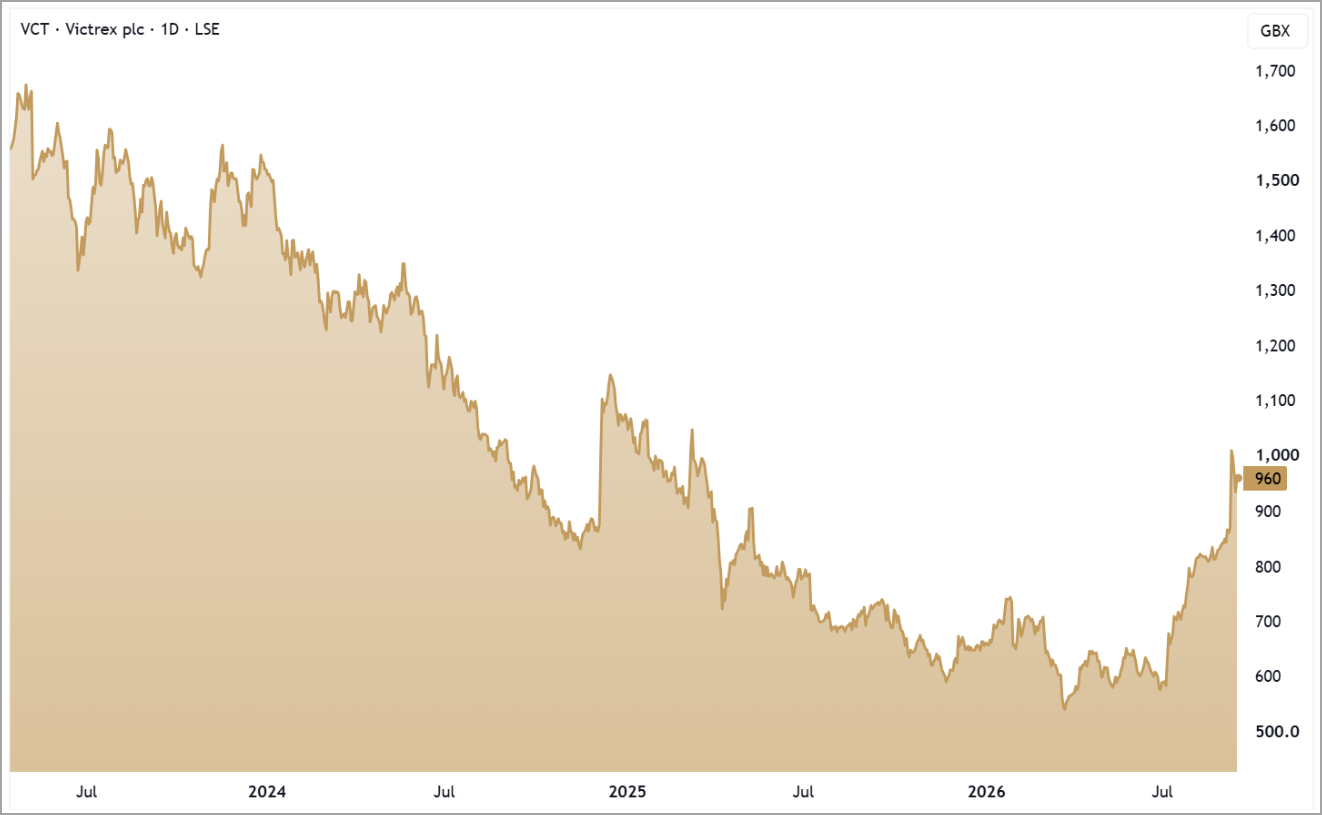
Victrex spent much of the past three years beneath a declining 200-day moving average, with rallies repeatedly running out of steam before they could change the broader trend. This summer has produced a very different pattern.
After establishing a low below 600p, the shares pushed through both the 50-day and 200-day moving averages, followed by a decisive acceleration as the trading picture strengthened. September’s profit upgrade then produced another high-volume move towards 1,000p.
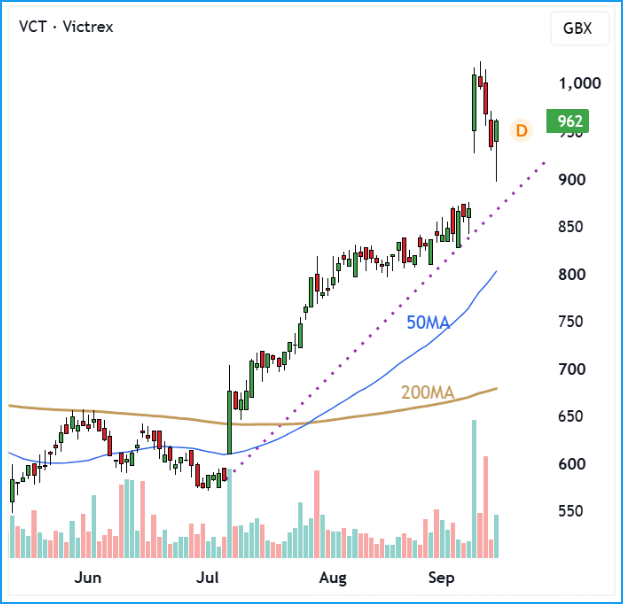
At around 960p, the shares have travelled a long way in a relatively short period, so some consolidation would be entirely normal. More significant for us is the change in character. Higher highs and higher lows are now developing above rising short-term momentum, while the longer-term moving average is beginning to turn.
The valuation reflects some of that progress. Victrex trades on roughly 20 times forecast FY27 earnings, so this isn’t a recommendation built around a bargain-basement multiple. Instead, the attraction is the possibility that current forecasts prove too conservative as higher volumes combine with lower costs and a more focused operating model.
The September upgrade provides the first evidence in that direction. Next week’s Capital Markets Event should give us a much better view of how far it could run.
Five key takeaways
1. Momentum is broadening: Stronger trading has progressed from Q2 through Q3 and Q4, culminating in an upgrade to FY26 underlying pre-tax profit guidance.
2. Growth is being driven by volumes: Q3 volumes increased 17% while average selling prices were unchanged, with Aerospace and Electronics among the strongest contributors.
3. There is meaningful operating leverage ahead: The completed restructuring is expected to deliver at least £10m of annualised savings from FY27 alongside any further improvement in demand.
4. Victrex has room to sharpen its advantage: Its strongest economics come from technically demanding applications where PEEK expertise and application development matter more than simply competing on price.
5. The market is recognising the change: The shares have broken a multi-year technical pattern as earnings momentum has improved, with the 24 September Capital Markets Event providing the next opportunity for management to demonstrate what stronger medium-term profitability could look like.