


13th May 2026. 9.02am

Regency View:
BUY NatWest (NWG)
- Income

Regency View:
BUY NatWest (NWG)
NatWest: High Income in a Volatile Market
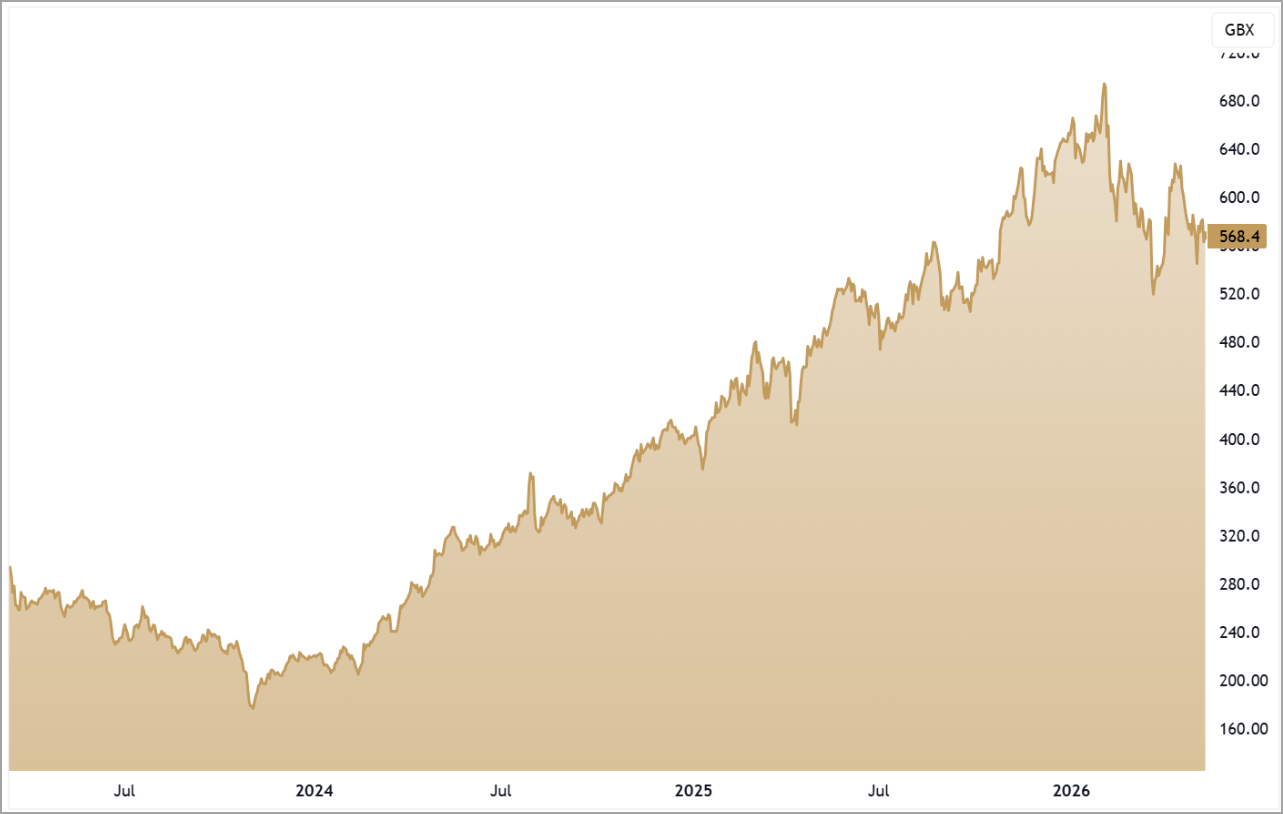
After a strong run through 2025, NatWest (NWG) has spent the past few months consolidating as sentiment towards UK financials has cooled. However, beneath the surface, the bank continues to generate substantial profits, grow shareholder returns and trade on a valuation that still looks surprisingly modest for the quality of earnings now being delivered. For us, this increasingly looks like one of the more attractive income plays in the FTSE 100.
A Simpler Bank Generating Serious Cash
NatWest today is a very different business from the one many investors still associate with the post financial crisis years. The group has spent the last decade simplifying operations, strengthening the balance sheet and refocusing on its core UK retail and commercial banking operations. That process is now feeding through into stronger profitability and, more importantly, significantly higher shareholder returns.
The scale of the recovery has been impressive. Reported earnings per share increased from 52.1p in 2024 to 67.4p in 2025, while total dividends climbed from 21.5p to 32.5p over the same period. Forecasts suggest that progression is set to continue, with consensus expectations pointing towards dividends of 36p in 2026 and more than 40p in 2027.
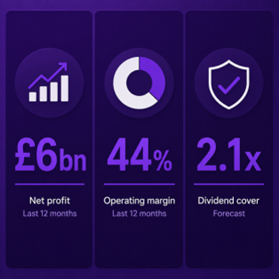
At current prices, the shares offer a forecast dividend yield of around 6.5%. Crucially, this does not look like a stretched yield propped up by weak fundamentals. Dividend cover remains healthy at just over 2x earnings, while the bank continues to generate substantial excess capital.
Alongside the dividend, NatWest has also been aggressively buying back shares. That matters because it steadily reduces the share count, helping earnings per share and future dividend capacity compound over time. In simple terms, management is increasingly returning surplus capital directly back to shareholders rather than allowing it to sit idle on the balance sheet.
Profitability Continues to Improve
One of the biggest misconceptions around UK banks is that profitability is purely a short-term function of interest rates. While higher rates have clearly supported margins across the sector, NatWest’s recovery has been driven by far more than that alone.
Operationally, the business looks far cleaner than it did several years ago. Costs have been better controlled, margins have improved and returns on equity have strengthened materially. The group generated almost £6bn in net profit over the last twelve months, with operating margins now sitting above 44%.
The latest trading update reinforced that broader trend. Income remained resilient, profitability stayed strong and management reiterated confidence in the outlook for 2026. Meanwhile, analyst forecasts for future earnings and dividends have continued to edge higher over recent months.
What makes the setup particularly interesting is that the valuation still feels anchored to an older perception of NatWest rather than the business it has become today. The market still tends to view UK banks with a degree of scepticism, even as balance sheets, capital levels and shareholder returns have improved materially across the sector.
That disconnect is where the opportunity may sit. We are looking at a business generating strong profitability, returning large amounts of capital to shareholders and still trading on less than 8x forward earnings.
Valuation Still Looks Undemanding
Despite the recovery in profitability, NatWest still trades close to book value and on a forward PE ratio of around 7.7x. That remains relatively modest for a business now generating double-digit returns on equity and rapidly growing shareholder distributions.
This is where the investment case becomes compelling from an income perspective. We are not relying on aggressive multiple expansion or a speculative growth narrative. Instead, the attraction comes from being paid a sizeable and growing income stream while holding a business that still appears conservatively valued.
Importantly, the dividend profile also looks increasingly dependable. The next dividend payment is due in early May, with a further interim dividend expected later in the year. Combined with ongoing buybacks, NatWest continues to stand out as one of the FTSE 100’s strongest total shareholder return stories.
Of course, UK banks will always remain sensitive to the broader economic backdrop and sentiment can shift quickly. However, the current valuation already appears to reflect a fair amount of caution, despite the substantial improvement in profitability and capital returns over recent years.
Technical Analysis: Consolidation Rather Than Breakdown
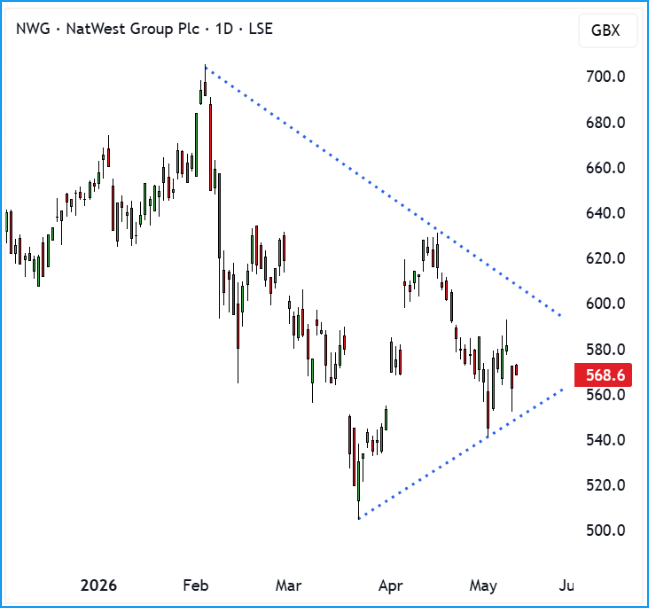
From a technical perspective, the shares have spent the past few months consolidating following a strong rally during 2025. After peaking earlier this year, the shares have pulled back through a series of lower swing highs, leaving the stock around 20% below its trend peak.
However, the recent price action is beginning to suggest this may be developing into a broader consolidation pattern rather than a complete breakdown in trend. The shares have started to form higher swing lows while resistance continues to drift lower, creating what increasingly resembles a long-term wedge or triangle formation.
This type of structure is often seen after strong advances, where momentum cools and positioning resets before the market decides on the next longer-term direction. For income-focused investors, periods like this can provide a more measured environment for building positions, particularly when the underlying fundamentals and shareholder returns remain supportive.
Five Key Takeaways
1. High income: NatWest offers a forecast dividend yield of around 6.5%.
2. Growing payouts: dividends and buybacks continue to accelerate shareholder returns.
3. Profit recovery: earnings and profitability have improved sharply in recent years.
4. Modest valuation: the shares still trade on less than 8x forward earnings.
5. Trend support: the longer-term recovery structure remains broadly intact.
NWG 3-Year Chart
Disclaimer:
All content is provided for general information only and should not be construed as any form of advice or personal recommendation. The provision of this content is not regulated by the Financial Conduct Authority.