


30th Sep 2026. 9.00am

Regency View:
BUY Hilton Food Group (HFG)
- Income

Regency View:
BUY Hilton Food Group (HFG)
Hilton Food Group: Investment Starts to Bear Fruit
Hilton Food Group (HFG) has spent the past few years putting significant amounts of capital behind the next stage of its growth, and we are now approaching the point where some of that investment should start contributing to earnings.
That makes the timing particularly interesting. September’s interim results brought an upgrade to full-year profit expectations, the core meat and fresh prepared food operations are performing well, and two major expansion projects are due to begin contributing from 2027. Yet despite a strong recent run in the shares, the valuation remains reasonable and the prospective dividend yield sits above 5%.
There are still a few moving parts within the business, particularly in seafood, while this year’s investment programme will keep pressure on cash flow and debt. Look beyond the current investment peak, however, and Hilton is beginning to offer an appealing combination of earnings growth, income and improving returns from capital already committed.
A much bigger food business than it first appears
Hilton has grown from its roots as a meat processor into an international food manufacturing business operating 21 facilities, including joint ventures, and serving customers across 21 markets. Its model is built around long-term partnerships with major grocery retailers, supplying meat alongside a growing range of fresh prepared foods and other products.
This isn’t a high-margin business, but that’s slightly beside the point. Hilton’s attraction comes from putting large, efficient facilities alongside major customers and processing substantial volumes through them over long periods. Those relationships create a degree of visibility that is unusual for a food manufacturer, while Hilton can take the same expertise into new markets as its retail partners expand.
The first half demonstrated some of that resilience. Volumes from continuing operations increased 2.1%, with growth across both the East and West regions, while revenue rose 11.5% at constant currency as higher raw material prices fed through. Core meat and fresh prepared food delivered higher adjusted profit, although weakness in seafood meant adjusted profit before tax from continuing operations fell 8.9% at constant currency to £32.8m.
That mixed picture is important because it stops us treating September’s upgrade as evidence that everything is suddenly firing at once. It isn’t. Instead, the stronger parts of Hilton are increasingly carrying a business that still has a few areas requiring work.
The next phase is getting closer
Where the story becomes more interesting is what Hilton has been building alongside its existing operations.
Its Saudi Arabian joint venture is expected to become operational during the fourth quarter of this year, while the new Canadian facility remains on track for launch in January 2027. Both are expected to start contributing to earnings next year, which gives us a reasonably clear bridge between the investment being made today and the additional earnings capacity that should follow.
There could be more behind them. Hilton is scoping an expansion of its Polish operations, where customer demand suggests the eventual project could be larger than originally envisaged. Fresh prepared food has already become an important growth area for the group, so this isn’t simply expansion for expansion’s sake; Hilton is putting additional capacity into parts of the business where it is seeing demand from established customers.
This creates an unusual point in the investment cycle. Capital expenditure is expected to reach around £100m this year, including the final year of material spending on Canada, while significant expenditure on Poland isn’t expected until 2027. The benefits from Canada and Saudi Arabia should therefore begin arriving as the largest part of the Canadian build moves behind the group.
Management’s medium-term ambitions are relatively measured, targeting mid-single-digit operating profit growth, average cash conversion of around 100% and average return on capital employed above 20%. If Hilton can get close to those targets, the current period of elevated investment should look rather different with hindsight.
Looking through the headline numbers
The September results need a little unpacking. Hilton increased its full-year adjusted profit before tax guidance from £60m–£65m to £66m–£71m, but the upgrade reflects the removal of losses from Dalco, which is being sold, together with favourable year-on-year currency movements. It would therefore be wrong to present the increase as being driven entirely by accelerating underlying trading.
There are nevertheless some encouraging developments underneath it. The core meat and fresh prepared food businesses increased adjusted profit during the first half, while management expects operational improvements and cost reductions at Seachill to help during the second half. The stubborn problem remains Foppen, where seafood margins have been under pressure and regulatory restrictions affecting exports from Greece to the US have contributed to exceptional costs.
Cash flow also deserves some context. Headline free cash flow was negative £39.7m during the first half as Hilton invested £45.3m in capital expenditure. Strip out investment in the Canadian and Saudi projects alongside the specified adjusting items, however, and adjusted free cash flow improved from a £30.8m outflow last year to a £10.4m inflow. Cash generated from operations also increased to £45.3m from £26.9m.
Net bank debt consequently increased to £194.4m from £126.7m at the end of 2025, but leverage remained at 1.4 times adjusted EBITDA, within Hilton’s 1–2 times target range. Management expects debt to rise further during the second half as investment continues and additional frozen inventory is purchased ahead of Christmas and Easter demand, although it still expects year-end leverage to remain comfortably within that range.
A valuation that leaves room for delivery
What makes this investment phase more attractive is that we aren’t being asked to pay a particularly demanding price for the potential benefits.
At around 697p, Hilton trades on roughly 13 times forecast earnings, while the prospective dividend yield is a little above 5%. Earnings forecasts have also been moving higher following September’s update, giving us the combination we generally prefer to see: expectations improving without the valuation becoming stretched.
The dividend provides a useful additional return while the growth projects mature. Hilton has maintained a progressive dividend policy since flotation, although the interim payment was held at 10.1p this year given lower first-half adjusted earnings. That feels sensible while capital expenditure remains elevated rather than an indication that income has become the overriding priority.
There are clear risks. Seafood needs fixing, raw material prices remain high, debt is elevated compared with the end of last year and the Canadian and Saudi investments now have to deliver the returns expected of them. Poland will also require further capital if the expansion proceeds.
The balance of the story is nevertheless beginning to change. Hilton has already committed much of the capital required for its next two growth projects, its stronger core operations continue to expand, profit expectations have moved higher and the first earnings contributions from that investment are approaching. At the current valuation, we think that gives investors a good opportunity to participate as Hilton moves from building additional capacity towards putting more of it to work.
Technical picture
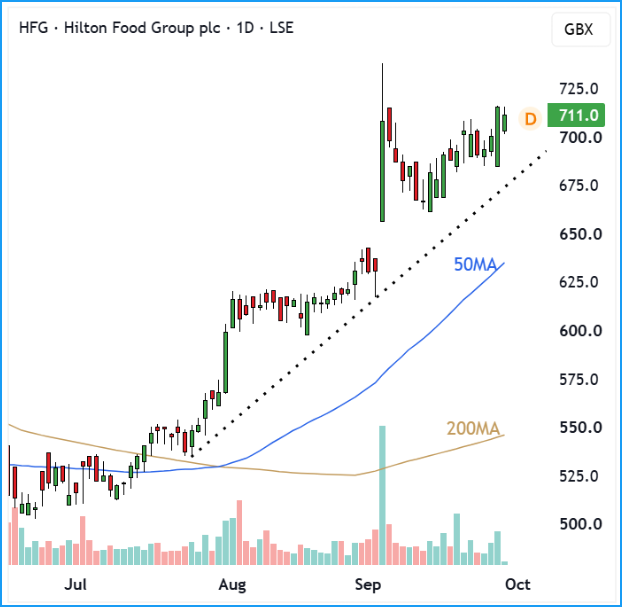
The market has already started to recognise the change. Hilton spent much of the first half building a broad base around 500p–550p before breaking above its 200-day moving average during the summer. Momentum accelerated in August as the shares pushed through 600p, before September’s results triggered a gap higher towards 700p.
What has happened since is encouraging. Rather than immediately giving back the results-day move, the shares have consolidated largely between the high-660s and low-700s and are currently around 697p. The price is some distance above its rising 200-day moving average, so some short-term consolidation would be perfectly normal, but the willingness of buyers to hold the bulk of September’s gap suggests the market is accepting the improved earnings outlook rather than treating the initial reaction as a temporary spike.
Five key takeaways
1. Investment is approaching the payoff stage: Canada is scheduled to launch in January 2027 and the Saudi Arabian joint venture in Q4 2026, with both expected to contribute to earnings next year.
2. The core business remains resilient: Volumes increased in the first half and core meat and fresh prepared food generated higher adjusted profit despite continued seafood weakness.
3. Expectations are moving higher: Full-year adjusted PBT guidance has increased to £66m–£71m, although Dalco and favourable currency movements account for part of that upgrade.
4. Cash flow should be viewed alongside expansion spending: Headline free cash flow remains under pressure, but adjusted free cash flow excluding the major Canada and Saudi investments improved considerably.
5. The valuation remains reasonable: At roughly 13 times forecast earnings with a prospective yield above 5%, there is still room for the shares to respond if Hilton converts its recent investment into stronger earnings and cash generation.
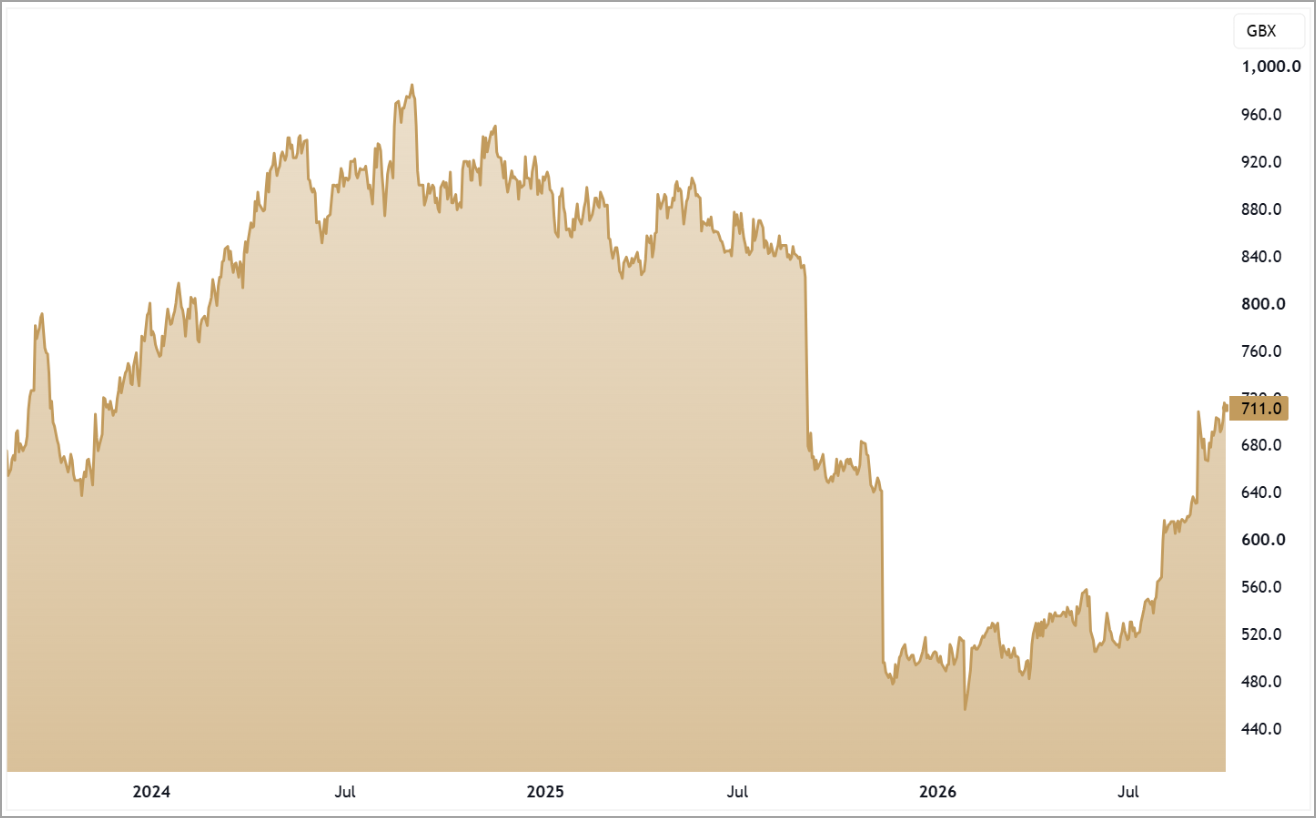
HFG 3-Year Candle Chart
Disclaimer:
All content is provided for general information only and should not be construed as any form of advice or personal recommendation. The provision of this content is not regulated by the Financial Conduct Authority.