


19th Aug 2026. 9.03am
Regency View:
BUY GSK (GSK)
- Value

Regency View:
BUY GSK (GSK)
Looking Beyond The Headlines
When a company reports a 69% decline in earnings per share, investors rarely look much further. In GSK’s case, that reaction risks missing what was actually a strong set of underlying results. While accounting charges dominated the headlines, the business itself continues to move in the right direction, with improving product mix, accelerating investment in its pipeline and management quietly becoming more confident about the year ahead.
After several months of share price weakness, the valuation has become increasingly difficult to ignore. Trading on less than 10 times forward earnings while offering a dividend yield above 4%, GSK now combines defensive characteristics with improving operational momentum. For long-term investors, that combination is becoming increasingly attractive.
The underlying business continues to strengthen
The first thing investors needed to separate from the latest results was accounting noise from operational performance.
Reported operating profit fell 75% during the second quarter, while statutory earnings per share declined by 69%. Those figures look alarming in isolation, but they were largely driven by a £1.3 billion impairment relating to camlipixant after management decided to discontinue its development, together with other one-off charges.
Strip those items out and a very different picture emerges.
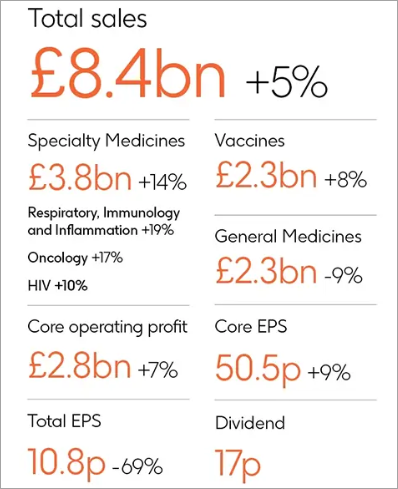
Revenue increased 5% to £8.4 billion, while core operating profit rose 7% and core earnings per share increased 9%. Free cash flow almost doubled to £2.0 billion during the quarter, highlighting the cash-generating strength of the underlying business.
Perhaps more importantly, growth is increasingly being driven by the parts of GSK that management has spent several years investing in. Specialty Medicines delivered another strong performance, with sales rising 14%, while Oncology grew 17% and Respiratory, Immunology & Inflammation increased 19%. Vaccines also continued to perform well, growing 8%, more than offsetting the ongoing decline across the older General Medicines portfolio.
That changing product mix is important. Rather than relying on ageing blockbuster drugs, GSK is steadily becoming a business driven by higher-growth speciality medicines, oncology treatments and vaccines.
Investing for the next decade
While the financial performance was encouraging, one of the most significant announcements arguably received the least attention.
Management unveiled its new “Accelerate Growth” programme, targeting £1.9 billion of annual cost savings by 2029. Importantly, this is not simply another cost-cutting exercise designed to boost margins. The majority of those savings will be reinvested into research and development and expanding the late-stage pipeline.
That confidence is reflected elsewhere.
Earlier this year, GSK expected around ten Phase III clinical trial starts during 2026. It now expects more than twenty, following the acceleration of seven late-stage assets across eighteen separate indications. At the same time, the company announced plans to establish a new flagship R&D centre on the Cambridge Biomedical Campus, reinforcing its long-term commitment to innovation.
The pipeline remains broad, spanning oncology, respiratory medicine, vaccines and liver disease, giving investors multiple opportunities for future growth rather than relying on a single breakthrough product.
Guidance edges higher
Management technically left full-year guidance unchanged, but the wording became noticeably more optimistic.
Revenue is still expected to grow between 3% and 5% this year, although management now expects performance towards the upper half of that range. Core operating profit is also expected towards the upper end of previous guidance, while core earnings per share is forecast to increase between 7% and 9%.
That may appear a subtle change, but experienced investors know companies rarely become more specific unless trading is progressing well.
Meanwhile, shareholder returns remain well supported. The board declared a second-quarter dividend of 17p per share and completed its previously announced £2 billion share buyback programme, demonstrating continued confidence in both cash generation and the longer-term outlook.
Valuation leaves room for upside
One of the attractions of GSK today is that investors are no longer paying a premium valuation for a high-quality pharmaceutical business.
The shares trade on a forward price-to-earnings ratio of just 9.8 times, while offering a forecast dividend yield of around 4%. Consensus forecasts continue to point towards steady earnings growth over the next two years, with analysts expecting earnings per share of around 179p this year, rising to 194p next year.
Return on capital remains strong at over 16%, operating margins are close to 20%, and despite elevated net debt following acquisitions and shareholder distributions, cash generation continues to provide considerable financial flexibility.
For a global pharmaceutical company with multiple growth drivers and improving operational performance, those valuation metrics appear undemanding.
Technical picture
The technical picture has become increasingly interesting following several months of consolidation.
After surging sharply higher in February, the shares have spent much of the year correcting beneath a well-defined descending trendline, producing a series of lower highs. While that has kept the longer-term uptrend on hold, the decline has been measured rather than disorderly.
The recent pullback has now brought GSK back towards an important support zone between approximately 1,775p and 1,810p. This area has repeatedly attracted buyers throughout the year and represents one of the most significant technical levels on the chart. A successful defence would suggest the longer-term consolidation remains intact, while a decisive break beneath support would weaken the current setup.
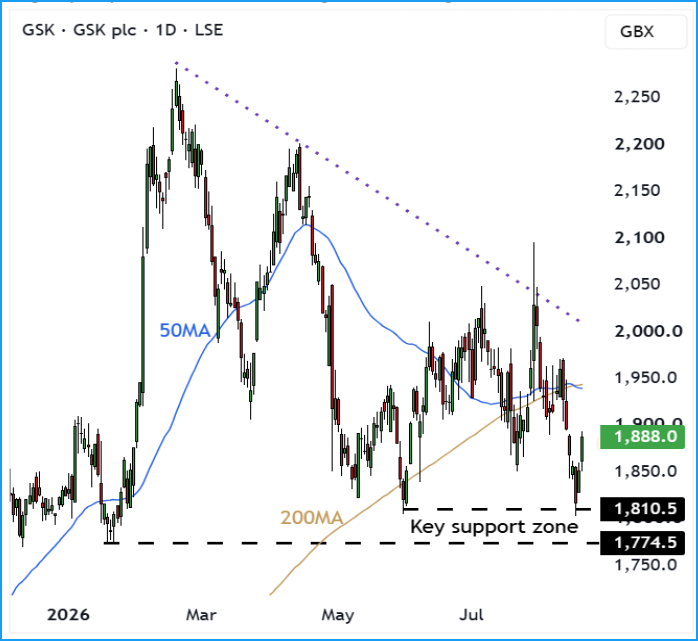
Encouragingly, the recent decline has already compressed much of the previous optimism from the share price. Should buyers begin to regain control, the initial objective would be a recovery towards the psychologically important 2,000p level, followed by a test of the falling trendline that has capped every rally since February. A break above that trendline would represent the first meaningful higher high for several months and could signal the beginning of a new medium-term advance.
Five key takeaways
1. Headline numbers flatter to deceive: Statutory earnings were hit by a £1.3 billion impairment, but core operating profit still increased 7% and core earnings per share rose 9%, highlighting continued operational strength.
2. Growth engines are gaining momentum: Specialty Medicines, Oncology and Vaccines continue to outpace the legacy portfolio, steadily improving the quality of GSK’s revenue base.
3. Pipeline investment is accelerating: Management has doubled its expected Phase III trial starts this year and launched a major programme to reinvest £1.9 billion of efficiency savings into future growth.
4. Valuation remains attractive: Trading on less than 10 times forward earnings with a forecast dividend yield above 4%, GSK offers an appealing combination of quality, income and reasonable valuation.
5. A key technical test is approaching: The shares are retesting a major support zone after a multi-month correction. If buyers successfully defend this area, the risk/reward profile could become increasingly attractive for long-term investors.
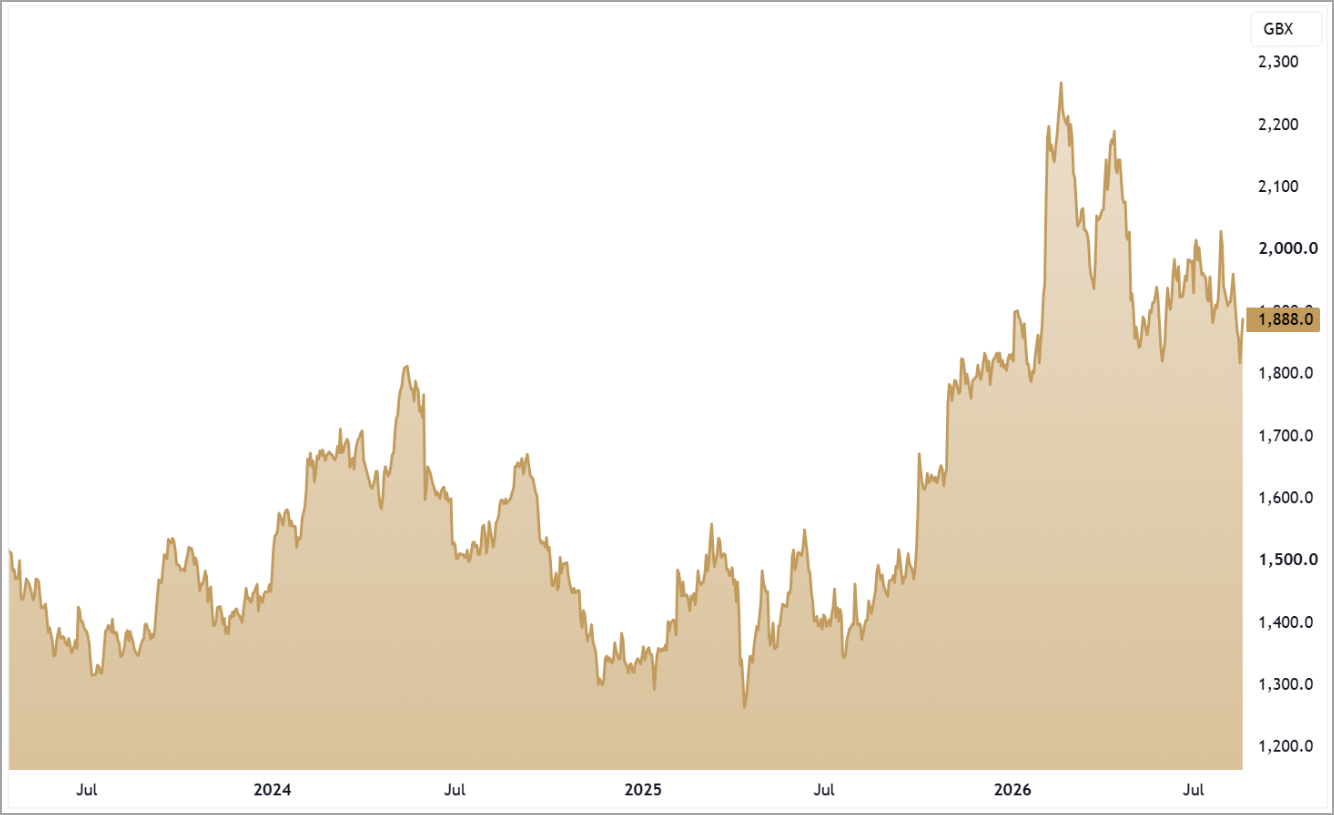
GSK 3-Year Chart
Disclaimer:
All content is provided for general information only and should not be construed as any form of advice or personal recommendation. The provision of this content is not regulated by the Financial Conduct Authority.