


2nd Sep 2026. 8.57am

Regency View:
BUY Drax (DRX) Second Tranche
- Income

Regency View:
BUY Drax (DRX) Second Tranche
Dividend Growth Meets a New Growth Phase
We first recommended Drax back in 2024, when the investment case centred on a highly cash-generative power business whose importance to the UK’s energy system was not, in our view, being fully reflected in the valuation. For newer members who joined us after that recommendation, Drax has subsequently developed into a rather broader business, and we think the latest changes are significant enough to justify adding a second tranche to our position.
The timing also looks increasingly attractive. July’s half-year results were underwhelming at first glance, but beneath the weaker headline numbers Drax is investing heavily in its next phase of growth, while continuing to increase the dividend. With the shares now showing the first convincing signs that their recent correction has run its course, we believe the balance between income, growth and improving price momentum has become considerably more attractive.
Looking beyond the headline numbers
There is no point pretending July’s headline numbers were particularly exciting.
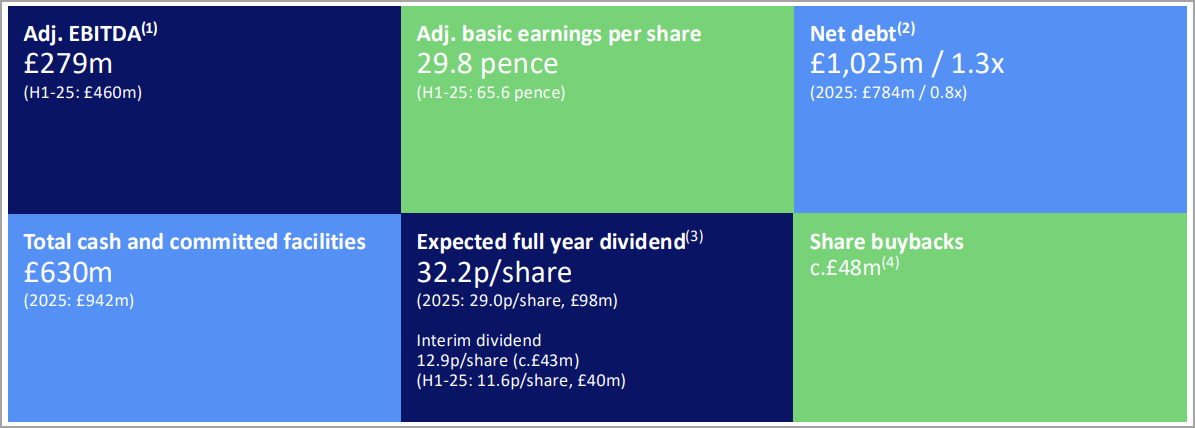
Adjusted EBITDA fell from £460m to £279m during the first half, while adjusted earnings per share declined from 65.6p to 29.8p. Cash generated from operations also fell sharply, from £378m to £79m.
The largest decline came from Biomass Generation, where adjusted EBITDA fell from £332m to £159m. Lower achieved power prices were the main reason, alongside a planned maintenance outage. Importantly, generation itself was broadly stable at 7.0TWh compared with 7.1TWh a year earlier.
In other words, this wasn’t a case of Drax’s core assets suddenly becoming less productive. The business is cycling against the unusually favourable power-price environment of recent years.
Management continues to expect full-year adjusted EBITDA in line with market expectations, which stood at £665m shortly before the results.
We therefore think 2026 is better viewed as a transition year, particularly given how much is changing elsewhere in the group.
Drax H1 2026 Results
Dividend growth continues
One reason we’re comfortable looking beyond the weaker near-term earnings is that shareholders continue to receive an attractive and growing income along the way.
The interim dividend has been increased by 11% to 12.9p per share, with the shares due to trade ex-dividend on 24 September and payment following on 23 October. Management expects the full-year dividend to rise by the same percentage to 32.2p.
At a share price around 800p, that represents a prospective yield of roughly 4%.
The yield alone isn’t what interests us, though. The consistency behind it is more impressive. This year is expected to mark Drax’s tenth consecutive year of dividend growth, with the annual increase averaging more than 11% over that period. Since 2017, the group has returned more than £1.2bn to shareholders through dividends and share buybacks.
That gives Drax an increasingly attractive combination. We’re receiving a meaningful income today while management invests in assets designed to broaden the earnings base over the coming years.
A much bigger business is taking shape
This is where our reason for adding a second tranche differs from the investment case we originally backed in 2024.
Drax is becoming much more than a biomass generation business.
The first of its new open-cycle gas turbine assets is operational, around 0.7GW of battery storage projects are being developed and the acquisition of Flexitricity has added trading and optimisation capabilities to the group.
The most significant development is the acquisition of Bluefield Solar Income Fund.
Bluefield adds around 0.9GW of operating and under-construction solar and onshore wind assets, alongside a development pipeline of approximately 2.9GW spanning solar and battery storage. Around 0.5GW of the solar portfolio benefits from long-term Contracts for Difference lasting between 15 and 20 years.
Put everything together and management believes Drax’s generation capacity could increase by approximately 85% compared with 2025.
That is a substantial change in scale, but diversification is arguably just as important. Biomass remains central to Drax, but future earnings should increasingly come from a broader collection of flexible and renewable generation assets.
The next phase starts from 2027
A lot of the investment being made today begins to bear fruit from 2027 onwards.
Around 0.7GW of battery storage developments are expected to start commissioning from 2027, while management is targeting more than £150m of annual structural cost savings compared with its 2024 cost base.
At the same time, the existing support arrangements for Drax Power Station run until the end of March 2027, after which the new low-carbon dispatchable Contract for Difference begins.
Looking further ahead, management is targeting £650m to £800m of adjusted EBITDA in 2029 from Pellet Production, Biomass Generation, flexible generation and its battery developments once those assets are fully operational. Crucially, that target doesn’t include Bluefield or other potential investment opportunities.
There are further possibilities at the existing Drax site too. The group has 4GW of grid access at Selby and is exploring additional uses for that increasingly valuable connection, including an initial 100MW data centre development.
Not every opportunity will necessarily become a meaningful earnings contributor, but there are now far more potential growth levers than when we established our original position.
Keeping an eye on the balance sheet
Expansion on this scale isn’t free, and this is probably the area we’ll be watching most closely.
Net debt increased to £1.03bn at the half year, although leverage remained relatively modest at 1.3 times adjusted EBITDA. Drax also had £630m of cash and committed facilities available, while its credit ratings were reiterated following the Bluefield announcement.
Management has paused the remainder of its £450m share buyback programme while it assesses the balance-sheet impact of Bluefield and other investment opportunities.
We think that’s sensible. With a meaningful dividend already being paid, we’d rather see Drax retain sufficient financial flexibility to pursue attractive projects than stretch the balance sheet simply to complete a buyback.
Buyers are returning
The share price is also beginning to behave very differently.
After peaking above 900p in May, Drax entered a persistent correction characterised by a succession of lower highs. Rallies repeatedly stalled beneath a falling trendline, while the 50-day moving average gradually rolled over and became another barrier to recovery.
The first meaningful change came in August.
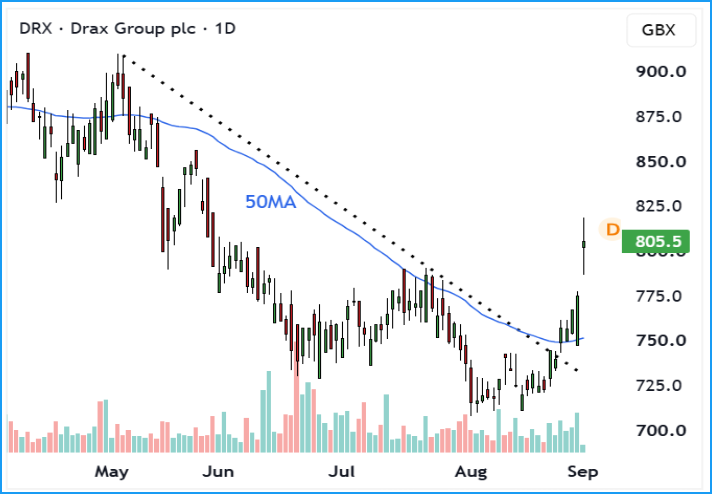
After finding support around 715p, the shares stopped making fresh lows and began to form a base. They subsequently broke through the descending trendline before reclaiming the 50-day moving average.
More importantly, the latest advance has carried the shares above the cluster of July and August swing highs around 775p to 790p. That breaks the sequence of lower highs that had defined the correction since May and provides the first credible evidence that buyers are regaining control.
There is still resistance nearby, with the 200-day moving average sitting around 820p. But rather than trying to catch a falling share price, we’re now adding after seeing evidence that the underlying price structure has begun to improve.
Five key takeaways
1. Dividend growth continues: The interim dividend has increased 11% to 12.9p, while management expects the full-year payout to rise by the same amount to 32.2p, equivalent to a prospective yield of around 4% at current prices.
2. The business is becoming more diversified: Batteries, flexible generation, Flexitricity and the Bluefield portfolio are steadily broadening Drax beyond its traditional biomass operations.
3. A new growth phase is approaching: New battery capacity begins commissioning from 2027, while management is targeting £650m to £800m of adjusted EBITDA from its existing growth programme by 2029.
4. The balance sheet remains manageable: Net debt has increased as Drax invests, but leverage of 1.3 times adjusted EBITDA leaves the group below its long-term target of around two times.
5. Second tranche buy: Having originally recommended Drax in 2024, we believe the combination of a growing dividend, an expanding generation portfolio and the first meaningful break in the recent downtrend provides a good opportunity to increase our position.
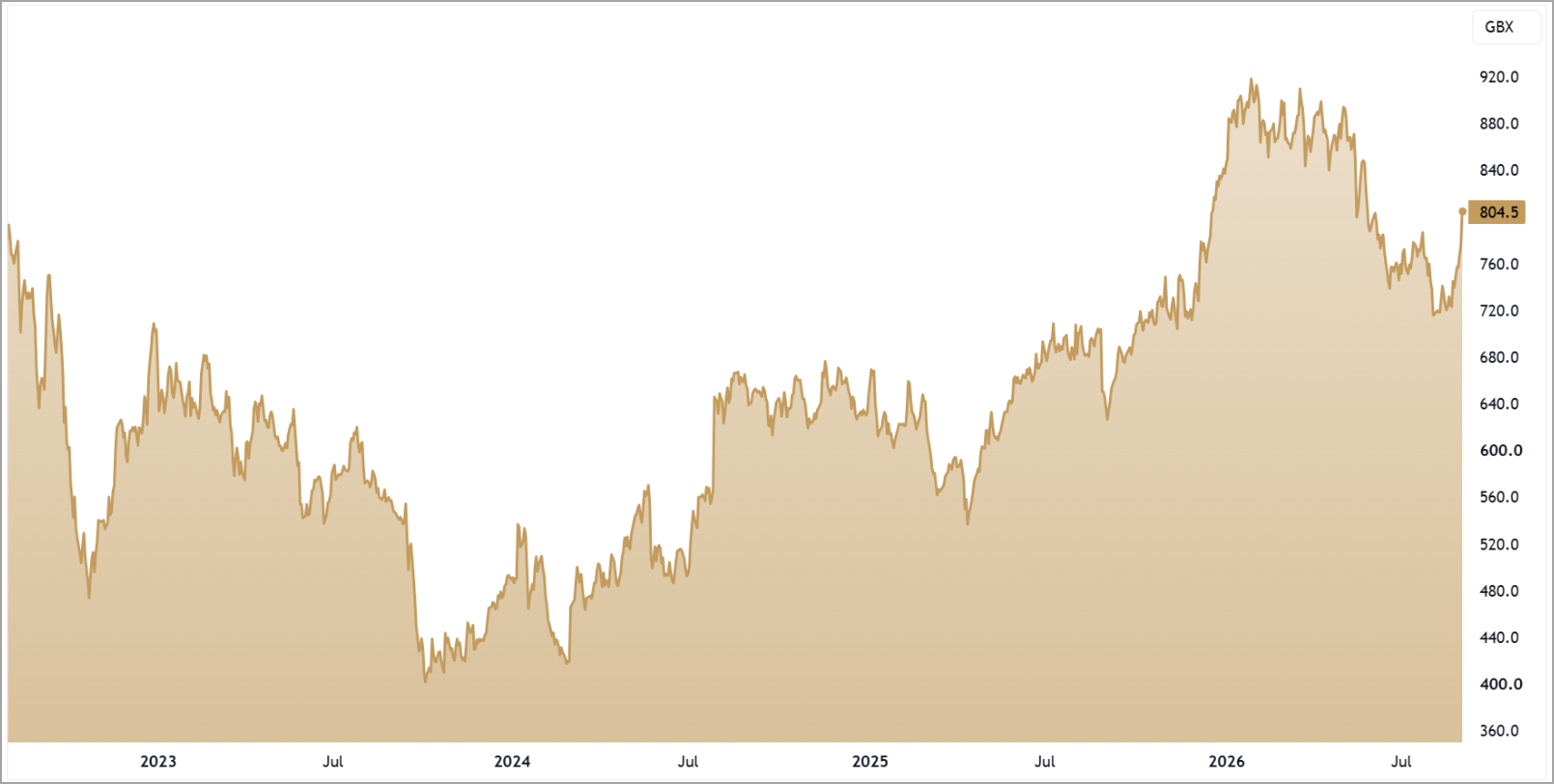
DRX 3-Year Chart
Disclaimer:
All content is provided for general information only and should not be construed as any form of advice or personal recommendation. The provision of this content is not regulated by the Financial Conduct Authority.