


5th Aug 2026. 9.02am

Regency View:
BUY Bloomsbury Publishing (BMY)
- Growth

Regency View:
BUY Bloomsbury Publishing (BMY)
The Growing Value of Ideas
One of the biggest beneficiaries of AI may not be an AI company at all.
It may be the businesses that already own vast libraries of trusted, copyrighted content.
That is becoming an increasingly interesting position for Bloomsbury. Best known as the publisher of Harry Potter, the business has quietly evolved into something much broader: an owner of intellectual property whose value extends well beyond selling books. Recent trading updates continue to point towards another record year, but it is the changing economics of content ownership that make the longer-term investment case particularly compelling.
Following another encouraging update in July, we believe now is an appropriate opportunity to add a second tranche to our position.
More than a publisher
Many investors still think of Bloomsbury primarily as a consumer book publisher. In reality, the business looks very different today.
The transformation has been deliberate. Alongside its well-known fiction and non-fiction catalogue, Bloomsbury has spent years expanding its Academic & Professional division, building a portfolio of digital resources, academic journals and specialist publications used by universities, researchers and professionals around the world.
That shift has changed the quality of the business.
Academic publishing brings recurring revenues, high customer retention and significantly greater earnings visibility than traditional retail publishing. It also makes the company less dependent on producing a blockbuster bestseller every year.
Consumer publishing still provides meaningful growth opportunities, but it now sits alongside a much steadier stream of recurring income. The result is a business that has become considerably more resilient than many investors perhaps appreciate.
Why AI changes the investment case
The market has understandably focused on Bloomsbury’s latest AI licensing agreements and last month’s Anthropic settlement.
We think the bigger story lies elsewhere.
For decades, publishers primarily monetised their intellectual property through physical books, ebooks, audiobooks, overseas rights and television or film adaptations. AI has now introduced another entirely legitimate commercial use for premium copyrighted content.
Earlier this year the company confirmed ongoing AI licensing revenue, while the approval of the $1.5 billion Anthropic settlement reinforced that copyrighted publishing catalogues carry tangible value within the emerging AI ecosystem. More than 14,000 Bloomsbury titles fall within the settlement, with payments expected to begin during the second half of the current financial year.
The settlement itself is unlikely to move the needle financially. However, it establishes something potentially far more important.
High-quality intellectual property is becoming more valuable, not less.
As AI models increasingly require trusted, professionally produced content, publishers that own extensive back catalogues may find themselves benefiting from revenue streams that barely existed a few years ago. We still view this as an emerging opportunity rather than a core earnings driver, but it adds another layer to an already attractive business model.
The pipeline remains healthy
The long-term opportunity would matter far less if the core publishing business were slowing.
Instead, the opposite appears to be happening.
In its July AGM trading update, management reiterated confidence in delivering record adjusted profit this year, supported by another strong publishing schedule. New releases from Sarah J. Maas, Katherine Rundell, Samantha Shannon, Dan Jones and Peter Frankopan provide a healthy line-up through the remainder of the financial year.
Perhaps even more interesting is the upcoming HBO adaptation of Harry Potter.
Successful television and film adaptations rarely benefit only new releases. They often reignite demand across entire back catalogues as new audiences discover original works. Predicting the precise commercial impact is impossible, but the franchise has repeatedly demonstrated remarkable longevity over the past three decades.
Alongside this, management confirmed that the Academic & Professional division continues to deliver underlying growth across all territories, excluding AI licensing revenue. That gives further confidence that earnings growth is being supported by multiple parts of the business rather than relying on a single catalyst.
Capital allocation continues to impress
High-quality businesses tend to create options.
Bloomsbury finished the last financial year with net cash of £29.2 million, leaving considerable flexibility to continue investing while pursuing selective acquisitions that strengthen its publishing portfolio.
Management’s capital allocation priorities remain refreshingly consistent. Organic investment comes first, followed by reducing borrowing where appropriate, maintaining a progressive dividend and acquiring complementary publishing assets when attractive opportunities emerge.
That discipline has been a feature of the business for many years.
The balance sheet also provides resilience should publishing markets become more challenging. Rather than needing to preserve cash, Bloomsbury retains the flexibility to continue investing when weaker competitors may be forced to retrench.
The market is digesting good news
The defining move in Bloomsbury’s chart came back in March.
Shares surged after management upgraded profit expectations, driven by an exceptional publishing schedule that included two new Sarah J. Maas releases arriving within just 11 weeks of each other. That announcement fundamentally changed investors’ expectations and triggered a powerful repricing of the business.
Since then, the trend has remained firmly higher, but the pace has understandably slowed.
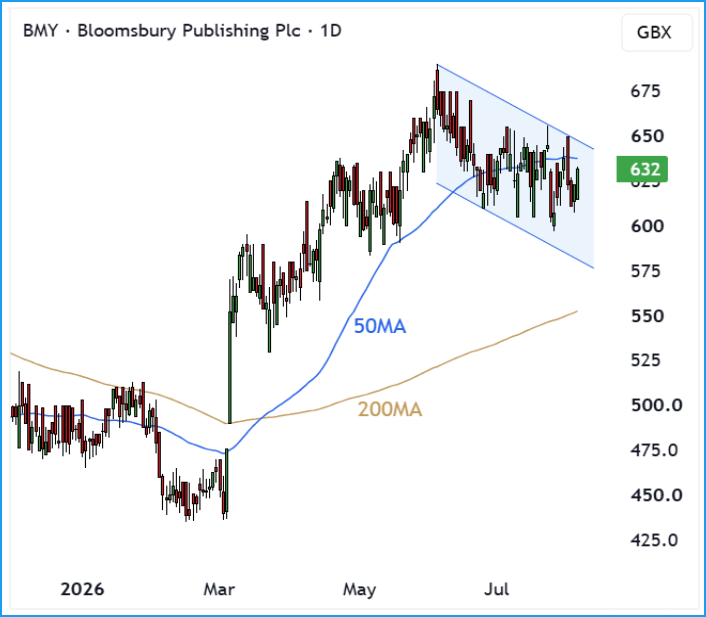
Rather than giving back those gains, the shares have spent the past couple of months consolidating in a shallow downward-sloping channel around the rising 50-day moving average. From a technical perspective, this resembles a classic bull flag, where a strong advance is followed by an orderly period of consolidation as buyers and sellers temporarily reach equilibrium.
Importantly, the longer-term trend remains intact. The shares continue to trade comfortably above the rising 200-day moving average, while the recent pullback has been relatively modest given the strength of the preceding rally.
Periods like this often serve an important purpose. They allow the market to absorb earlier gains, reset sentiment and provide the opportunity for longer-term moving averages to catch up with price. If Bloomsbury continues to deliver on the operational progress outlined in recent trading updates, this consolidation could prove to be another stepping stone within the broader uptrend rather than the start of a reversal.
Five key takeaways
1. Higher-quality earnings: Bloomsbury’s Academic & Professional division now provides a growing stream of recurring revenue, making the business less reliant on individual bestseller releases.
2. AI adds a new growth driver: AI licensing agreements and the Anthropic settlement demonstrate that Bloomsbury’s extensive catalogue is becoming more valuable through entirely new monetisation channels.
3. Multiple catalysts ahead: A strong publishing pipeline, continued academic growth and the launch of HBO’s Harry Potter series provide several opportunities to support earnings over the coming year.
4. Strong balance sheet: A net cash position of £29.2 million gives management the flexibility to invest, pursue bolt-on acquisitions and continue growing shareholder returns.
5. A high-quality business at a reasonable price: Trading on around 14x forward earnings despite double-digit forecast EPS growth, Bloomsbury offers an attractive combination of quality, financial strength and long-term growth potential.
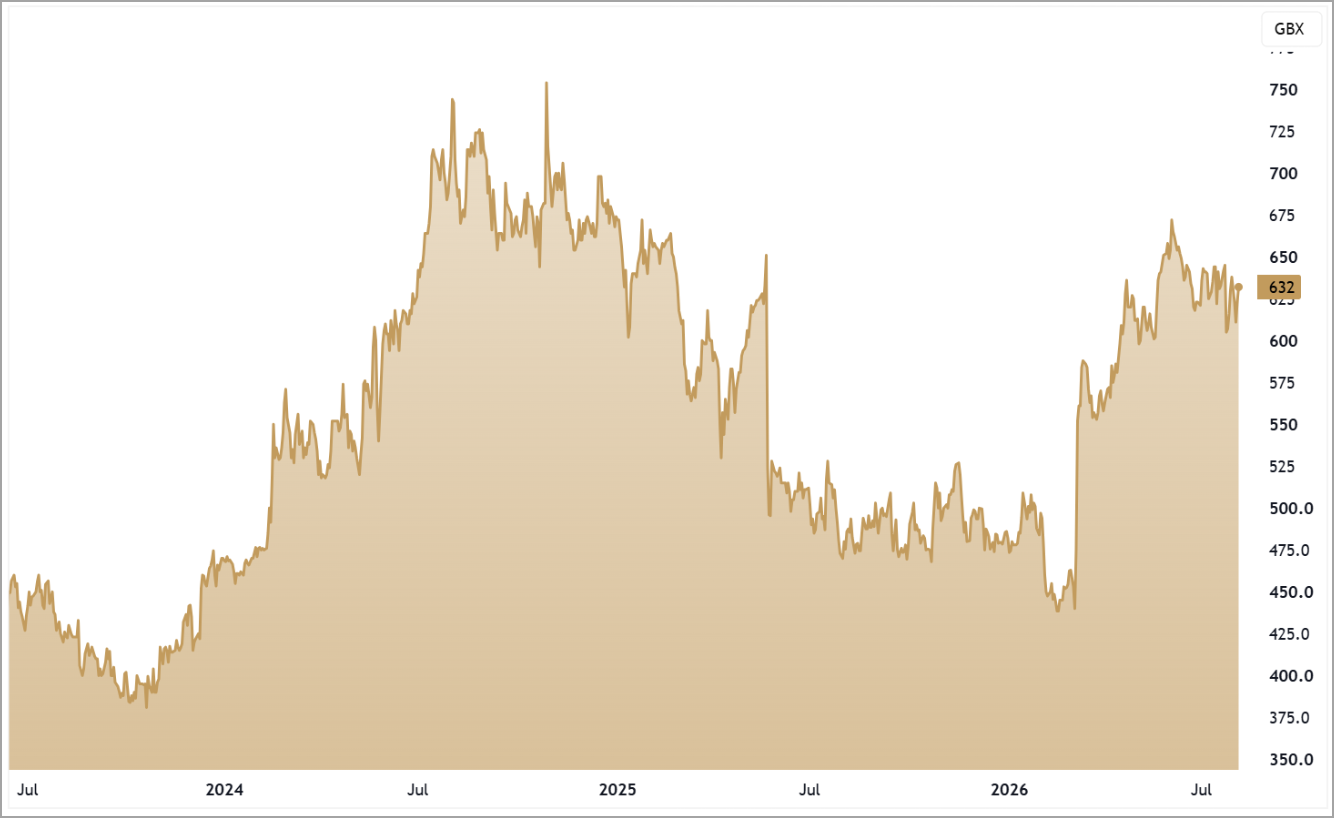
BMY 3-Year Chart
Disclaimer:
All content is provided for general information only and should not be construed as any form of advice or personal recommendation. The provision of this content is not regulated by the Financial Conduct Authority.