


2nd Oct 2025. 9.07am

Regency View:
Update
Regency View:
Update
After a strong run of upbeat AIM Investor updates, this week takes on a more sobering tone as several stocks slipped on weaker results, cautious outlooks and reporting uncertainty. Profit warnings and regional slowdowns served as a reminder of the risks that come with AIM investing, yet the period also brought bright spots, with a handful of companies delivering strategic wins and resilient financials that point to longer-term opportunity.
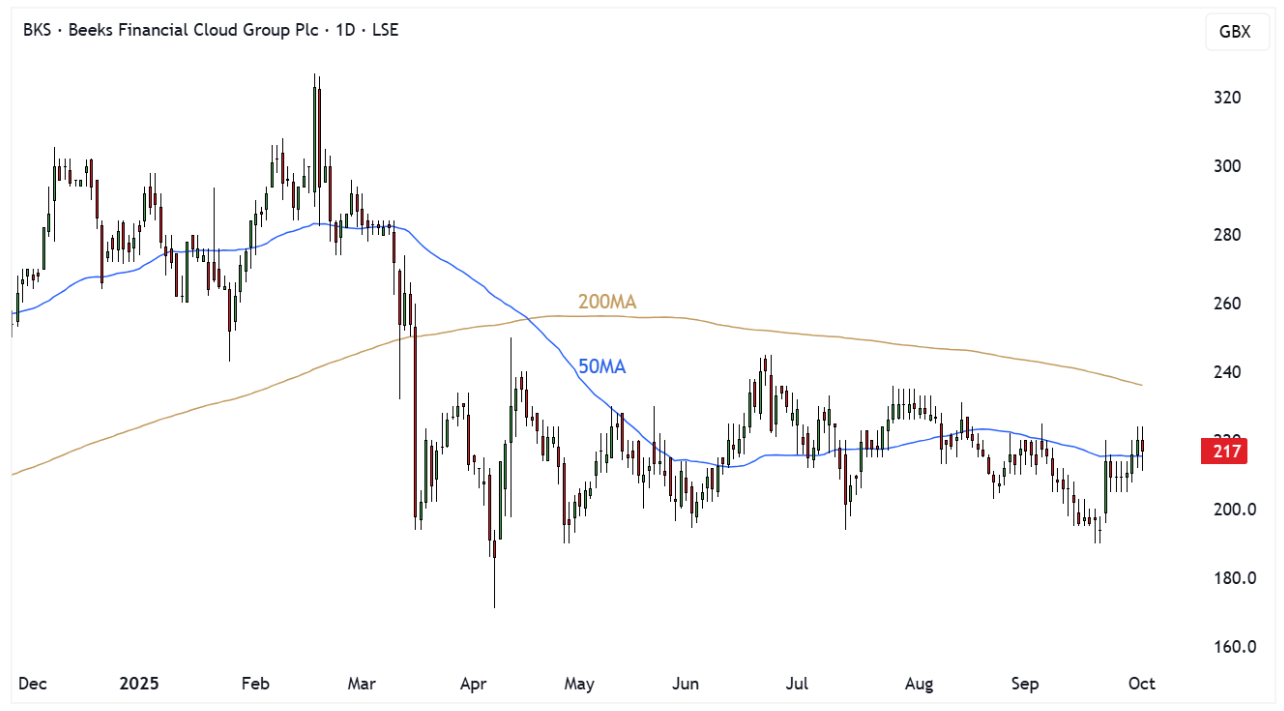
Beeks Financial rides higher on TMX deal
Beeks Financial (BKS) saw its shares rally after announcing a landmark partnership with TMX Datalinx, the data arm of TMX Group which owns the Toronto Stock Exchange. Under the agreement, TMX will launch its new Elastic Market Access service using Beeks’ Exchange Cloud infrastructure, giving Canadian and global clients secure, scalable and low-latency access to trading systems. It represents a further expansion of Beeks’ footprint into exchange-level infrastructure, a niche where it is building a strong competitive moat.
The financials of the agreement are structured as a revenue-share model, with recognition expected from early 2026. While that means near-term numbers remain unchanged, investors were quick to appreciate the longer-term implications. Adding TMX to the roster reinforces confidence that Beeks’ Exchange Cloud is becoming a preferred solution for leading financial exchanges, offering recurring multi-year revenues at high margins.

From an investment perspective, the deal strengthens the case that Beeks is not just another cloud provider but a strategically important infrastructure partner. As recurring revenue continues to dominate the mix, the business model is becoming more predictable, and each new exchange win increases the likelihood of further re-ratings by the market.
BKS Daily Candle Chart
Billington faces profit squeeze
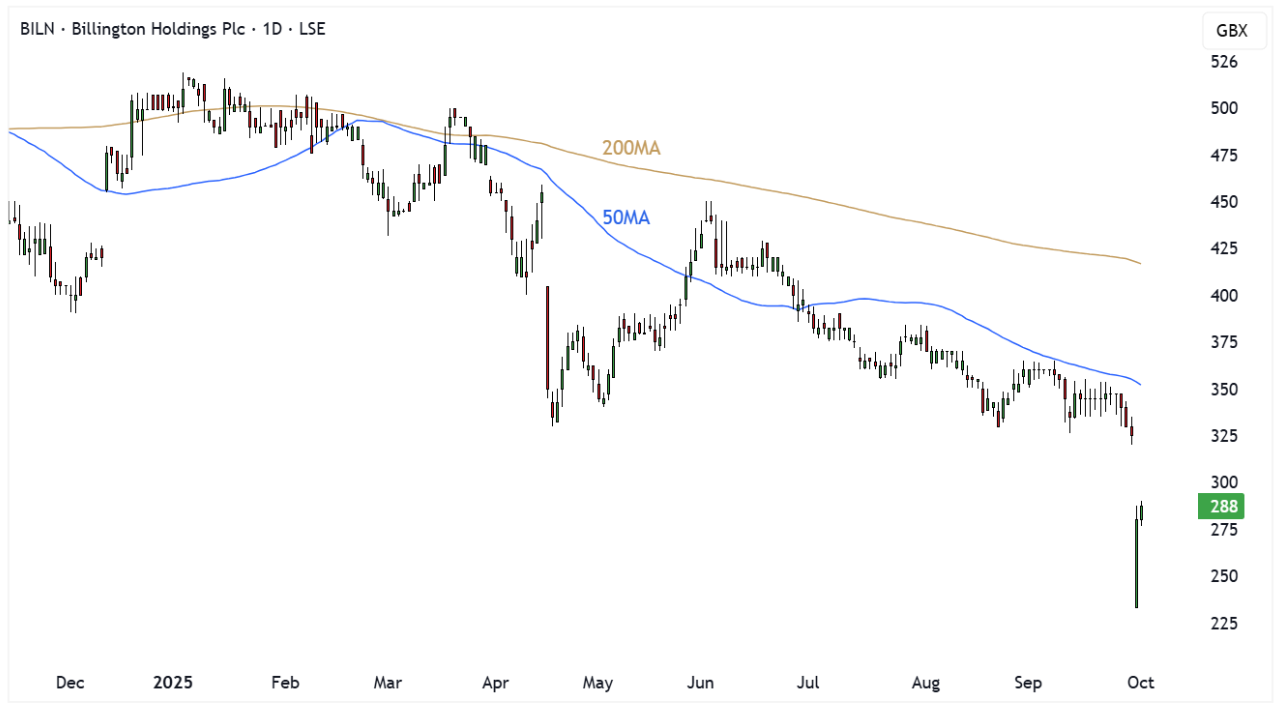
Billington (BILN) reported a disappointing set of interim results that sent the shares lower. Revenue dropped 28% to £41.8m, while profit before tax fell 64% to just £1.7m. Management explained the decline was due to client-led project delays and a higher mix of labour-intensive contracts, which delayed profit recognition. After a strong 2024, the shift in contract profile exposed the group to weaker margins, even though output actually rose.
Looking ahead, Billington admitted that full-year 2025 results will undershoot expectations. However, management pointed to a “very healthy” order book stretching into 2026, with an emphasis on productive hours rather than steel tonnage. Cash balances remain strong at £18.7m, underlining the financial resilience of the group even as reported profits stumble. The market reaction reflected the frustration that good operational execution is not translating into short-term earnings.

For shareholders, the key takeaway is that Billington remains fundamentally sound but faces a tougher near-term market. The shares could stay under pressure until clearer evidence of margin recovery emerges. However, for longer-term investors, the combination of a strong balance sheet, proven track record and a growing contracted pipeline leaves the business well placed to benefit when sector confidence returns.
BILN Daily Candle Chart
Ebiquity struggles with US slowdown
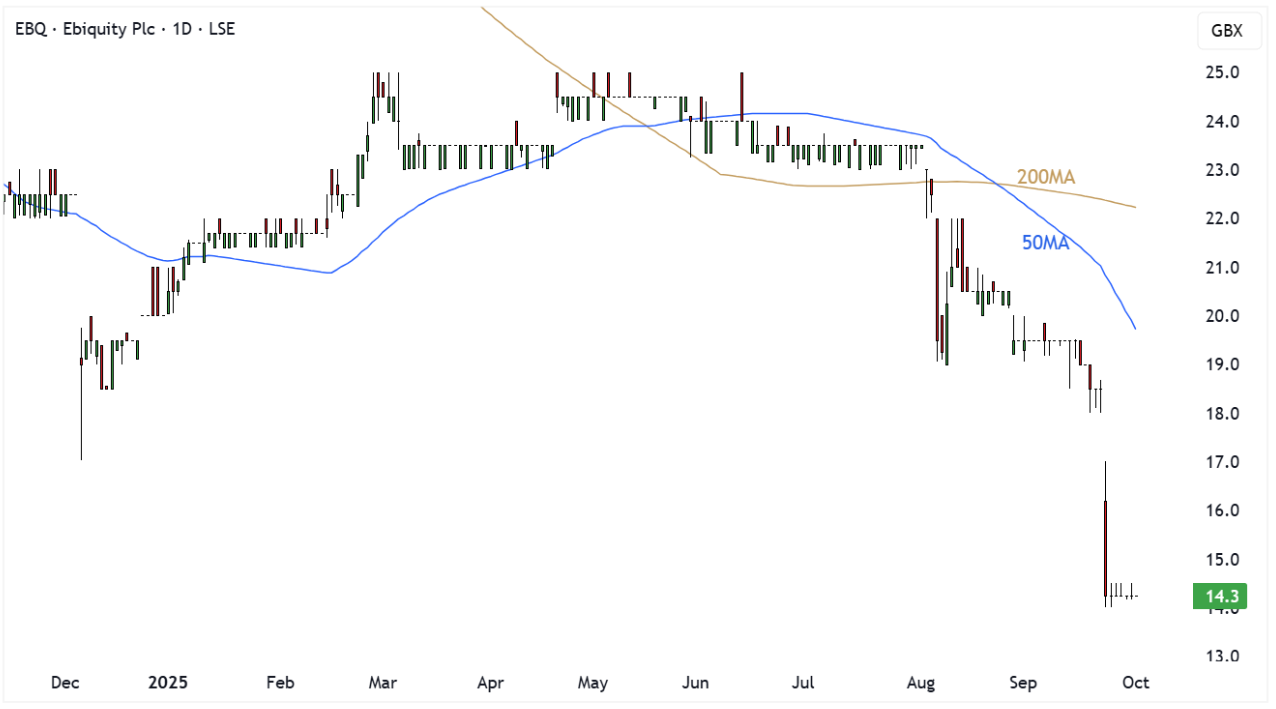
Ebiquity (EBQ) issued a trading update that revealed persistent weakness in its North American business, which offset strength elsewhere. Around 85% of group revenues come from global operations outside the US, where growth has been solid, particularly in Marketing Effectiveness and Contract Compliance services. But in the US, macro uncertainty has caused client spending to slow and delayed decision-making, leading to a flat revenue outlook for the year at £75m.
To address the issue, management has reshaped its North American leadership team and introduced targeted cost savings to protect profitability. Adjusted operating profit is now expected to come in around £5.5m, supported by efficiency gains, and the company highlighted a comfortable liquidity position with £8.9m cash and £11m undrawn facilities at June. While the fundamentals remain secure, the drag from the US business continues to weigh on overall performance.
For investors, the frustration lies in the fact that strong growth in core global markets is being overshadowed by a single geography. The group’s differentiated positioning, deep expertise and unique data assets remain valuable, but the timeline for recovery depends on stabilisation in the US market. Until that happens, the shares may struggle to build momentum.
EBQ Daily Candle Chart
Trouble at HSS Hire
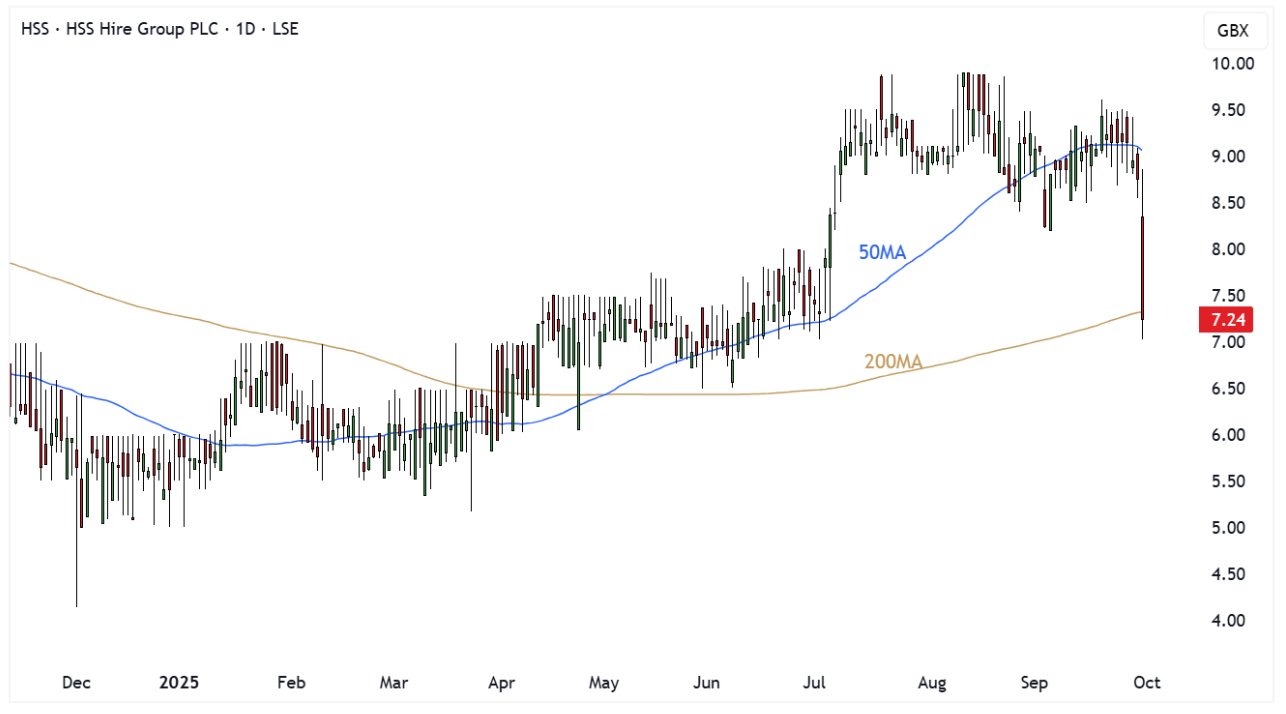
HSS Hire (HSS) unnerved the market after warning it may miss the statutory deadline to publish its annual report for the 15 months to March 2025. If the report was not filed by 30 September, the shares faced the prospect of a temporary suspension. At the same time, the company hinted that it was engaged in a series of “promising commercial and strategic initiatives,” but provided no detail on what these entailed.
The problem for investors is that while long-term strategy may indeed be attractive, the immediate issue of regulatory deadlines is binary: either the accounts are filed, or the shares face suspension. After a period of restructuring, which included the separation of ProService from The Hire Service Company, investors were hoping for greater clarity and consistency, not further uncertainty. The update, therefore, represented a setback for confidence.

For retail investors, the lesson here is that corporate governance and transparency are just as important as operational performance. Even if strategic discussions lead to improved positioning down the line, the current lack of visibility undermines sentiment. Until reporting timetables are confirmed, volatility is likely to remain elevated.
HSS Daily Candle Chart
Next Fifteen delivers solid half-year
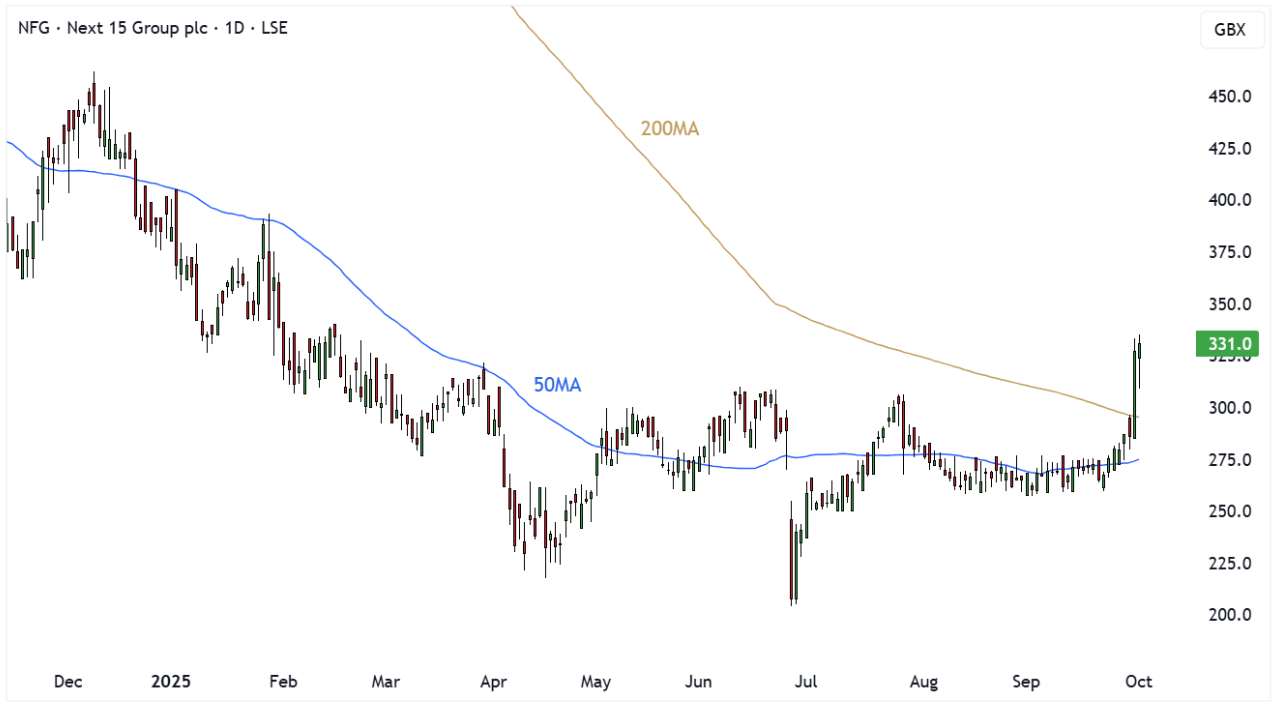
Next Fifteen (NFG) provided half-year numbers that reassured the market and drove the shares higher. Adjusted operating profit came in at £32.7m, giving a margin of 14.2%, while adjusted EPS was 21.4p. Although statutory EPS slipped into a small loss due to exceptional charges, investors focused on the underlying performance, which showed resilience in the face of a challenging marketing services environment.
Alongside the numbers, the company announced that COO Jonathan Peachey will step down at the end of October. The change represents continuity planning rather than disruption, and management emphasised that the operational performance and strategic direction of the business remain intact. Investors were content to take the update as confirmation of stability at a time when client budgets are under pressure.
For shareholders, the appeal is that Next Fifteen continues to combine scale with agility. By investing in digital and data-driven services while keeping a firm grip on costs, the group is positioning itself to capture demand shifts. With adjusted margins holding firm, the company has given investors reason to back the shares despite wider sector headwinds.
NFG Daily Candle Chart
Serica Energy goes shopping in the North Sea
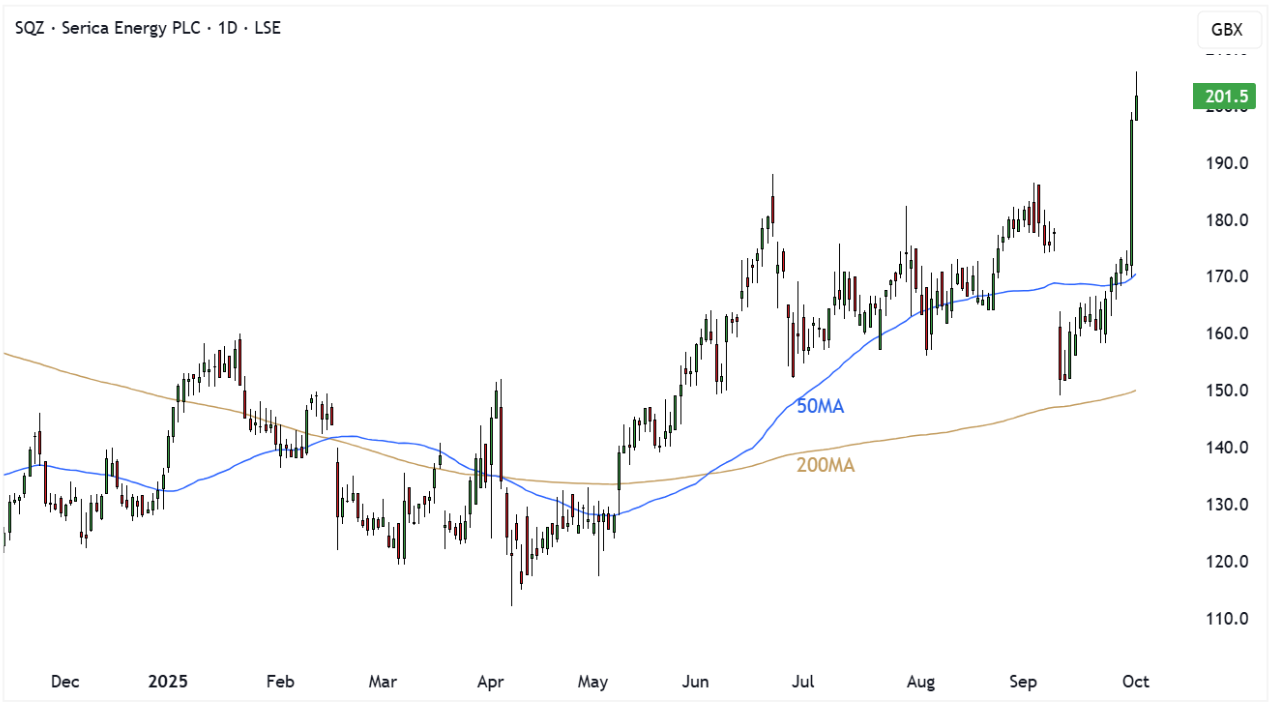
Serica Energy (SQZ) jumped on news that it has agreed to acquire Prax Upstream, along with associated asset interests in the UK North Sea, for $25.6m. The deal includes a 40% operated stake in the Greater Laggan Area, a 10% interest in the Catcher field, 5.2% of the Golden Eagle Area Development, and full ownership of the Lancaster field. Collectively, the package adds 11 million boe of 2P reserves at a very attractive $2.3 per boe.
The acquisition not only enhances production and reserves but also gives Serica operatorship of the Shetland Gas Plant, a key piece of infrastructure with multiple growth opportunities. Management expects around $100m in interim cashflows from the deal structures, plus an additional $50m of free cash flow in 2026. With aggregate tax losses of more than $4.5bn now on the books, Serica will also retain considerable fiscal flexibility.

For investors, the message is clear: Serica is using its strong balance sheet to secure cash generative assets on attractive terms, diversifying its portfolio and creating new growth avenues. It represents a clear execution of strategy and underlines the company’s potential to return further value to shareholders in the years ahead.
SQZ Daily Candle Chart
Spectra Systems: strong earnings, weaker cash
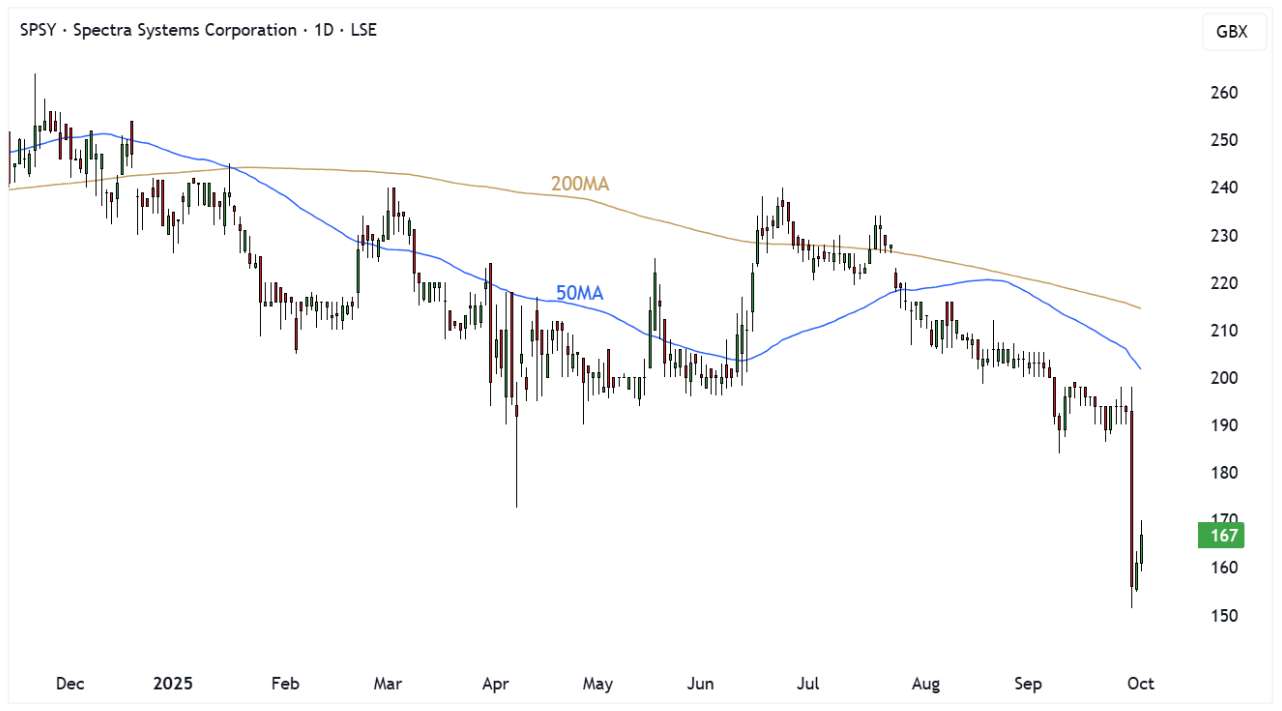
Spectra Systems (SPSY) reported interim results showing headline growth but disappointed the market with its cash position. Revenue surged 54% to $35m and adjusted PBTA more than doubled to $14.3m. EPS jumped 85% to 20.8 cents, with strong contributions from covert materials, optical products, and gaming security. On an operational basis, the business is delivering.
However, the company burned $0.7m of cash during the half and ended June with just $2.6m in cash against $3.7m of debt. Although restricted customer cash offers some cushion, investors were unnerved by the working capital outflow and the relatively thin cash balance. With large contracts recognised on a cost-accounting basis, timing of receipts remains crucial to funding flexibility.

For shareholders, the long-term attractions of Spectra’s banknote and security technologies remain intact, but near-term sentiment will be dictated by liquidity. Until the company demonstrates sustained positive cash generation, the shares may struggle to fully reflect the impressive operational performance.
SPSY Daily Candle Chart
Disclaimer:
All content is provided for general information only and should not be construed as any form of advice or personal recommendation. The provision of this content is not regulated by the Financial Conduct Authority.