


15th Oct 2026. 9.07am

Regency View:
Update
Regency View:
Update
It’s been a mixed fortnight for newsflow across the AIM Investor portfolio, with some fairly sharp contrasts in how companies are progressing. Celebrus and Oxford Metrics have both disappointed with significant reductions to earnings expectations, while Synectics is beginning to demonstrate the benefits of its operational changes. Elsewhere, Water Intelligence has delivered steady growth while taking an interesting step towards building a more recurring revenue business.
Celebrus Technologies: Execution Problems Force Another Rethink
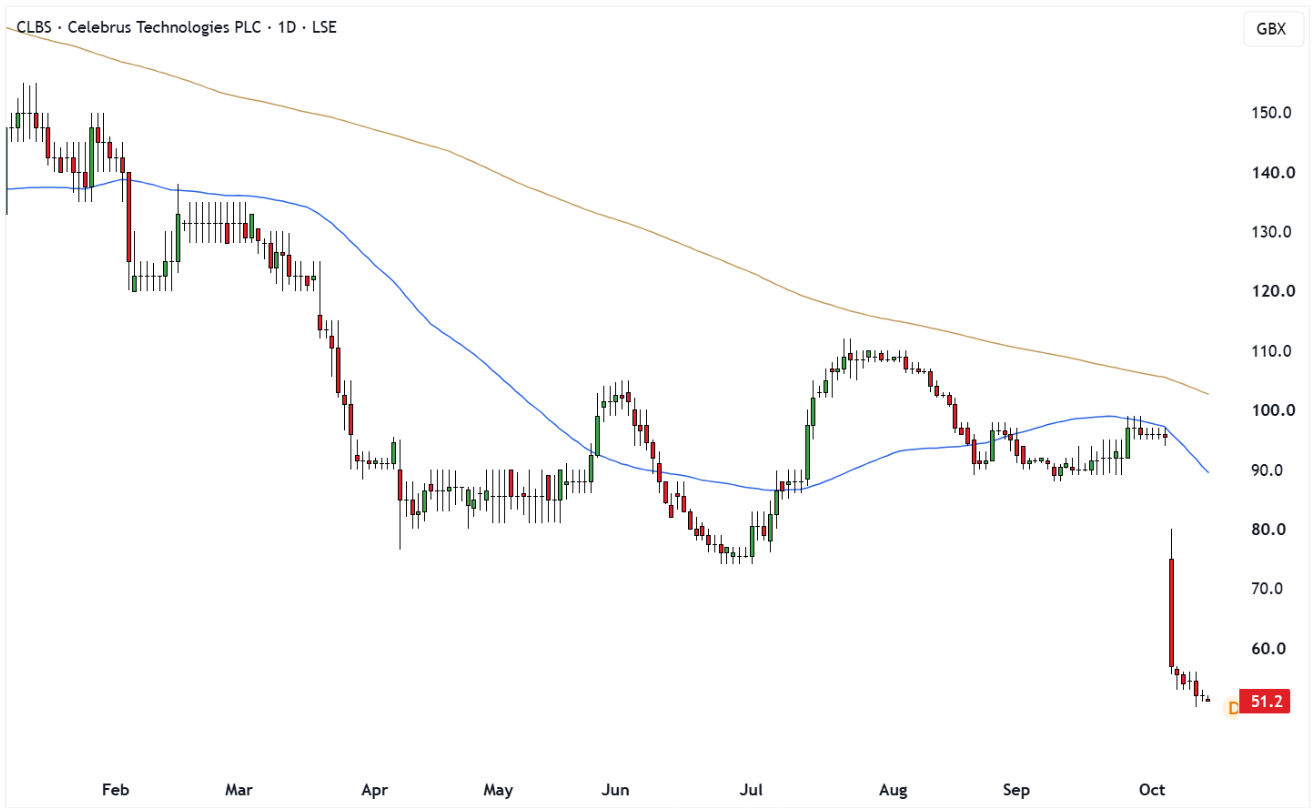
Celebrus Technologies (CLBS) came under heavy selling pressure after warning that full-year results would fall significantly short of market expectations. Revenue for the six months to September is expected to be approximately $9.2m, down from $10.4m, although software revenue actually increased from $7.9m to $8.9m. The bigger disappointment came from the revised FY27 guidance, with management now expecting revenue of $20m to $20.5m against previous market expectations of $23.7m, while the anticipated adjusted pre-tax loss has widened considerably from $0.9m to between $2.8m and $3m.
Perhaps the most concerning aspect of the update was management’s unusually frank admission that the loss of a significant customer was partly the result of its own execution shortcomings. The customer exercised a break clause after the first year of a three-year contract, contributing to a decline in annual recurring revenue from $15m to $14.7m. New customer wins and upselling added $0.6m of recurring revenue during the half, but this was more than offset by $0.9m of reductions, largely associated with that single customer. Meanwhile, the sales pipeline continues to grow, but converting those opportunities into signed contracts is taking longer than anticipated, with the average sales cycle still around eight months.

There is some reassurance in the balance sheet, with Celebrus holding $22.3m in cash and remaining debt free, although the cash balance has fallen from $32.5m at the March year end. Management has strengthened its sales and customer success operations, including appointing a new senior services executive to improve the consistency of complex customer implementations. These changes make sense, but the investment case has become more difficult because the problems extend beyond the timing of new business wins to the company’s ability to deliver and retain those contracts once secured. We still see value in Celebrus’ underlying technology, but confidence will need to be rebuilt through execution rather than further promises of pipeline growth.
What we are watching next: The half-year results on 8 December, progress converting the sales pipeline, customer retention and whether the operational changes begin to restore recurring revenue growth.
Themes: Software | Recurring Revenue | Execution
CLBS Daily Candle Chart
Oxford Metrics: A Difficult Transition Towards New Growth Markets
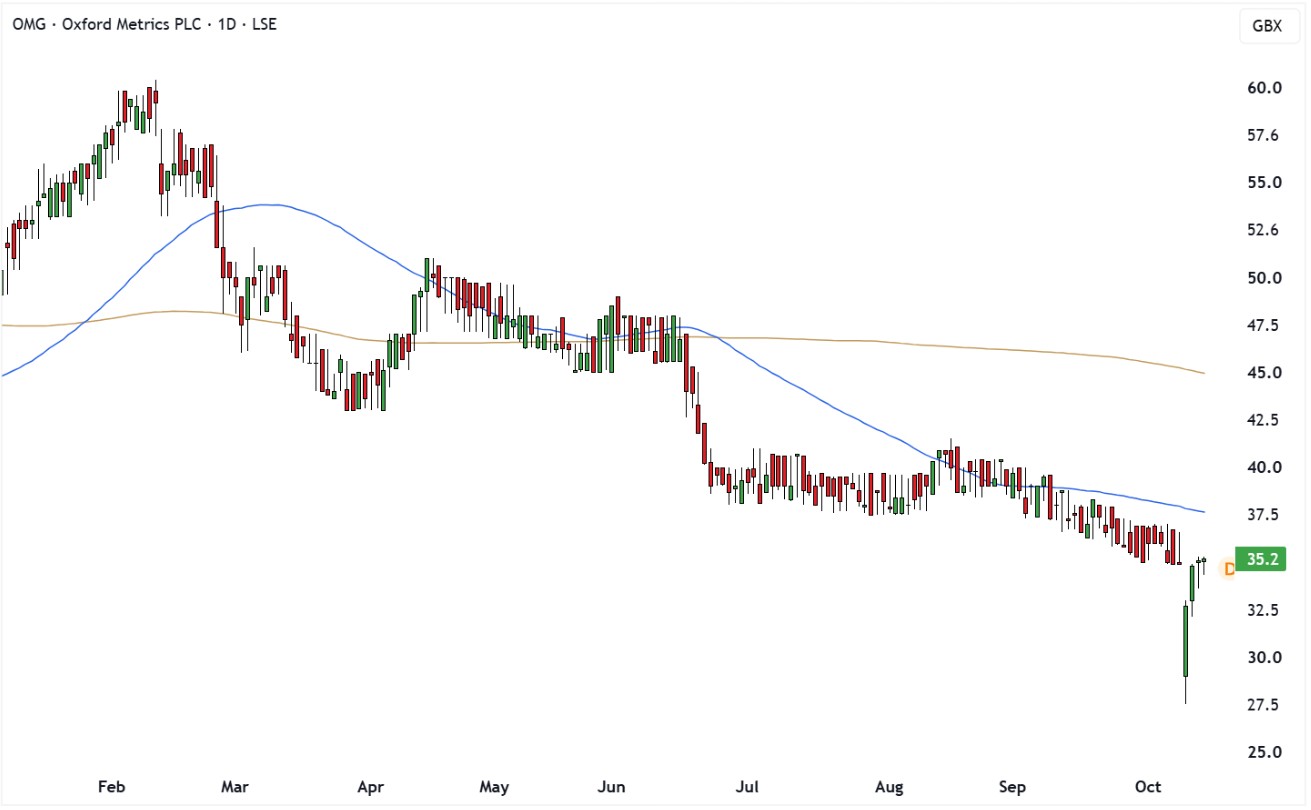
Oxford Metrics (OMG) delivered another disappointing trading update, with weaker demand across several of Vicon’s established markets and delays to major projects within Industrial Vision and Metrology Systems (IVMS). For the extended 15-month financial year ending December 2026, management now expects revenue of £47m to £51m, compared with previous market expectations of £56.2m. More significantly, the group is forecasting an adjusted operating loss of between £0.5m and £3.9m, rather than the £3m profit previously anticipated. Reduced investment across film, television and gaming, alongside pressure on research funding, has affected Vicon, while a major contact lens inspection project has slipped into early 2027.
There are, however, some interesting developments taking place beneath this weakness. Vicon is finding growing demand from robotics companies, particularly those developing humanoid robots and autonomous systems, where its motion capture technology can be used to train machines and measure their performance. Oxford Metrics is also accelerating its move into markerless motion capture, supported by the recent acquisition of Captive Devices and the planned addition of move technology. The launch of Nexus Markerless through a recurring software subscription model is another important step, potentially allowing Vicon to generate more predictable revenue from its technology rather than relying so heavily on hardware sales and large individual projects. Meanwhile, IVMS is narrowing its focus towards repeatable inspection products, which should be easier to scale than bespoke customer installations.

The challenge is that these emerging opportunities are not yet large enough to compensate for weakness elsewhere, and management is having to move more aggressively on costs as a result. The expanded efficiency programme is expected to deliver annualised savings of £1.5m to £2m, with approximately £1.5m benefiting FY27 after reinvestment. Despite expecting lower revenue next year, the Board still believes adjusted operating profit can meet or exceed the existing £3.5m market forecast, which places considerable importance on delivering those savings. Oxford Metrics retains a substantial financial cushion, with £29.5m in cash and fixed-term deposits, and plans a further buyback of up to £3m. There is an attractive longer-term opportunity in robotics and movement intelligence, but the immediate priority is demonstrating that the business can return to profitability while those newer markets develop.
What we are watching next: Delivery of the cost savings programme, conversion of robotics opportunities into meaningful revenue and whether FY27 profitability can recover despite weaker sales expectations.
Themes: Robotics | AI | Restructuring
OMG Daily Candle Chart
Synectics: Stronger Margins Begin to Show Through
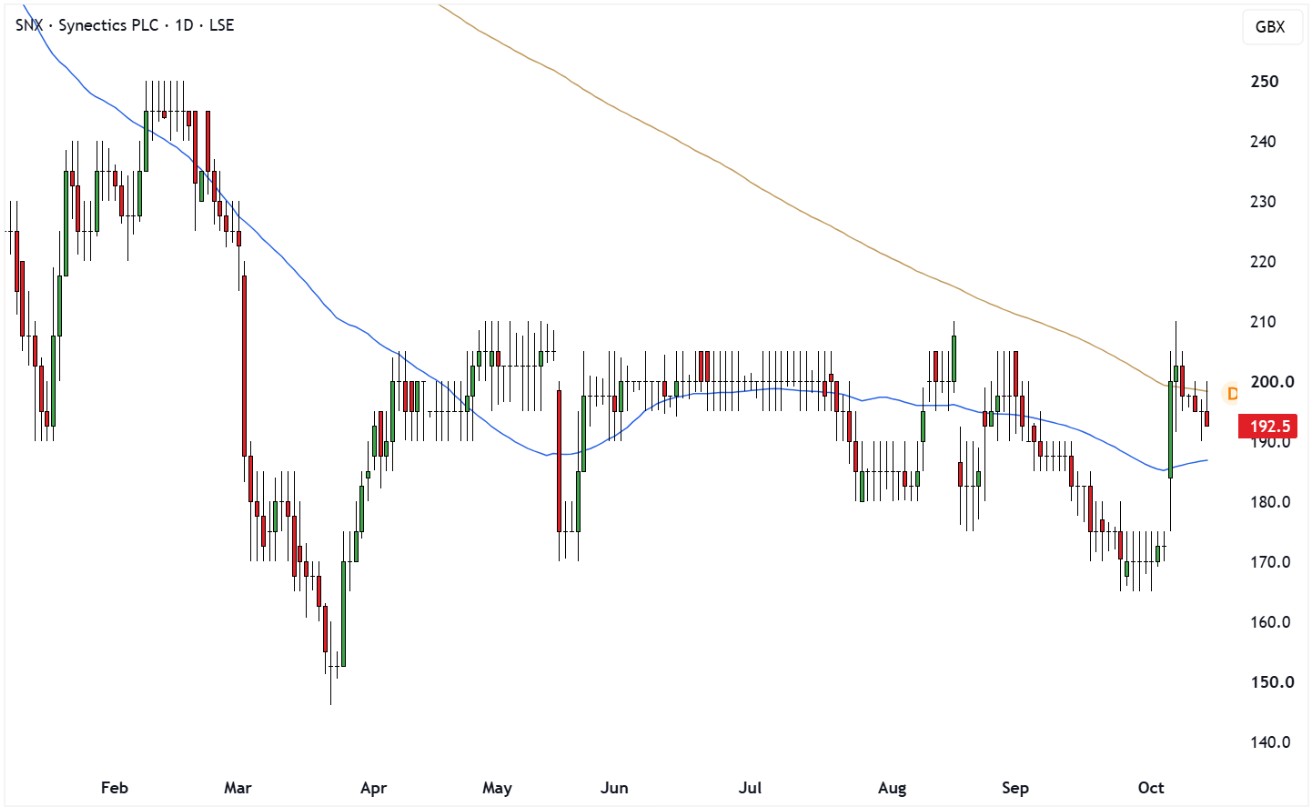
Synectics (SNX) was one of the brighter spots in the portfolio, with shares jumping after the security and surveillance specialist indicated that full-year profitability should reach the top end of previous expectations. Revenue for the year ending November 2026 remains on track to meet market forecasts, but adjusted EBITDA is now expected towards the upper end of the £3.7m to £4.1m range communicated at the interim results. The improvement reflects stronger margins and good performance across the business, providing some early evidence that the operational changes introduced under chief executive Amanda Larnder are beginning to make a difference.
What makes the update particularly encouraging is that Synectics has achieved this despite delays to some potentially significant energy-sector opportunities, particularly in the Middle East. Those projects remain active but are now expected to extend into FY27, meaning the improvement in profitability has come primarily from the existing business rather than a sudden acceleration in large contract wins. Management attributes the progress to its 5P strategy, which includes simplifying product deployment, strengthening relationships with strategic partners and improving commercial discipline. These might not be the most exciting changes on paper, but they can make a substantial difference to the profitability and scalability of a specialist technology business.

For us, this is a useful sign that Synectics is becoming a more resilient business, particularly given the uneven nature of demand across its end markets. The company has spent much of the past year putting the commercial and operational foundations in place for more sustainable growth, and the latest update suggests that some of those efforts are beginning to feed through into the numbers. There is still work to do, and the significant energy pipeline should not be treated as secured revenue until contracts are converted, but the prospect of stronger margins alongside additional opportunities moving into FY27 is encouraging. The next stage will be demonstrating that these improvements can support growth in both revenue and profitability.
What we are watching next: Conversion of the Middle Eastern energy pipeline, further margin improvement and evidence that the 5P strategy can support more consistent growth during FY27.
Themes: Security | Margins | Operational Improvement
SNX Daily Candle Chart
Water Intelligence: A New Revenue Opportunity Takes Shape
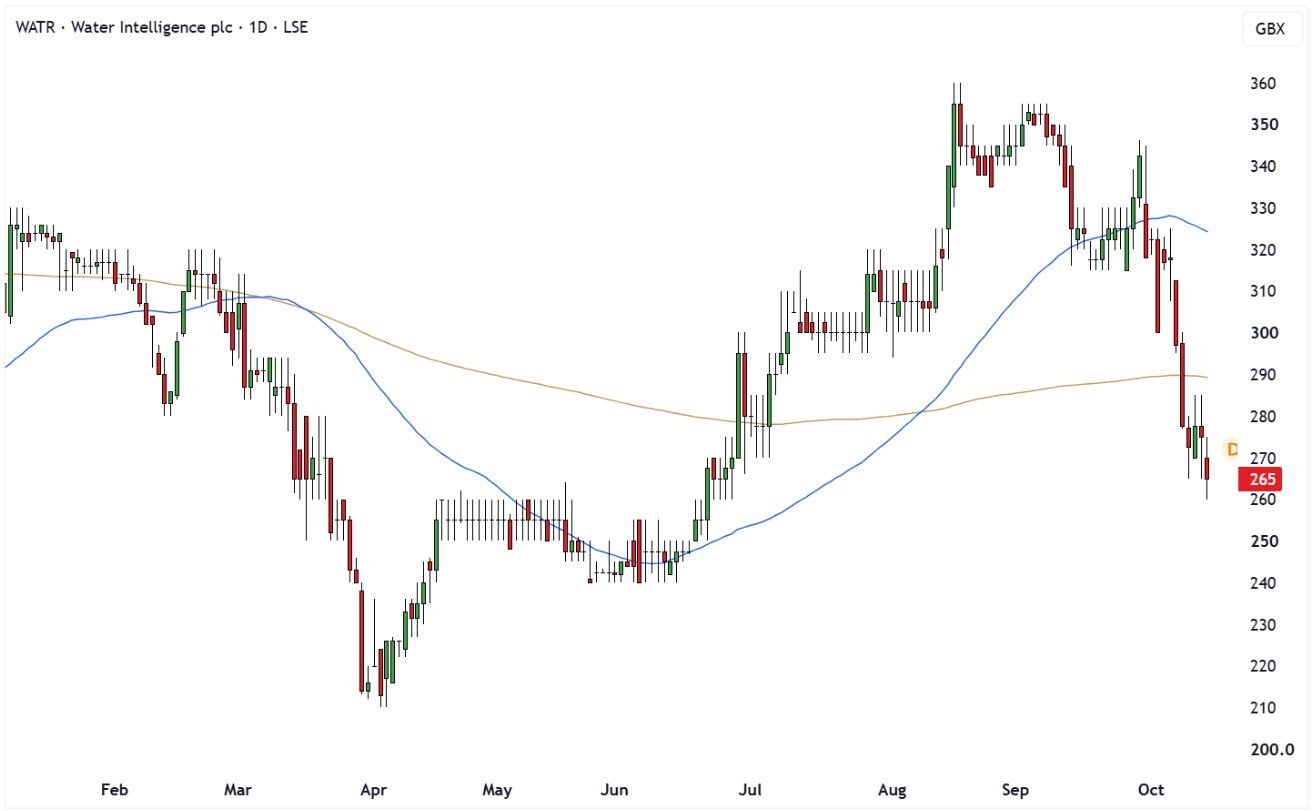
Water Intelligence (WATR) delivered a solid set of interim results, with revenue increasing 7% to $48.2m and adjusted EBITDA rising 6% to $9.8m. International corporate sales were particularly strong, growing 40% to $9.5m, while the US corporate business was broadly flat at $30.2m. Profitability was slightly less convincing, with the adjusted EBITDA margin slipping from 21% to 20% as higher materials and fuel costs weighed on the business. Statutory pre-tax profit also declined 22% to $3.3m, partly reflecting additional expenditure on developing the group’s next phase of growth.
That next phase is arguably the most interesting part of the announcement. Water Intelligence is launching a preventive maintenance offering designed to move the business beyond detecting and repairing leaks after they have occurred. By combining wireless water monitoring devices with its established American Leak Detection service network, the group intends to identify potential problems earlier and provide ongoing monitoring, maintenance and aftercare through subscription arrangements. Paid pilot programmes with strategic customers have produced encouraging results, with management preparing to scale the offering during the fourth quarter. The opportunity is particularly interesting because Water Intelligence already has relationships with 23 major US insurance companies and an established nationwide service network, giving it a potential route to market without having to build an entirely new distribution infrastructure.

The attraction is that preventive maintenance could allow Water Intelligence to generate more recurring revenue from customers it already serves, while making better use of the technology and operational infrastructure developed over recent years. However, this remains an emerging opportunity, and we would like to see evidence of commercial adoption and improving margins before placing too much weight on its potential. Cash generation also deserves attention, with operating cash flow falling from $6.7m to $3.4m, partly because of receivables expected to be collected during the second half. The group finished June with $4.4m in cash and approximately $21.3m of net bank debt, so converting the new opportunity into profitable, cash-generative growth will be particularly important.
What we are watching next: Commercial rollout of the preventive maintenance offering, adoption of subscription services, recovery in operating cash flow and whether margins begin to benefit from the new business model.
Themes: Water Infrastructure | Recurring Revenue | Technology
WATR Daily Candle Chart
Disclaimer:
All content is provided for general information only and should not be construed as any form of advice or personal recommendation. The provision of this content is not regulated by the Financial Conduct Authority.