


26th Mar 2026. 9.06am

Regency View:
BUY TruFin (TRU)

Regency View:
BUY TruFin (TRU)
How TruFin turned into a cash machine
For many small caps, profitability is something that always feels just around the corner. TruFin (TRU) has now moved beyond that phase, with the numbers beginning to reflect a business that is firmly into execution mode.
The group has transitioned from a period of heavy investment into one where operating leverage is starting to come through, supported by a mix of recurring revenues and a growing publishing business. With cash building on the balance sheet and capital now being returned to shareholders, this is no longer a turnaround story, it is a business entering a more mature phase of growth.
A portfolio that is starting to make sense
TruFin operates through a collection of businesses spanning payments, lending technology and digital publishing. On the surface, that mix can look slightly disjointed, but the structure is beginning to show its strengths as each division plays a defined role within the group.
Playstack, the games publishing arm, has emerged as the key driver. Revenues increased 24% to £55.3m in 2025, while profit before tax rose 59% to £12.2m. More importantly, this is becoming a repeatable model rather than a one-off success. The portfolio of games continues to expand, with over 20 million new installs during the year and more than $100m in lifetime revenues generated on Steam.
Alongside this sits Oxygen, a far steadier and more predictable business focused on early payment solutions and procurement intelligence. Revenues grew 18% to £9.1m, with EBITDA up 67%. Long-term client relationships and consistent renewal rates provide a level of visibility that helps balance the more variable nature of the publishing division.
Financials now doing the heavy lifting
The financial inflection is now clear. Group revenue increased 20% to £65.9m, but the more telling shift is in profitability. Adjusted EBITDA rose 66% to £12.6m, while adjusted profit before tax increased sharply to £8.4m.
This level of profit growth relative to revenue points to a business where the cost base has largely been built, allowing incremental revenue to fall through at higher margins. After several years of losses, TruFin has moved firmly into a phase where operating leverage is working in its favour.
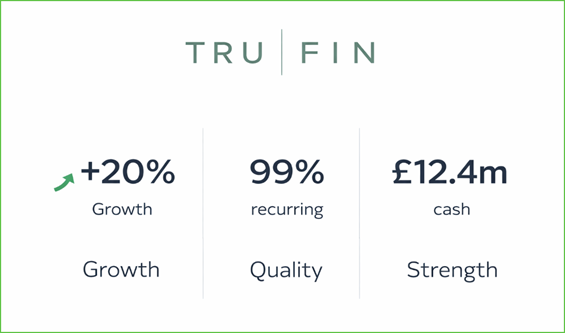
The quality of those revenues has also improved. The group now generates 99% of its income from recurring software, subscription, licensing and game revenues. That transition away from more capital-intensive lending activities is important, as it improves both visibility and scalability.
Cash generation is following through. The group ended the year with £12.4m of cash, supported by positive free cash flow, while the balance sheet remains ungeared. This provides a solid foundation as the business moves into its next phase.
Capital allocation signals a shift in mindset
One of the more interesting developments is how management is now deploying capital. This is often where small caps either build credibility or lose it, and TruFin is starting to show discipline.
During 2025, the group completed £8m of share buybacks, acquiring 7.5m shares at an average price of 106p. This was followed by a further £6m buyback announced in early 2026. These are not token gestures. They represent a meaningful return of capital relative to the company’s size.
The message is straightforward. The business is generating cash in excess of its immediate reinvestment needs, and management is willing to return that capital where appropriate. It also suggests confidence in the underlying value of the shares at current levels.
For investors, this marks an important shift. The focus is no longer solely on growth at any cost, but on generating returns from that growth.
Not without its weak spots
There are still areas that need to improve, and this is not a completely clean story.
Satago, the lending technology business, remains in recovery mode following the loss of a major contract in 2024. Revenues declined 50% to £1.2m in 2025, although losses have narrowed following cost reductions. Encouragingly, subscription revenues are growing strongly, suggesting the repositioning of the business may be starting to gain traction.
Playstack, while highly profitable, also carries the inherent risk of the gaming industry. Revenues can be influenced by the success of individual titles, even if the group’s high success rate and expanding pipeline help mitigate that to some extent.
These factors help explain why the shares have not fully re-rated despite the improvement in financial performance. The market is starting to recognise the progress, but it has not fully closed the gap.
A trend that is holding
From a technical perspective, the shares have undergone a clear change in trend over the past year. Following a prolonged period of sideways movement, the stock broke higher during mid-2025 and has since established a steady uptrend, with a consistent pattern of higher highs and higher lows.
Pullbacks have been well supported, with the price repeatedly finding demand around the rising 50-day moving average. This suggests that buyers are stepping in on weakness rather than chasing strength, which is typically a constructive signal.
The longer-term picture is also improving. The upward-sloping 200-day moving average reflects a broader shift in trend, confirming that the move is not simply short-term momentum but part of a more established advance.
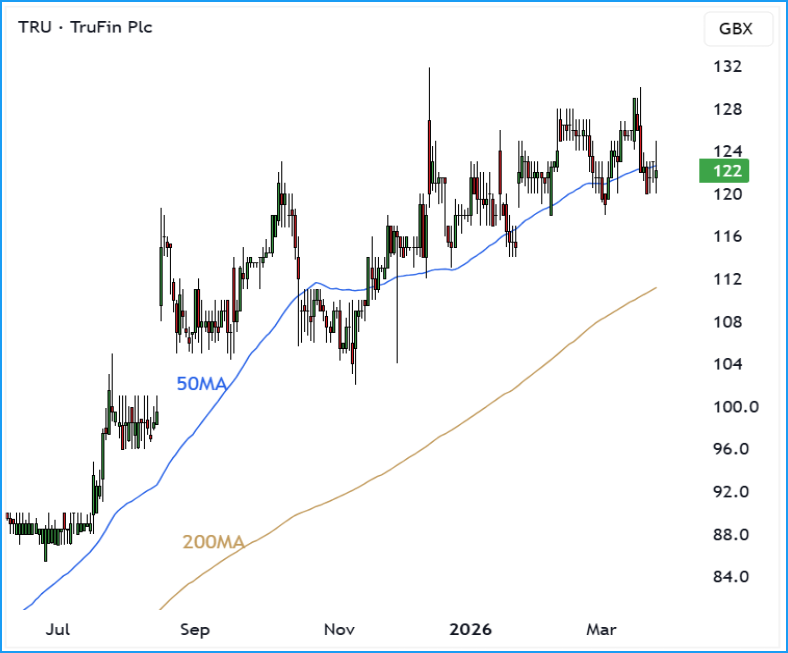
More recently, the shares have entered a period of consolidation just below their recent highs. This type of price action tends to indicate acceptance at higher levels rather than exhaustion, leaving the broader uptrend intact.
Five Key Takeaways
1. The inflection has already happened: TruFin has moved from losses into meaningful profitability, with operating leverage now driving earnings growth.
2. Revenue quality has improved significantly: With 99% of revenues now recurring or repeatable, the business has shifted towards a more scalable and predictable model.
3. Cash generation is now a core part of the story: Positive free cash flow and a net cash position provide flexibility and support the investment case.
4. Capital allocation is becoming a strength: Meaningful share buybacks signal both discipline and confidence from management.
5. The chart supports the fundamentals: A sustained uptrend with constructive consolidation suggests the market is gradually recognising the shift in the business.
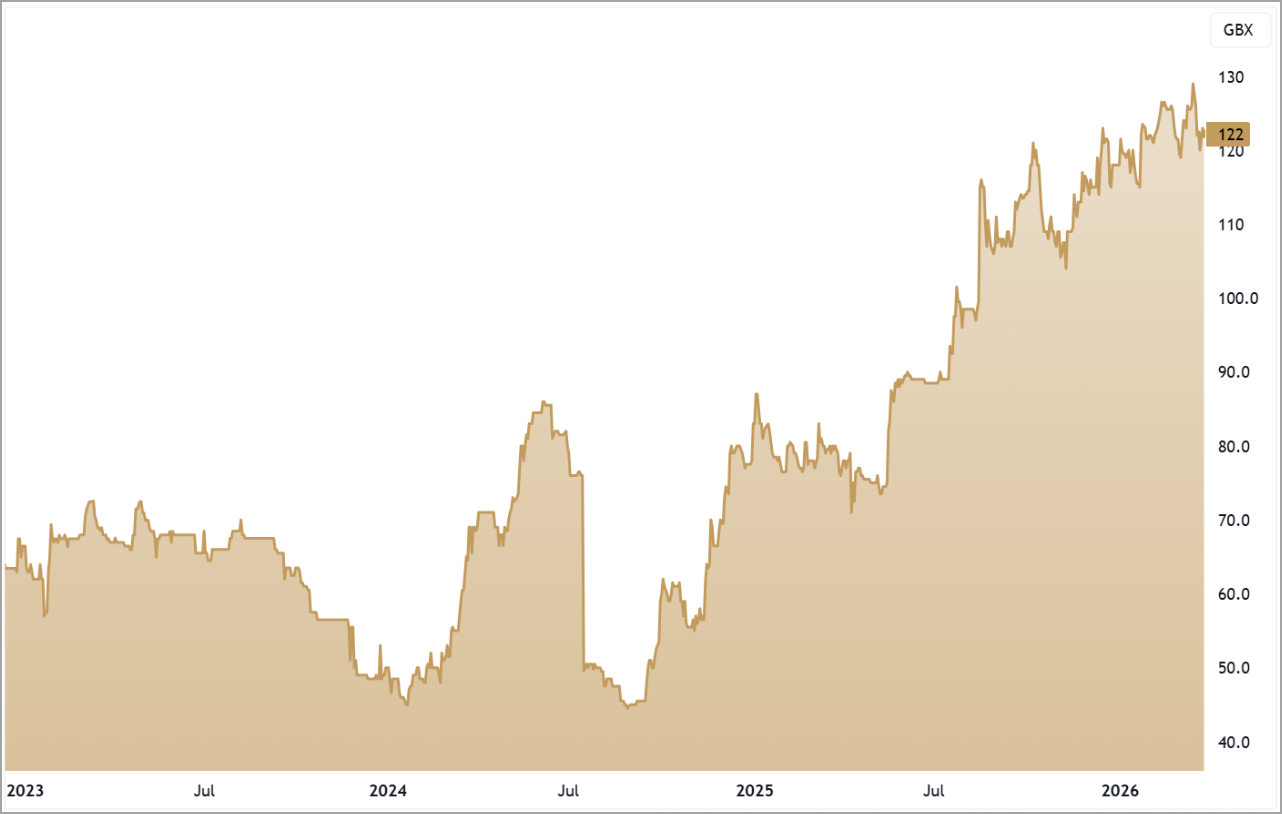
TRU 3-Year Chart
Disclaimer:
All content is provided for general information only and should not be construed as any form of advice or personal recommendation. The provision of this content is not regulated by the Financial Conduct Authority.