


12th Feb 2026. 9.04am

Regency View:
BUY Tribal (TRB)

Regency View:
BUY Tribal (TRB)
Tribal: From fixing the engine to hitting the accelerator
Every AIM cycle throws up a familiar pattern. A company spends a few years fixing its balance sheet, simplifying its model and getting its house in order. The share price does very little while that work is happening. Then, almost quietly, the numbers start to change. Cash starts to build. Recurring revenue starts to dominate. Guidance starts to edge higher rather than lower. And the market slowly realises the story has shifted.
Tribal (TRB) looks like it has reached that part of the journey. After several years of restructuring and strategic refocus, the group has closed FY25 with stronger profits, a swing back to a net cash position and clear momentum in its transition toward a SaaS and subscription-led model. The shares have already started to respond, but the bigger change is happening under the surface, in the quality and visibility of the business itself.
A specialist with deep roots in education
Tribal is not a generic software company. It operates squarely in the global education sector, providing student information systems and related services to universities and education institutions. In simple terms, its software helps universities run the operational backbone of student administration, from enrolment and records through to ongoing engagement and reporting.
That niche focus matters. Education institutions are not quick to change core systems, which means customer relationships tend to be long, sticky and high value once embedded. It also means the sales cycle can be slow, but churn is low and lifetime value is high. This is exactly the kind of market where a shift toward subscriptions and cloud delivery can materially improve the quality of earnings over time.
Alongside its core software platform, Tribal also runs an education services business through Etio, which provides consultancy and support services to the same sector. This gives the group both a product engine and a services arm, with increasing cross-sell opportunities as more customers move onto subscription licences and cloud deployments.
The SaaS transition is starting to show through
The January trading update was the clearest sign yet that the strategy is working. Management confirmed that FY25 revenue and adjusted EBITDA will come in slightly ahead of already upgraded expectations, but the more important detail sat in the balance sheet and the recurring revenue metrics.
Tribal ended the year with £11.4m of net cash, a dramatic swing from £3.2m of net debt a year earlier. That is not just accounting noise. It reflects better profitability, lower capex requirements, stronger working capital control and a business that is now generating cash rather than consuming it.
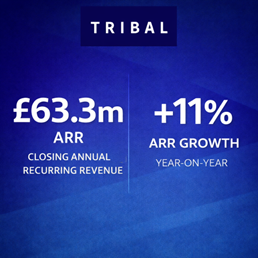
At the same time, recurring revenues continue to build. Closing ARR rose 11% to £63.3m, while contracted ARR increased 14% to £65m. This is being driven by a combination of new customer wins, upgrades from existing customers and the rollout of the Higher Education Full-Service subscription licence. In practice, this means more of Tribal’s revenue base is becoming predictable, repeatable and higher quality.
The HEFS model is a particularly important piece of the puzzle. It moves customers onto a subscription framework that improves revenue visibility, supports margins and strengthens cash flow. It also creates a natural pathway into cloud adoption and deeper platform usage, which is where the longer-term operational leverage really starts to appear.
Financials that are getting easier to like
On headline numbers, Tribal is not an expensive stock. The shares trade on a forward PE in the mid-teens, with an EV to EBITDA multiple around 10x. That is not bargain-basement, but it is also not the kind of valuation usually attached to a business with improving margins, rising recurring revenues and a newly strengthened balance sheet.
Return on capital is running around 17%, operating margins are above 12%, and free cash flow per share has turned meaningfully positive again. The balance sheet now looks far more resilient, with net cash providing both downside protection and strategic flexibility.
Consensus expectations are also moving in the right direction. Analysts now see FY25 and FY26 numbers edging higher, with EBITDA and cash performance expected to come in ahead of prior forecasts. That matters, because reratings in this part of the market rarely come from heroic growth assumptions. They come from steady delivery, rising confidence and a gradual shift in how investors perceive risk.
There is also a small but growing dividend, which is a useful signal of management confidence rather than the main attraction. The real story here is the improvement in earnings quality and cash generation, not income.
Why the market is starting to pay attention
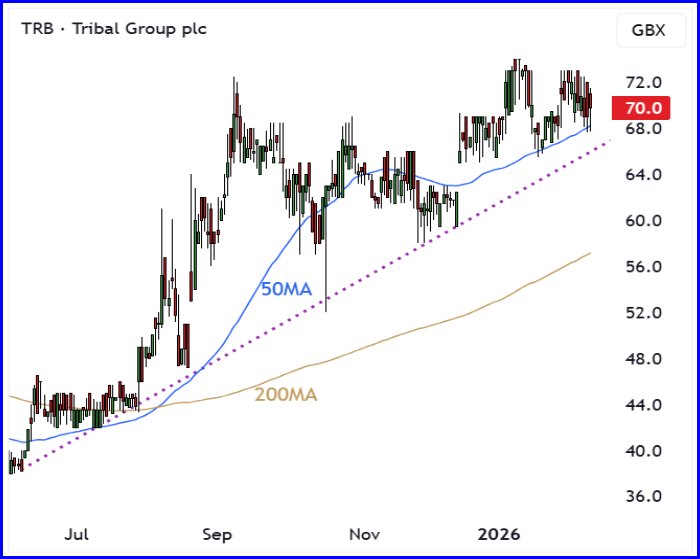
The share price action over the last year reflects this improving backdrop. Tribal has moved out of a long basing phase and into a more constructive uptrend, with the shares now comfortably above the 200-day moving average. Momentum scores are high, relative strength has improved over six and twelve months, and recent pullbacks have been met with buying interest rather than indifference.
This is not a chart that screams speculation. It looks more like a market gradually reappraising a business whose fundamentals are catching up with its strategy. The January update helped reinforce that shift, particularly with the surprise swing to a much stronger net cash position.
Importantly, this is happening without any need for heroic growth assumptions. Revenue growth remains steady rather than explosive, but the mix is improving, margins are more stable and cash flow is becoming more reliable. In small-cap software, that combination is often more valuable than chasing the fastest top-line number.
A different kind of recovery story
What makes Tribal interesting is that this is not a turnaround in the classic sense. The business is not being rescued from the brink. Instead, it is evolving from a more project-led, mixed-quality revenue model into something that looks increasingly like a proper SaaS platform with services wrapped around it.
That shift changes how investors should think about the company. Recurring revenues deserve higher multiples than one-off project work. Predictable cash flow deserves more confidence than lumpy delivery. And a net cash balance sheet deserves a lower risk premium than a leveraged one.
The market has started to reflect some of that, but probably not all of it yet. For investors looking for a small-cap software name where the quality of earnings is improving and the financial risk is falling, Tribal is starting to tick a lot of boxes.
Five Key Takeaways
1. SaaS transition delivering: Tribal’s shift toward subscriptions is now translating into better margins, stronger cash flow and improved revenue visibility.
2. Balance sheet reset: The move from net debt to a solid net cash position materially strengthens the company’s financial footing.
3. Recurring revenues rising: ARR and contracted ARR are both growing, improving the quality and predictability of earnings.
4. Operational leverage improving: Lower capex and better cost discipline are allowing more of each pound of revenue to drop through to profit.
5. Momentum building: Recent upgrades and strong price action suggest the market is starting to recognise the turnaround.
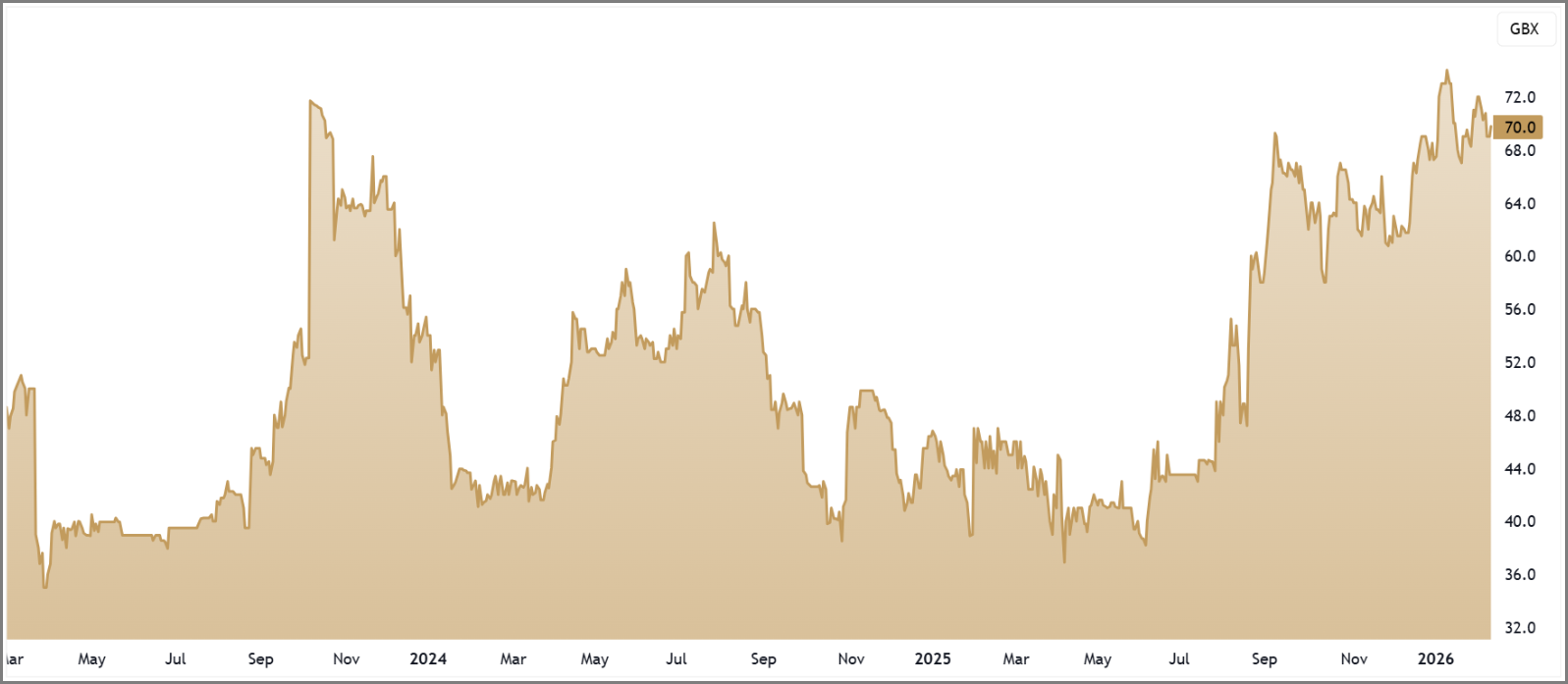
TRB 3-Year Chart
Disclaimer:
All content is provided for general information only and should not be construed as any form of advice or personal recommendation. The provision of this content is not regulated by the Financial Conduct Authority.