


4th Nov 2026. 9.02am

Regency View:
Update
Regency View:
Update
It has been a busy fortnight for our FTSE Investor stocks, with company results, strategic developments and changing earnings expectations producing some sharp moves in share prices. AstraZeneca and Rentokil found favour with investors, while GSK and NatWest came under pressure despite reporting respectable underlying performances. Elsewhere, Drax announced a potentially significant move into AI infrastructure, BT benefited from a possible shift in the broadband market, and Bloomsbury’s interim results left investors weighing a weaker first half against an ambitious second-half publishing schedule.
AstraZeneca (AZN): Earnings Growth Outpaces Revenue
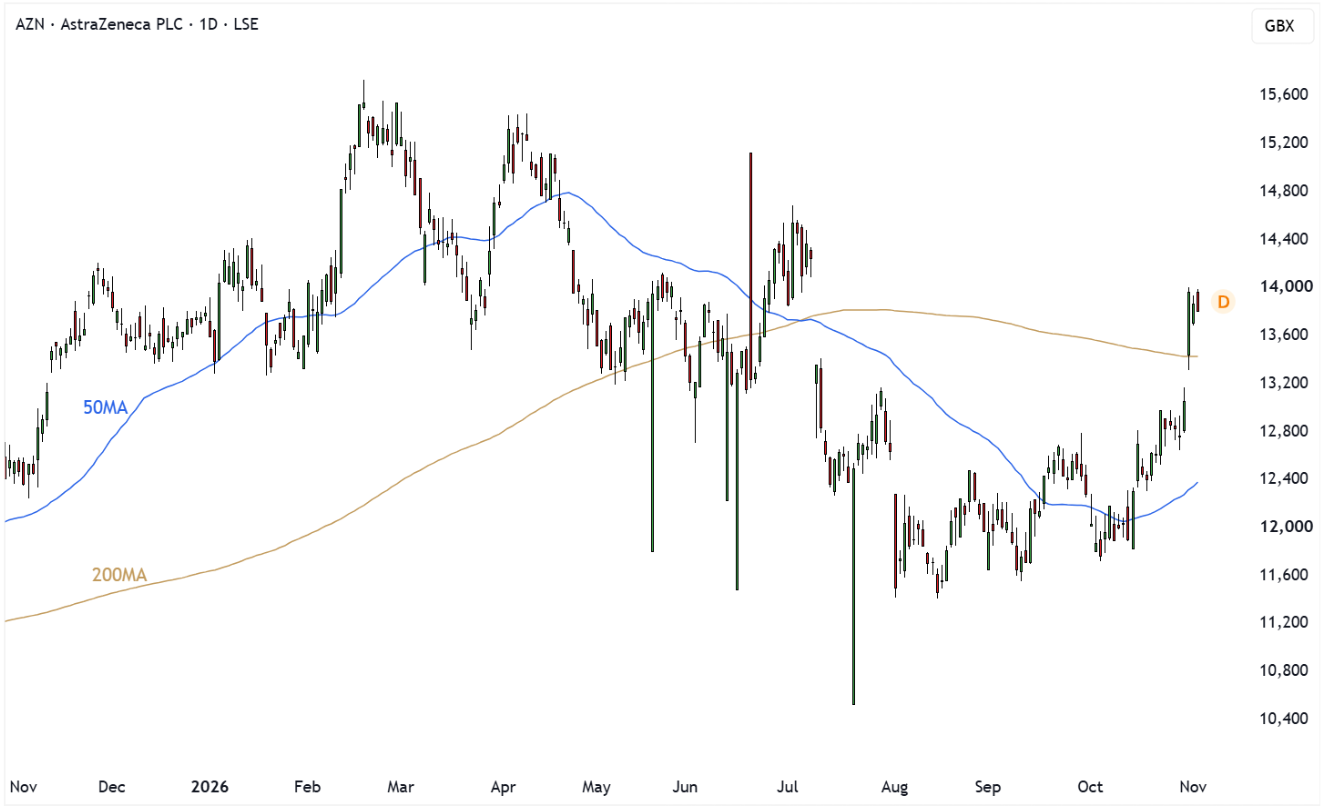
AstraZeneca shares moved higher following a solid set of third-quarter results, with the pharmaceutical group demonstrating that its expanding portfolio of medicines is translating into stronger profitability. Revenue for the first nine months increased 8% to $46.9bn, while core earnings per share rose 14% to $8.00. The difference between those growth rates is encouraging, particularly as core operating margins improved to 35%. Oncology remains the principal growth engine, accounting for almost half of group revenue, with strong contributions from treatments including Imfinzi and Enhertu.
The performance was not entirely uniform across the business. Cardiovascular, Renal and Metabolism revenue declined as generic competition and pricing pressures affected established medicines, particularly Farxiga. However, growth across Oncology, Respiratory and Immunology, and Rare Disease more than compensated for these pressures. AstraZeneca also reaffirmed its full-year guidance for mid-to-high single-digit revenue growth and low double-digit core earnings growth at constant exchange rates, suggesting that management remains comfortable with the trajectory of the business.

Perhaps the more significant development is the continued progress of AstraZeneca’s drug pipeline. The company has reported 12 positive Phase III programme readouts so far this year, with management estimating combined peak annual revenue potential comfortably above $10bn. These figures are projections rather than guaranteed future sales, but they illustrate the scale of the opportunity. The balance sheet warrants some attention, with net debt rising to $25.8bn and operating cash inflow lower than a year earlier. Nevertheless, the combination of improving margins, established blockbuster medicines and a broad development pipeline provides a solid foundation for future earnings growth.
What we are watching next: Further late-stage clinical trial results, the commercial performance of newer oncology treatments and progress towards full-year earnings guidance when AstraZeneca reports on 9 February 2027.
Themes: Oncology Growth | Operating Margins | Drug Pipeline
AZN Daily Candle Chart
Bloomsbury Publishing (BMY): A Lot Riding on the Second Half
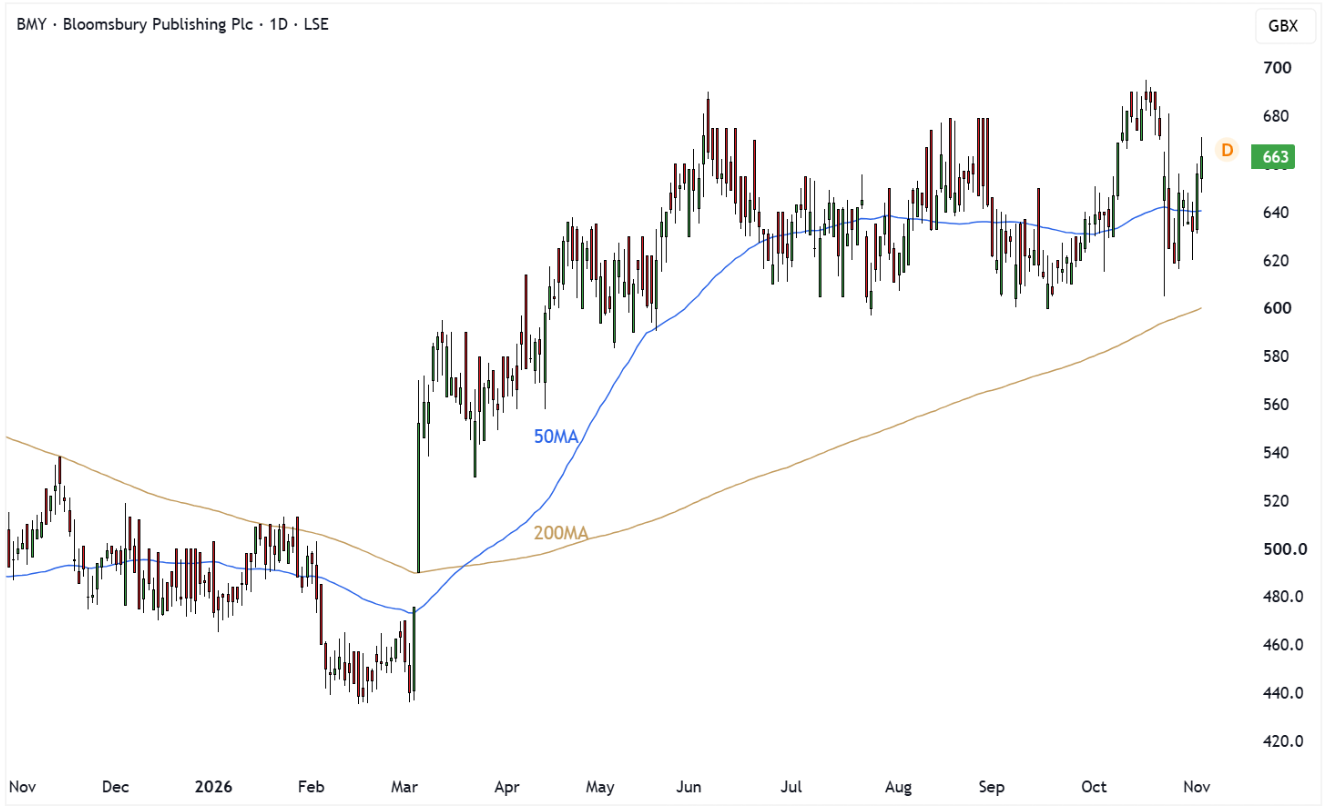
Bloomsbury’s interim results received a mixed response from investors, reflecting a substantial decline in first-half profitability alongside management’s confidence in a stronger second half. Revenue fell approximately 5% to £151.6m, while adjusted pre-tax profit declined 30% to £16.8m. Consumer Publishing accounted for much of the weakness, with revenue falling to £102.8m from £113.4m a year earlier. The comparison was always likely to be demanding following the exceptional success of previous bestselling titles, but the scale of the profit decline nevertheless raises the stakes for the remainder of the financial year.
There were more encouraging signs within Academic & Professional Publishing, where revenue increased to £48.8m, supported by underlying growth across print and digital products. However, adjusted profit declined to £6.8m from £11.0m, partly reflecting a reduced contribution from AI licensing. This is worth monitoring because licensing agreements can generate attractive margins without the same costs associated with traditional publishing. The underlying academic business appears to be recovering, but its ability to rebuild profitability will depend partly on the mix of revenue generated.

Management continues to expect record full-year results, supported by a publishing schedule weighted towards the second half, including new Sarah J. Maas titles and renewed interest in the Harry Potter franchise. Bloomsbury also enters this important trading period with a much stronger balance sheet, reporting net cash of £22.8m compared with £2.4m a year earlier. That provides some reassurance, although the immediate investment case depends on the forthcoming releases delivering sufficient sales to offset the weaker opening six months. We remain positive about the quality of Bloomsbury’s publishing assets, but execution over the Christmas trading period will be particularly important.
What we are watching next: Sales momentum from major new releases, the contribution from the Harry Potter franchise and whether Academic Publishing can rebuild margins as the year progresses.
Themes: Consumer Publishing | Second-Half Recovery | AI Licensing
BMY Daily Candle Chart
BT Group (BT.A): A Rival Could Become a Customer
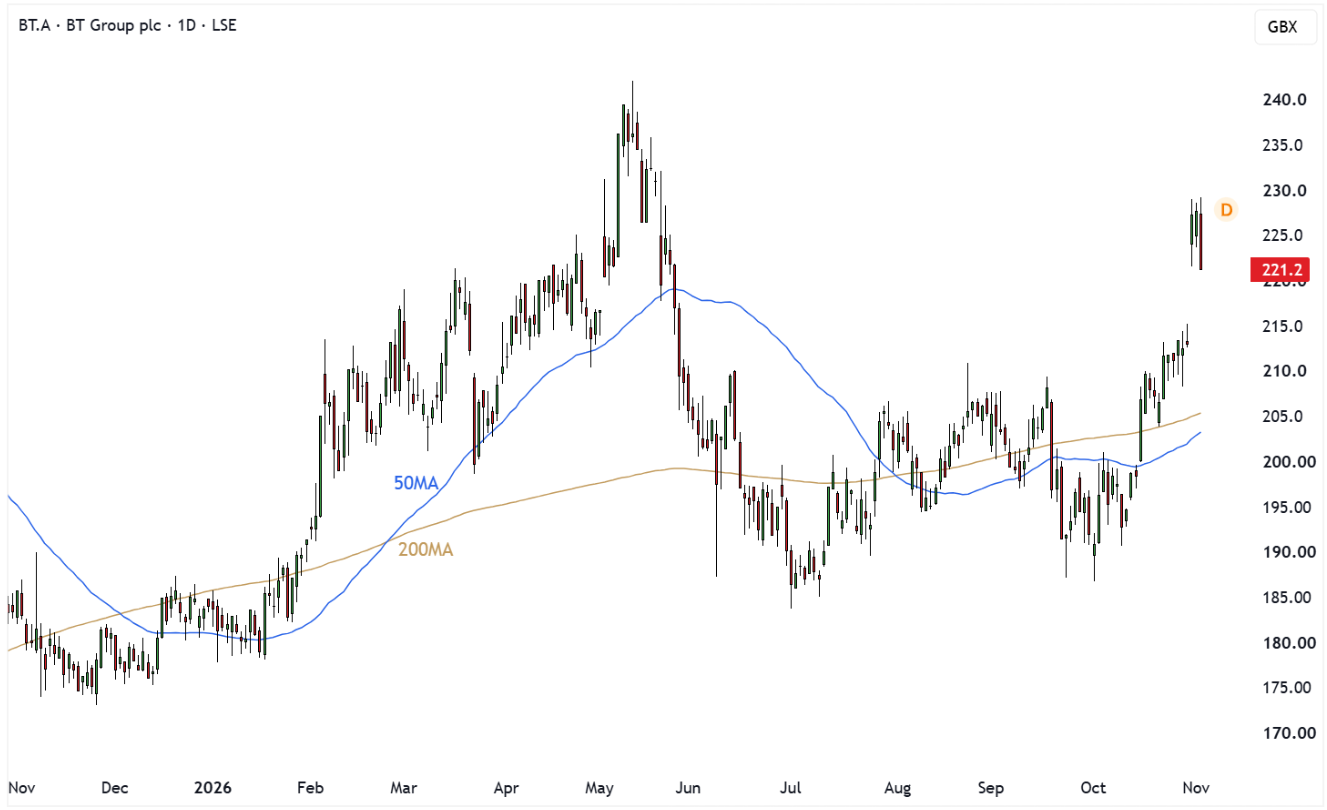
BT shares rallied following reports that Virgin Media O2 was approaching an agreement to use Openreach’s fibre broadband network in areas beyond its existing coverage. Although neither company had formally confirmed the proposed arrangement, the development attracted attention because it could see one of BT’s principal competitors become an additional wholesale customer. Openreach has spent heavily expanding its full-fibre network, and securing greater utilisation of that infrastructure is central to the longer-term investment case.
The reported agreement comes alongside suggestions that Virgin Media O2 is pausing parts of its cable-to-fibre upgrade programme as it looks to reduce expenditure. This potentially changes the competitive dynamics of the UK broadband market. Rather than continuing to duplicate infrastructure in every location, Virgin Media O2 could increasingly rely on Openreach where building its own network is less attractive. For BT, additional wholesale volumes could improve returns on capital already committed to the network, particularly as more premises become available for connection.

There are important qualifications. The proposed deal would reportedly cover new customers outside Virgin Media O2’s existing footprint, rather than its entire customer base, and the commercial terms remain unknown. The uncertainty surrounding Virgin Media O2’s proposed acquisition of Netomnia also complicates the competitive picture. Nevertheless, the development supports a broader point we have made about BT: the value of Openreach should become clearer as the business moves beyond its most intensive investment phase and begins converting its infrastructure spending into stronger cash generation. Any meaningful new wholesale agreement would be a welcome step in that direction.
What we are watching next: Formal confirmation of the agreement, the potential scale of additional Openreach connections and evidence that BT’s fibre investment is beginning to support stronger free cash flow.
Themes: Fibre Infrastructure | Wholesale Demand | Cash Generation
BT.A Daily Candle Chart
Drax Group (DRX): AI Opens Up a New Opportunity
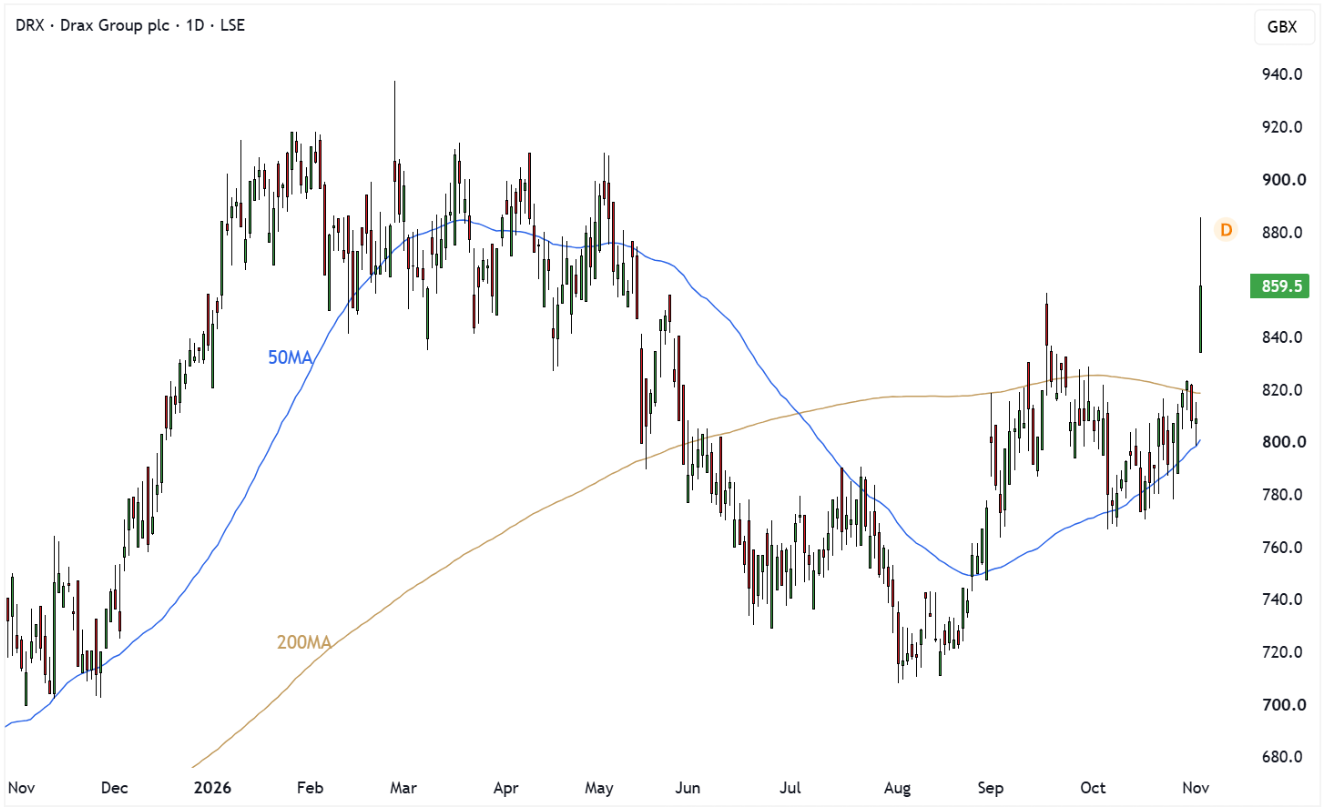
Drax shares jumped following the announcement of a strategic partnership with Brookfield and its AI infrastructure platform Radiant to develop a potentially enormous data centre at Drax Power Station in Yorkshire. The ambition is to create more than 1GW of computing capacity over several phases, beginning with a development of up to 100MW targeted for operation in early 2028. Brookfield estimates that total potential investment, including semiconductor chips, could eventually exceed £20bn. This is a substantial proposal, although it is important to distinguish the overall project investment from any financial benefit that might ultimately accrue to Drax.
What makes the announcement particularly significant is the infrastructure Drax already controls. The power station estate includes approximately 4GW of grid access, 2.6GW of dispatchable generation capacity and more than 1,000 acres of land. Access to reliable electricity is becoming one of the main constraints on AI data centre development, giving existing power infrastructure considerable strategic value. The initial phase would draw electricity directly from the grid, while a proposed second phase could use generation from Drax itself under a long-term power purchase agreement. This potentially creates an additional source of revenue alongside the company’s established electricity generation activities.

The opportunity is substantial, but the project remains at an early stage. Planning permission, regulatory approvals, an anchor tenant and final investment decisions are all required before the first phase can proceed. The proposed second phase also depends on government agreement to use capacity covered by Drax’s existing Contract for Difference arrangements. For now, the announcement does not establish a new earnings forecast. Even so, we see considerable merit in the strategic direction. Drax has assets that are difficult and expensive to replicate, and the rapid growth of AI infrastructure could provide a new route to extracting value from them.
What we are watching next: Planning progress, securing an anchor customer, the commercial structure of the partnership and further detail on how Drax could benefit financially from the proposed development.
Themes: AI Infrastructure | Power Generation | Asset Value
DRX Daily Candle Chart
GSK (GSK): Strong Sales Fail to Impress
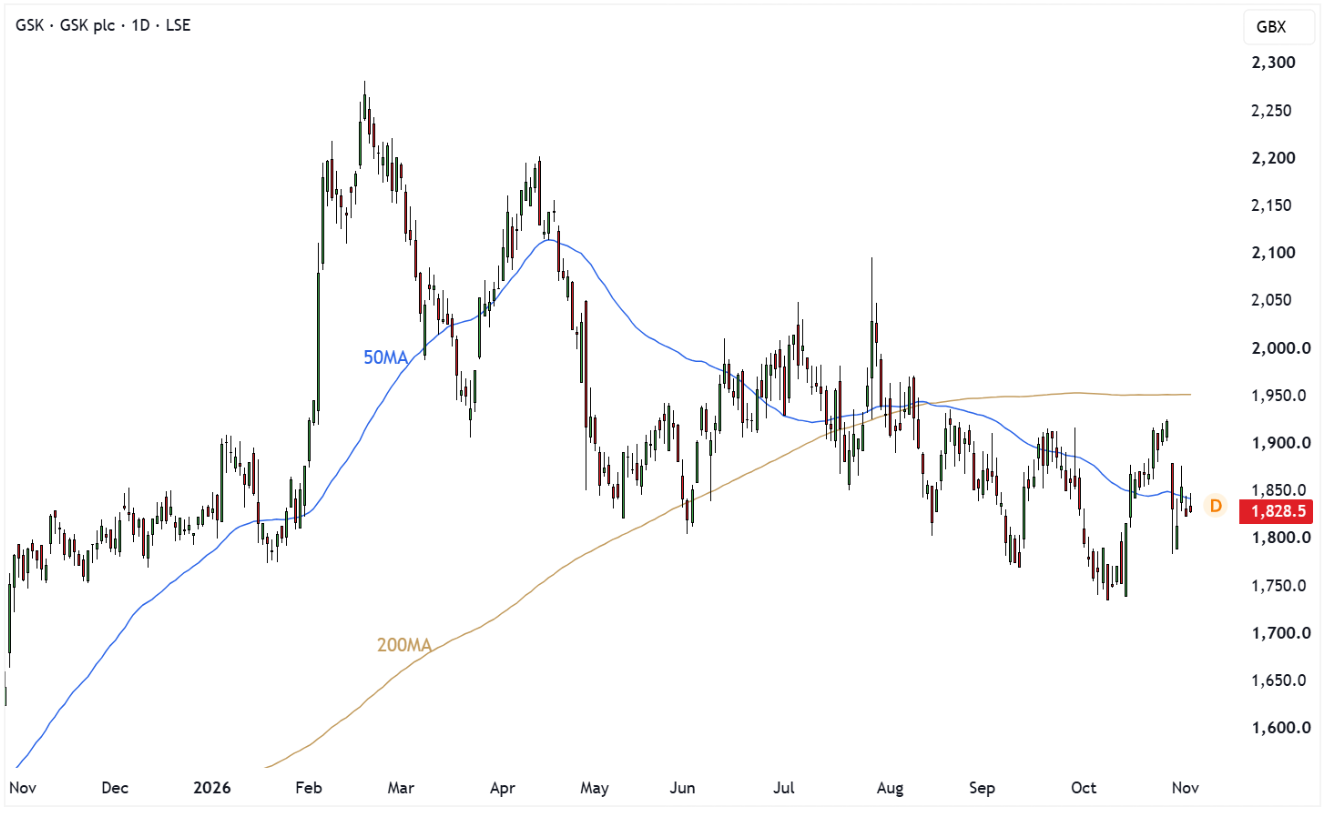
GSK shares fell sharply following its third-quarter results, despite the pharmaceutical group reporting sales and profits ahead of market expectations. Quarterly revenue reached £8.89bn, an increase of 5% at constant exchange rates, supported by 15% growth in Specialty Medicines. However, core earnings per share increased by just 1% to 54.6p, highlighting the gap between revenue growth and the earnings being delivered to shareholders. The market’s negative reaction suggests investors are becoming increasingly focused on the cost of expanding GSK’s drug portfolio and the pace at which newer medicines can generate meaningful returns.
Vaccines remain an area of concern, with divisional sales declining 2% to £2.58bn. Shingrix and Arexvy both experienced weaker demand, while the newer asthma treatment Exdensur fell short of market expectations. At the same time, research and development spending increased substantially as GSK continued investing in its pipeline. The company has made progress with new approvals and late-stage clinical programmes, but investors appear to want clearer evidence that this spending will translate into sustained earnings growth. Management reaffirmed its full-year outlook, although core earnings growth is now expected towards the lower end of its existing range.
There are positives beneath the disappointing share price reaction. Specialty Medicines continues to grow at an attractive rate, while quarterly free cash flow increased 67% to £2.08bn. However, net debt has risen to £20.7bn following acquisitions, adding another consideration as the company pursues its expansion plans and £1.9bn cost-saving programme. Our view is that GSK’s underlying business remains capable of delivering growth, but the market is becoming less willing to give management the benefit of the doubt. Stronger commercial performance from new treatments, alongside better conversion of sales growth into earnings, would help restore confidence.
What we are watching next: Vaccine demand, uptake of newer specialty medicines including Exdensur, progress with the cost-saving programme and the impact of acquisitions on earnings and debt.
Themes: Specialty Medicines | Vaccine Demand | Earnings Growth
GSK Daily Candle Chart
NatWest Group (NWG): Investors Question Future Income
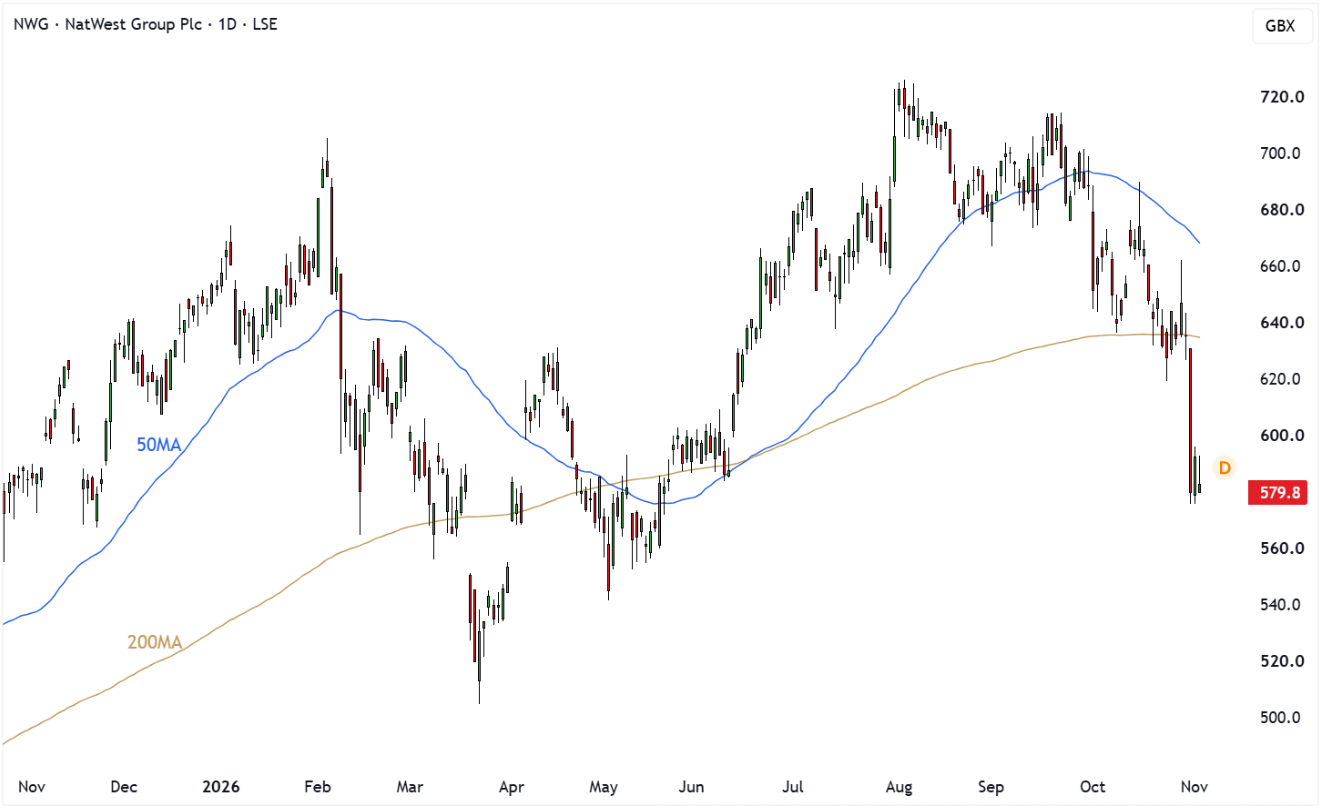
NatWest shares suffered a sharp decline following its third-quarter results, despite the bank continuing to deliver strong profitability and returns. Operating profit before tax reached £2.23bn, marginally ahead of the equivalent period last year, while total income increased 7.1% to £4.64bn. Return on tangible equity remained impressive at 21.6%, and net interest income rose almost 9% year on year. However, the market was less concerned with the profitability already achieved than with the outlook for interest income over the next couple of years.
Net interest margin edged up to 2.50% from 2.49% in the previous quarter, but investors remain cautious about the sustainability of earnings as interest rates, deposit costs and lending competition evolve. NatWest reaffirmed the guidance provided at its half-year results rather than raising expectations, while analysts at Jefferies highlighted continuing downside risks to consensus net interest income forecasts for 2027 and 2028. Impairment charges also increased to £277m from £140m in the previous quarter, although much of the rise reflected the absence of favourable releases recorded earlier in the year rather than a sudden deterioration in credit quality.
There is still plenty to like about the underlying business. Customer lending and deposits increased during the quarter, operating efficiency continued to improve and the acquisition of Evelyn Partners is expanding NatWest’s wealth management capabilities. The CET1 capital ratio also strengthened to 13.5%, providing reassurance over the bank’s capital position. Nevertheless, banking shares are particularly sensitive to changes in earnings expectations, and the market appears to be questioning whether current profitability can be sustained. We remain encouraged by NatWest’s returns and operational progress, but the outlook for net interest income will be central to how the shares perform from here.
What we are watching next: Net interest income guidance for 2027 and 2028, deposit pricing, impairment trends and the contribution from Evelyn Partners as integration progresses.
Themes: Net Interest Income | Banking Margins | Capital Returns
NWG Daily Candle Chart
Rentokil Initial (RTO): Early Signs of a Turnaround
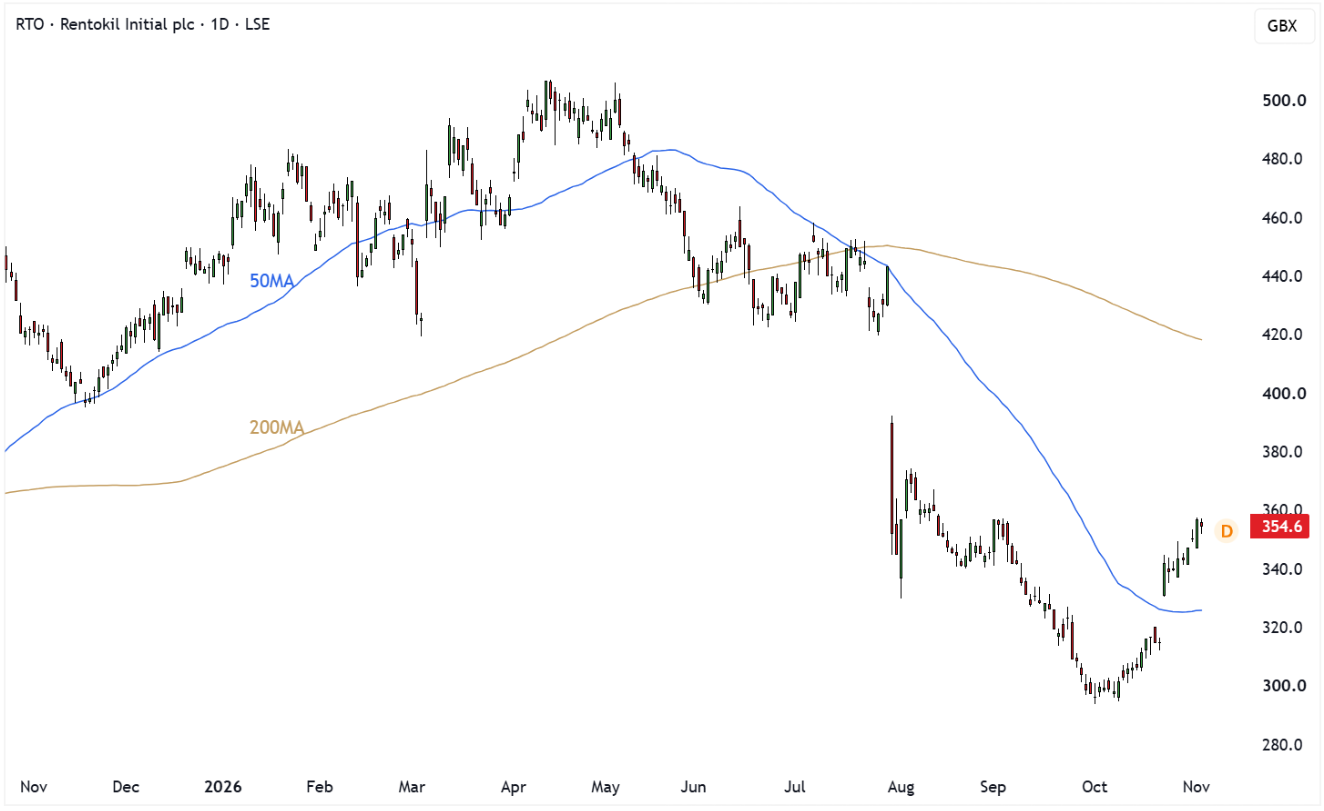
Rentokil shares moved sharply higher following a third-quarter trading update that offered encouraging signs of progress in its North American pest control business. Group organic revenue increased 3.4%, with North America Pest Control Services delivering growth of 2.4%. While that figure remains relatively modest, management reported improving trends through the quarter, particularly in residential customer enquiries. Lead volumes, which had been weak earlier in the summer, recovered to a decline of approximately 1% in September. For a business that has struggled to restore momentum in its largest market, even modest evidence of improvement is significant.
Chief executive Mike Duffy has been focusing on improving customer retention, sales conversion and operational consistency across the North American branch network. The company is separating its residential and commercial operations to give each business greater focus, while introducing new processes designed to improve service delivery and customer acquisition. There were encouraging signs in customer retention, which increased to 81.1%, while employee retention also improved. Outside North America, the International Pest Control business continued to perform well, delivering organic revenue growth of 5.7%, with the UK particularly strong. This provides a useful reminder that Rentokil’s difficulties have been concentrated in specific parts of the business rather than across the entire group.
The announcement also included a $200m share buyback programme, supported by a stronger balance sheet and the planned disposal of SOLitude Lake Management for estimated net cash proceeds of $180m. Management expects full-year profit to remain in line with market expectations, while operational savings elsewhere in the group are intended to fund further investment in North America. We view the update as an encouraging step in the recovery, particularly as it combines improving operational trends with more disciplined capital allocation. However, one quarter does not establish a lasting turnaround. The next challenge is to convert better lead generation and retention into sustained organic growth and improved profitability in the North American business.
What we are watching next: North American residential lead volumes, customer retention, progress with the operational improvement programme and whether organic growth continues to accelerate into 2027.
Themes: North American Recovery | Operational Efficiency | Share Buybacks
RTO Daily Candle Chart
Disclaimer:
All content is provided for general information only and should not be construed as any form of advice or personal recommendation. The provision of this content is not regulated by the Financial Conduct Authority.