


14th Oct 2026. 8.59am

Regency View:
BUY Oxford Instruments (OXIG)
- Growth

Regency View:
BUY Oxford Instruments (OXIG)
A New Phase of Growth Takes Shape
There is often a considerable gap between developing a promising technology and turning it into a profitable commercial business. Companies can spend years refining products, building manufacturing capacity and establishing customer relationships before the financial rewards become apparent. For investors, the interesting point comes when that investment begins translating into larger orders, stronger revenues and improving profitability.
That is what makes Oxford Instruments (OXIG) particularly interesting following its latest trading statement. The FTSE 250 tech group has reported a remarkable acceleration in demand for its Advanced Technologies division, while its share price appears to be emerging from several months of consolidation.

At the heart of advanced manufacturing
Oxford Instruments supplies specialist equipment used to develop, manufacture and analyse advanced materials and components. Its products serve semiconductor manufacturing, materials science and scientific research, where precision, technical expertise and reliability are essential.
The business operates through two divisions. Imaging and Analysis is the larger, more established operation, supplying sophisticated instruments used by research institutions and industrial customers to examine materials at microscopic and atomic levels.
Advanced Technologies is where the more exciting growth opportunity is developing. The division supplies equipment used to manufacture advanced semiconductor and photonic devices, including components involved in high-speed optical communications.
As data centres and AI infrastructure expand, the need to transmit information quickly and efficiently is becoming increasingly important. Oxford Instruments is positioned within the manufacturing supply chain for these technologies, supplying equipment that enables customers to produce the components rather than competing directly in the end markets.
What makes this particularly interesting is the changing nature of its customer base. Historically, much of the division’s activity centred on R&D, but it is increasingly securing larger contracts from manufacturers moving towards commercial production. That transition has the potential to change the scale and profitability of the business.
Orders are accelerating
The trading statement released this week on Tuesday provides compelling evidence that this commercial transition is gathering momentum.
Group orders increased by almost 44% during the six months to September, while reported revenue rose 8%, or 9% at constant currency. Management also expects the adjusted operating margin to improve by more than one percentage point compared with the equivalent period last year.
The standout performance came from Advanced Technologies, where orders surged 125%, with approximately three-quarters associated with datacom applications. Management highlighted new commercial volume-manufacturing customers, reinforcing the view that demand is moving beyond traditional research applications.
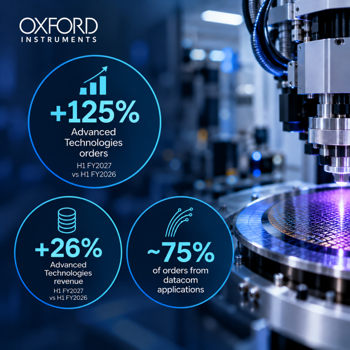
Perhaps most encouragingly, the division’s orderbook now extends well into the financial year ending March 2028, with expected revenue for the current financial year already fully covered by orders. This provides valuable visibility for a business supplying complex manufacturing systems with relatively lengthy production and delivery schedules.
Advanced Technologies revenue increased 26% during the first half, accompanied by a material improvement in operating margins despite continued investment in manufacturing capacity. Imaging and Analysis also performed well, recording 11% order growth and improved profitability.
Management has maintained its full-year expectations rather than issuing an earnings upgrade, but the strength of the orderbook suggests the more significant financial benefits could emerge beyond the current financial year.
Why profitability could accelerate
Looking back through Oxford Instruments’ 2026 Annual Report helps explain why these developments are particularly interesting.
During the financial year ended March 2026, Advanced Technologies generated revenue of £108.5m but adjusted operating profit of just £2.8m, representing a margin of only 2.6%. That is surprisingly modest profitability for a specialist technology business, particularly one supplying equipment into technically demanding markets.
The explanation lies partly in the division’s transition towards larger commercial manufacturing contracts. Orders were growing considerably faster than revenue, while Oxford Instruments was investing in the infrastructure needed to support future production, including its Severn Beach manufacturing facility.
This creates an interesting opportunity because a substantial amount of investment has already been made. As larger orders move through production, there is potential for revenue to increase faster than operating costs, delivering a meaningful improvement in profitability.
The latest trading statement suggests this process is beginning to take shape, although converting large orders into profitable revenue remains an important execution challenge.
Encouragingly, the balance sheet provides considerable flexibility. Net cash increased to approximately £75m at the end of September from £45.1m a year earlier, while £83m of the company’s £100m share buyback programme has already been completed.
A premium valuation with growth potential
The principal reservation is valuation, with Oxford Instruments trading on approximately 27 times forecast earnings for the financial year ending March 2027 and 24 times expectations for March 2028.
These are demanding multiples, particularly when current forecasts suggest earnings per share of approximately 111p for FY2027 and 126p for FY2028. With a prospective dividend yield below 1%, the investment case rests firmly on capital growth.
However, there is an important distinction between paying a premium for an established business with limited growth prospects and paying one for a company whose earnings potential may be changing.
Oxford Instruments increasingly falls into the latter category. Its expanding commercial orderbook and improving margins suggest that future earnings could develop more strongly than current forecasts imply, although the timing of large contracts and potential customer concentration remain important risks.
We are therefore comfortable with the premium valuation, provided the company continues demonstrating that its accelerating orders can translate into sustained revenue growth and improving profitability.
Emerging from consolidation
The technical picture adds another encouraging element, particularly following the extended period of consolidation that developed after the shares’ strong advance earlier this year.
Oxford Instruments rallied from around 2,000p at the beginning of 2026 to highs above 3,300p in late May, before entering a corrective phase characterised by lower highs and increasingly compressed price swings.
Prices found support around 2,550p to 2,600p, close to the rising 200-day moving average. The subsequent recovery was strong enough to break above the descending resistance line that had contained the market since May, suggesting the corrective structure may be ending.
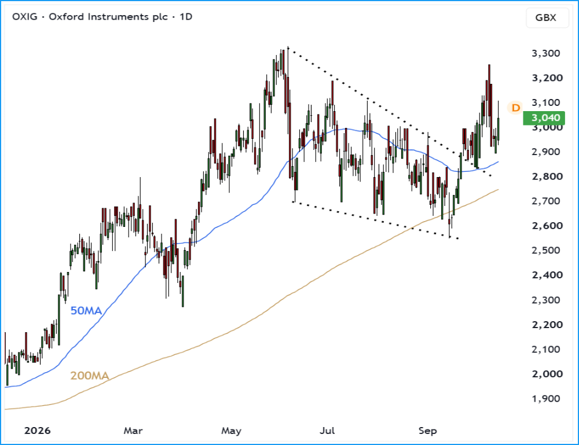
The shares have also reclaimed the 50-day moving average, which is beginning to turn higher, while the longer-term 200-day average continues to rise. Although sellers have emerged around 3,150p to 3,200p, the latest pullback has remained above the 50-day average, with the shares trading around 3,030p.
What makes the timing particularly interesting is that the shares appear to be emerging from consolidation just as the underlying business is reporting a substantial acceleration in demand. This alignment between improving fundamentals and strengthening price action supports our positive house view.
Five key takeaways
1. Commercial demand is accelerating: Advanced Technologies orders increased 125%, driven by datacom applications and new manufacturing customers.
2. Strong earnings visibility: The orderbook extends well into FY2028, providing a foundation for future revenue growth.
3. Potential operating leverage: Historically modest divisional margins leave considerable room for improvement as production volumes increase.
4. Constructive technical setup: The shares have broken above descending resistance following several months of consolidation.
5. Growth at a premium: The valuation is demanding, but improving commercial demand could support stronger earnings over the coming years.
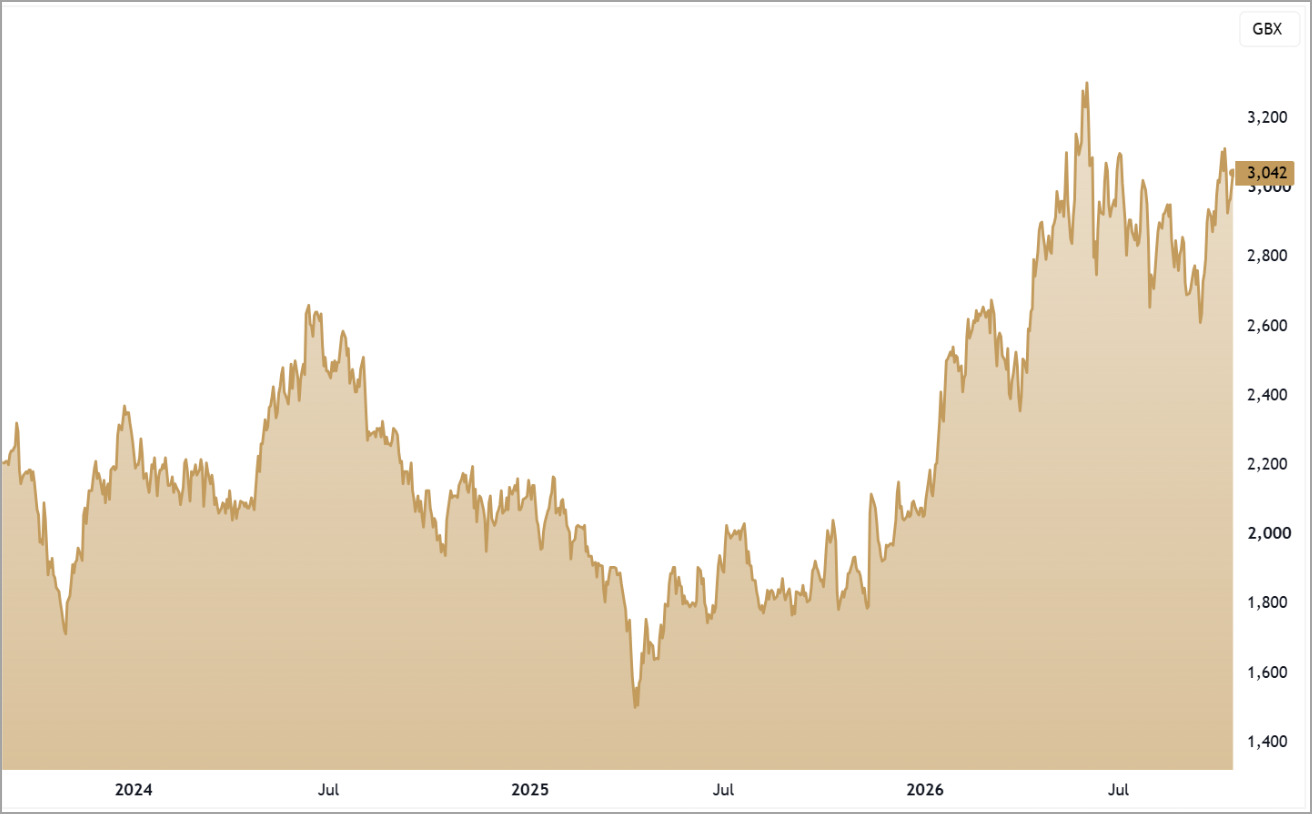
OXIG 3-Year Chart
Disclaimer:
All content is provided for general information only and should not be construed as any form of advice or personal recommendation. The provision of this content is not regulated by the Financial Conduct Authority.