


2nd Oct 2026. 10.49am

Weekly Briefing – Friday 2nd October
| Market | Movement this week (%)* |
|---|---|
| FTSE 100 | -2.17% |
| FTSE 250 | -0.05% |
| FTSE All-Share | -1.92% |
| AIM 100 | +0.81% |
| AIM All-Share | +0.41% |
* Price movement from Monday's open at 8am
Regency View:
Weekly Briefing – Friday 2nd October
Market Overview
Dear Investor,
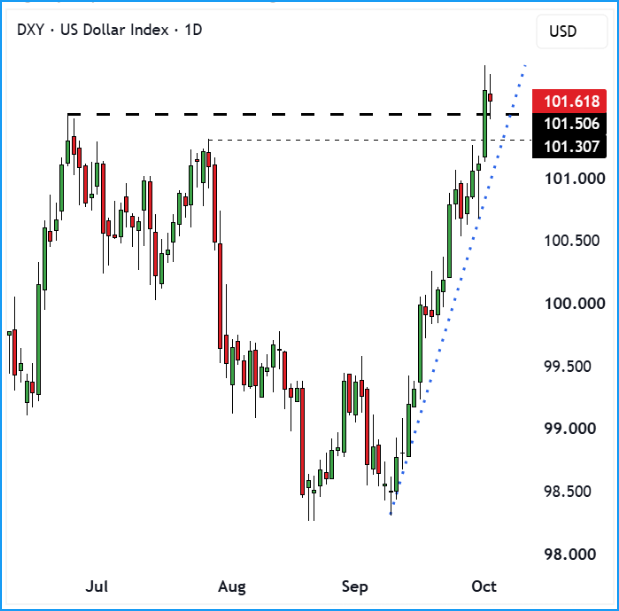
This week has once again been dominated by dollar strength and jitters in the bond market, although the moves have become increasingly difficult for equity investors to ignore. The US Dollar Index surged to its highest level since April 2025, while government bond yields climbed sharply across several major markets as investors continued to wrestle with inflation, rising borrowing requirements and the prospect of interest rates remaining higher for longer.
The dollar has been one of the clearest beneficiaries. Higher US yields have increased the attraction of dollar-denominated assets, while concerns over government finances in parts of Europe have put additional pressure on the euro. The result has been a fairly decisive move through the highs reached during the summer, with the Dollar Index breaking above the 101.3 to 101.5 area that had previously capped its progress.
There has also been an interesting divergence in equity markets. The S&P 500 has remained relatively steady close to its highs, suggesting investors haven’t suddenly lost their appetite for risk, but the mood has been considerably less comfortable on this side of the Atlantic. The FTSE, DAX and CAC have all lost ground this week as rising bond yields and renewed concerns around government finances have given investors rather more to think about.
For UK investors, a stronger dollar isn’t necessarily good or bad news in isolation. The FTSE contains plenty of businesses earning a significant proportion of their revenues overseas, meaning dollar strength can provide a useful translation benefit when those earnings are brought back into pounds. Commodity producers also operate in markets largely priced in dollars, while companies reliant on imported goods or dollar-denominated costs can find themselves on the other side of the equation. The impact therefore depends considerably more on the individual company than the direction of the index might suggest.
That distinction is particularly relevant when markets become unsettled. Higher borrowing costs and a stronger dollar create a tougher backdrop for some businesses, but they can simultaneously improve the relative position of others, and the UK market contains plenty of exposure to both sides of that divide. With the FTSE coming under pressure this week while Wall Street has remained comparatively resilient, there is an understandable temptation to focus on the difference between the two markets. For us, the more useful question is what the changing backdrop means for the individual UK companies sitting underneath the index.
Wishing you a great weekend,
Tom
Thomas Light – Chartered FCSI
Director of Research

Market Movers
On the rise: Saga (LSE: SAGA) +25.4% on the week
Saga shares jumped after a strong set of half-year results prompted management to raise its full-year profit expectations and suggest that one of its key medium-term targets could now be reached ahead of schedule. Underlying pre-tax profit almost doubled to £46.6 million during the six months to the end of July, helped by continued strength across its cruise and holidays businesses alongside an improving performance from insurance.
The upgrade was the part that really caught investors’ attention. Saga now expects underlying pre-tax profit of between £65 million and £70 million for the full year, compared with £44.2 million from continuing operations last year, while management believes its target of generating at least £100 million of annual underlying pre-tax profit could be achieved ahead of the original January 2030 deadline. There are still some risks during the second half, particularly disruption from the Middle East conflict and low river levels in Europe, but the direction of travel has become considerably more encouraging.

Perhaps more importantly, the results provide further evidence that Saga’s overhaul is beginning to produce a very different business. The sale of its insurance underwriting operation has reduced the amount of capital tied up in insurance, leaving Saga focused more heavily on owning the customer relationship and distributing products, while cruises, holidays and travel insurance provide the main avenues for growth. Net debt has also been moving lower, addressing an issue that weighed heavily on the investment case for several years.
Regency View: Saga’s turnaround has moved beyond simply repairing the balance sheet, with stronger trading now feeding through into rapidly improving profits and management bringing its medium-term ambitions closer. The shares have already risen around 145% over the past year and are trading close to their 52-week high, so expectations are considerably higher than they were, but the latest upgrade provides genuine earnings support for that rerating.
Rockhopper Exploration came under further pressure despite half-year results showing that development of its flagship Sea Lion oil project in the Falkland Islands remains on schedule. The shares have now fallen more than 35% over the past six months, with renewed tensions between Argentina and the UK over oil development around the islands adding another layer of uncertainty to what was already a fairly speculative investment case.
Operationally, there was actually plenty of progress in this week’s update. The first phase of Sea Lion remains fully funded and is targeting first oil in the first quarter of 2028, with development drilling expected to begin early next year. Rockhopper’s 35% interest now includes 110 million barrels of 2P reserves and 219 million barrels of 2C resources, while an updated independent assessment increased the post-tax NPV10 attributed to its 2P and 2C interests from $2.16 billion to $2.95 billion.

The complication is politics. Argentina has recently stepped up its threats against companies and individuals involved in Falkland Islands oil development, creating renewed headlines around a dispute that has followed Sea Lion for years. Both the UK and Falkland Islands governments have rejected the Argentine measures, while project operator Navitas maintains that the dispute is not expected to have a material impact on Sea Lion’s development timetable. For investors, however, it introduces another risk that is difficult to quantify when the project is still some way from producing its first barrel.
Regency View: Sea Lion continues to make tangible progress and the latest independent valuation highlights the scale of the asset Rockhopper is trying to bring into production, but the investment case remains heavily dependent on successful execution between now and first oil in 2028. Recent political noise has provided investors with another reminder of the risks attached to that journey, although for now there is nothing in this week’s update to suggest it has knocked the project itself off course.
Sector Snapshot
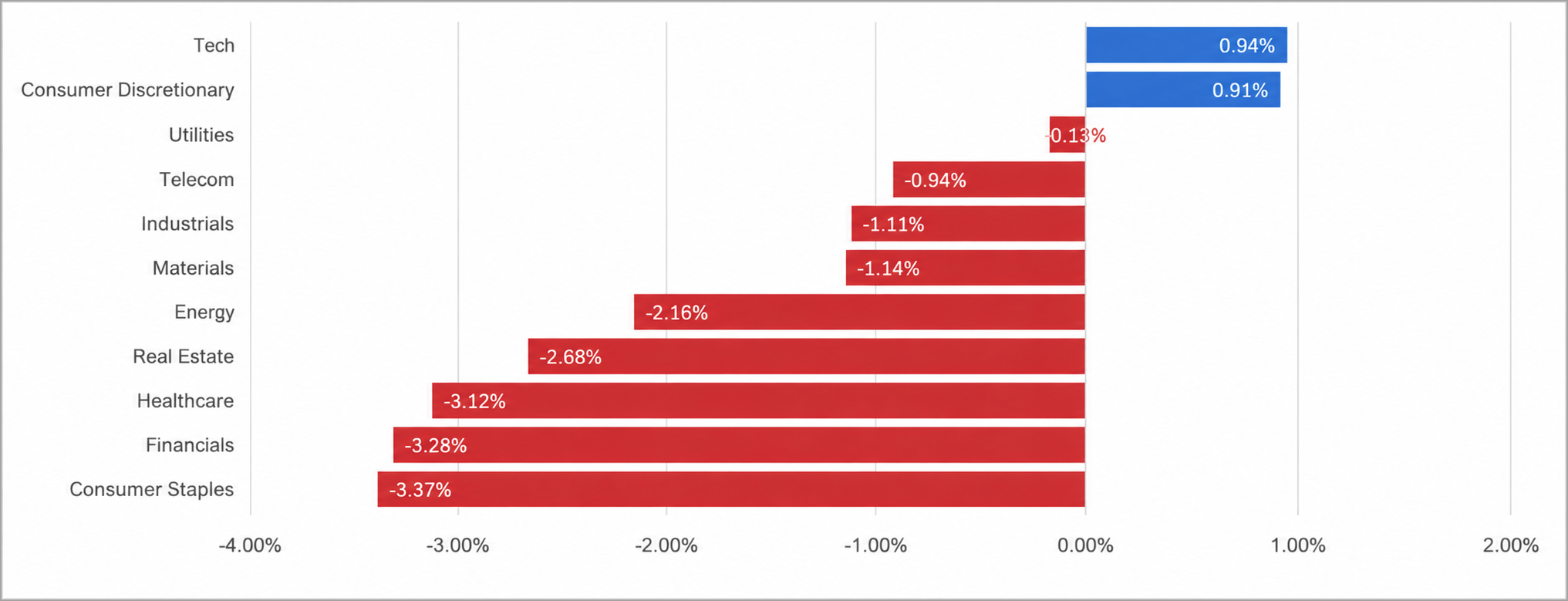
Tech and Consumer Discretionary were the only sectors to make positive ground this week, although gains were relatively modest at 0.94% and 0.91% respectively. Utilities was broadly flat, while Telecom, Industrials and Materials recorded more noticeable declines as weakness once again spread across the majority of the market.
The heavier selling was concentrated elsewhere, with Energy and Real Estate both falling by more than 2%, while Healthcare, Financials and Consumer Staples brought up the bottom of the table with declines of more than 3%. Overall, the sector picture remained fairly defensive, with nine of the eleven sectors finishing lower and the relatively small gains among the week’s leaders doing little to offset the broader weakness.
UK Sector Performance (7-Days)
UK Price Action
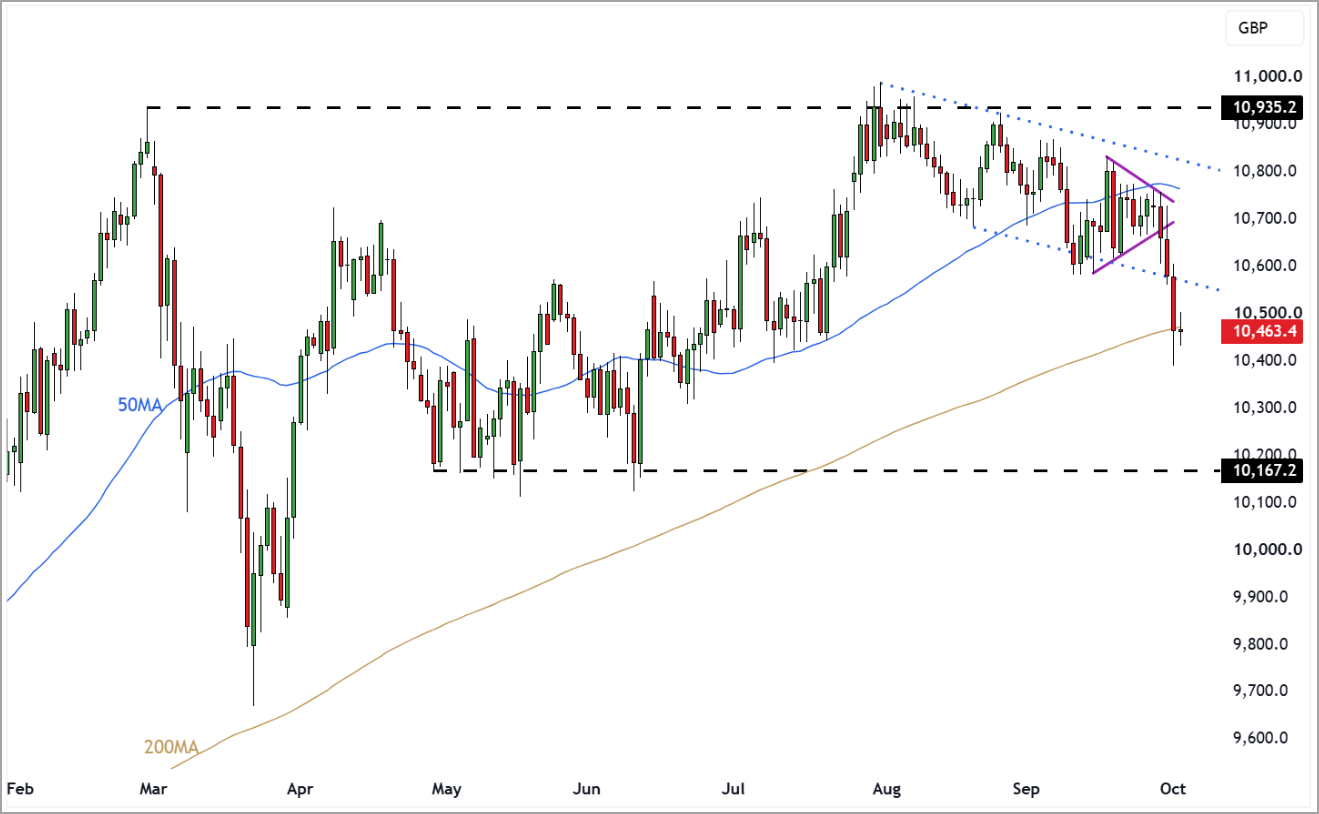
We mentioned in last week’s UK Price Action that the FTSE’s increasingly tight compression was worth watching because periods like this can often precede a more volatile directional move. This week’s price action has been a good example, with the index breaking decisively lower from that compression and extending the descending channel that has been developing since the August highs.
More importantly, the sell-off has taken the FTSE below its 50-day moving average and through the lower boundary of the channel, with selling accelerating into Thursday. That puts the focus on the rising 200-day moving average, which is now being tested for the first time since the recovery from the March lows. The market is becoming increasingly stretched in the short term, but after such a decisive break, the response around the 200-day average should tell us more than simply assuming the sell-off has gone too far.
UK100 Daily Candle Chart
Disclaimer:
All content is provided for general information only and should not be construed as any form of advice or personal recommendation. The provision of this content is not regulated by the Financial Conduct Authority.