


23rd Sep 2026. 8.55am

Regency View:
Update
Regency View:
Update
Autumn reporting season is beginning to gather pace, and there has been plenty for us to digest across the FTSE Investor portfolio over the past fortnight. Kingfisher and Kier have been rewarded for stronger results and improved guidance, Bytes has continued its recent recovery with another upgrade, while Associated British Foods has provided a reminder that the outlook is not improving evenly across every part of the portfolio.
Associated British Foods: Sugar Clouds the Outlook
Associated British Foods (ABF) kept its expectations for the current financial year broadly intact in its latest trading update, but the market was more concerned by what lies ahead. Primark sales increased by 2% during the fourth quarter, although like-for-like sales fell 3%, with continued weakness in continental Europe offsetting a more resilient performance in the UK and Ireland. Management still expects Primark to deliver an adjusted operating margin of around 10% for the full year.
The bigger disappointment came from Sugar. ABF expects the division to report an adjusted operating loss towards the upper end of its previous £25m to £60m range this year, before losses potentially widen to somewhere between £70m and £170m in FY27. That is an unusually broad range and reflects uncertainty around European sugar prices, energy costs, African production, weather and currencies. Grocery also has some work to do, with weaker trading at Twinings and Ovaltine and the recently acquired Hovis expected to make a loss during its first year of consolidation.
There were some more encouraging details beneath the headline numbers. Primark’s UK business remains relatively resilient, womenswear is performing well and the decision to introduce home delivery in Great Britain marks a significant evolution of its previously store-led model. With the planned separation of Primark from the Food businesses progressing towards completion in December 2027, however, investors are increasingly likely to judge the two sides independently. The immediate task is therefore to stabilise Sugar while demonstrating that Primark can return to like-for-like growth rather than relying primarily on new space.
What we are watching next: Primark’s performance in continental Europe, the development of home delivery in Great Britain and whether the outlook for Sugar begins to narrow as ABF moves into FY27.
Themes: Primark | Sugar | Demerger
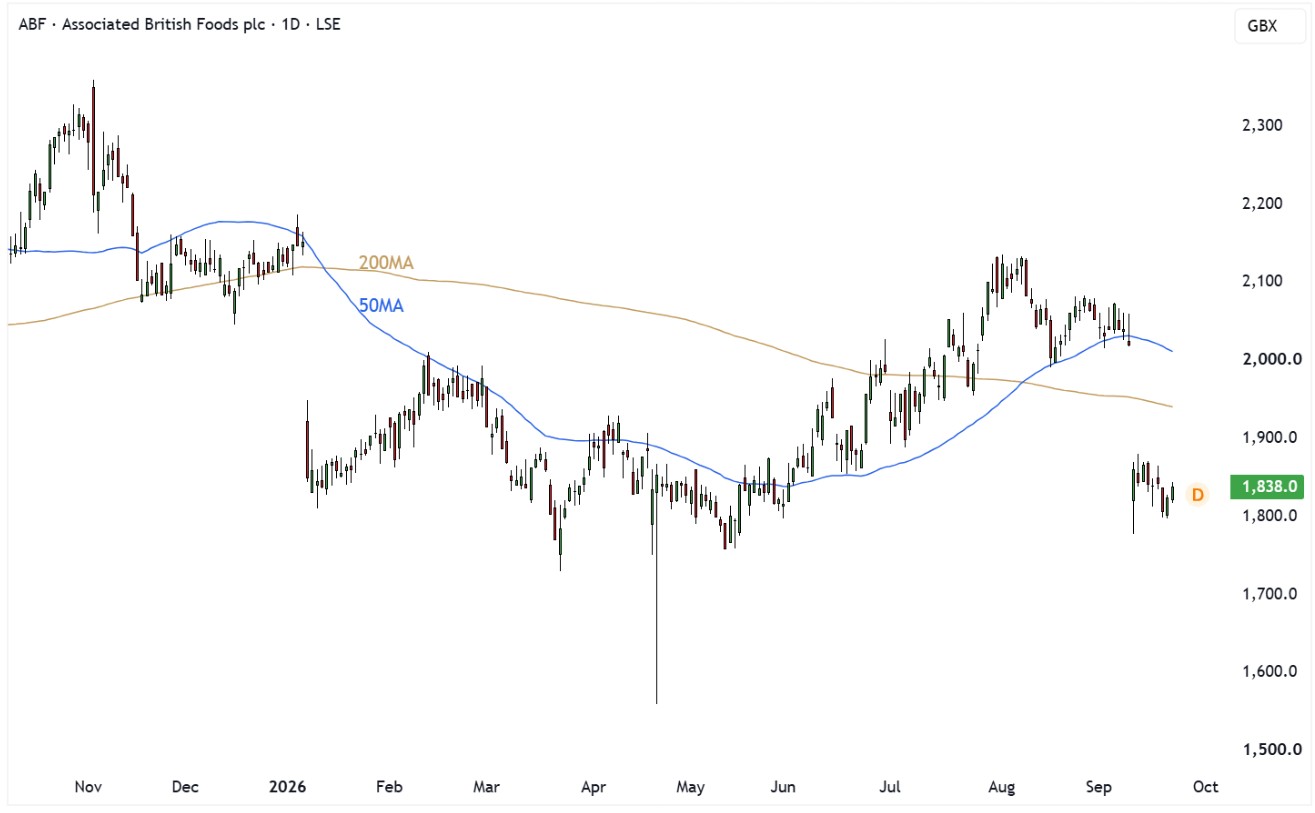
ABF Daily Candle Chart
Bloomsbury Publishing: Newton Begins a Long Goodbye
Bloomsbury Publishing (BMY) has started what will eventually be a significant changing of the guard, although nobody is being rushed out of the building. Founder and Chief Executive Nigel Newton has moved into the role of Executive Chairman as part of a five-year succession plan designed to gradually transfer leadership of the business he founded 40 years ago.
The next major step will come in two years, when Bloomsbury plans to appoint a new Chief Executive following a search considering both internal and external candidates. Newton will then remain Executive Chairman for the first three years of the new Chief Executive’s tenure before becoming Non-Executive Chairman in 2031. Meanwhile, former Chairman John Bason becomes Deputy Chairman and Senior Independent Director and will lead the process of finding Newton’s eventual replacement as Chief Executive.

There are always additional questions when a founder who has been so closely associated with a company’s development begins to step away, but Bloomsbury is giving itself plenty of time to manage the process. Newton’s continued involvement should preserve important author and industry relationships while allowing a successor to settle into the role gradually. The key will be finding someone capable of maintaining Bloomsbury’s culture and independence while continuing the expansion of the business beyond the publishing franchises that originally made its name.
What we are watching next: The Chief Executive succession process and, eventually, whether Bloomsbury chooses an internal candidate or brings in somebody from outside the business.
Themes: Succession | Governance | Leadership
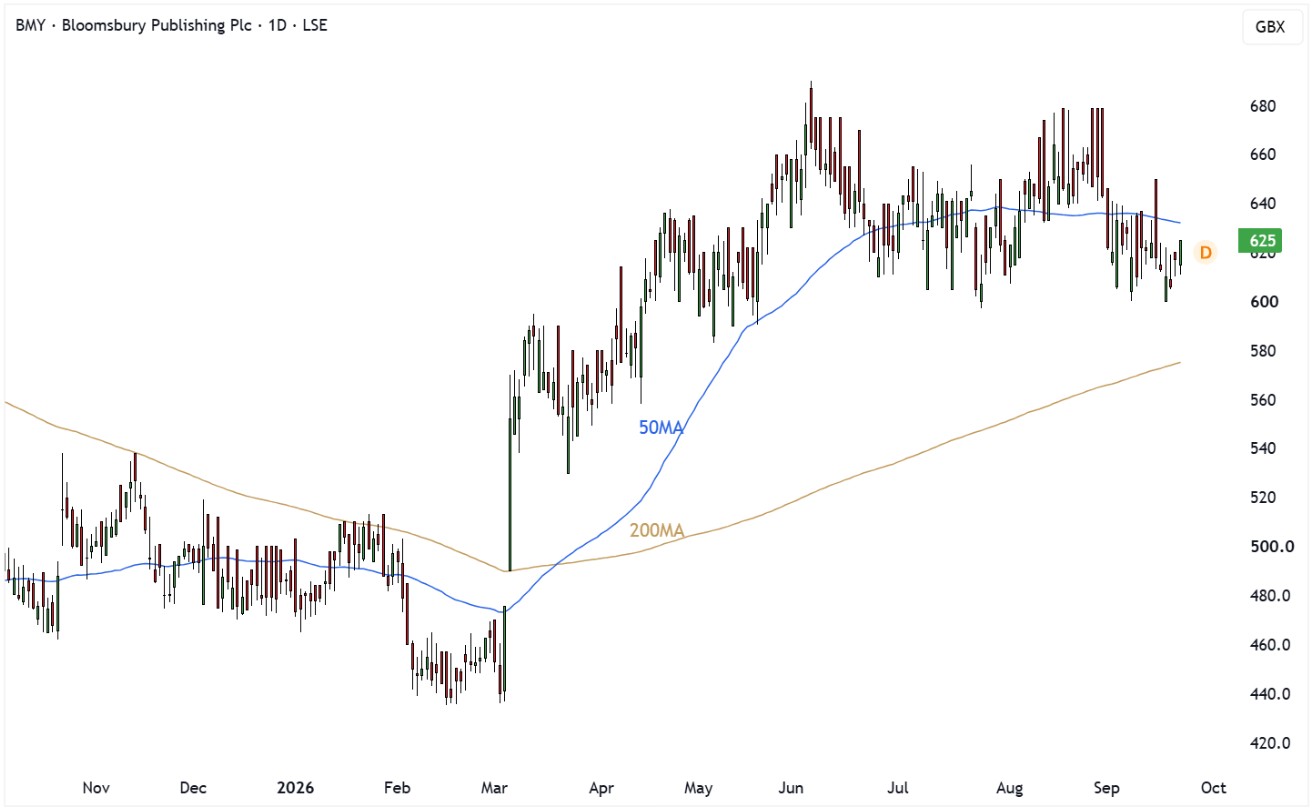
BMY Daily Candle Chart
Bytes Technology: Another Upgrade Keeps the Recovery Moving
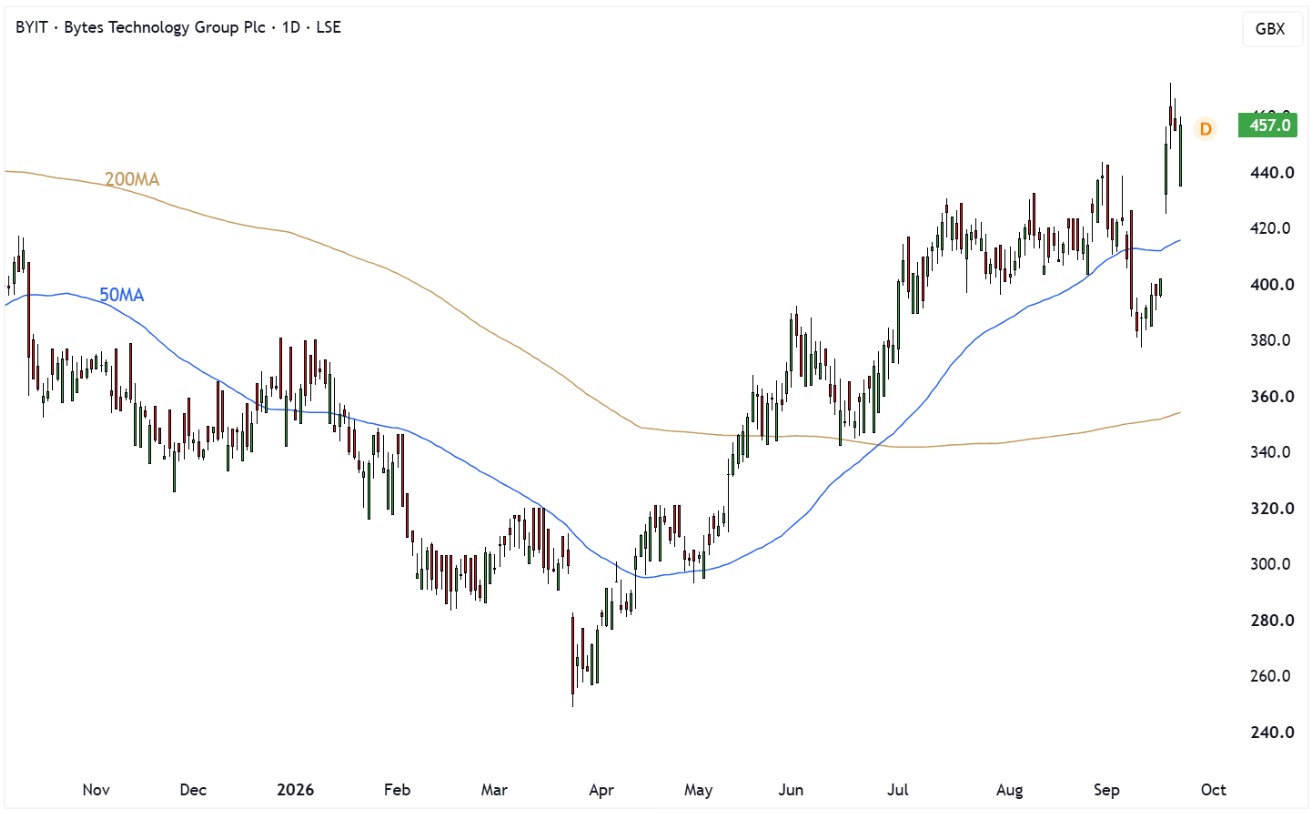
Bytes Technology (BYIT) delivered another encouraging update last week, with stronger-than-expected first-half trading prompting management to raise its expectations for FY27. Gross Invoiced Income is estimated to have increased by around 19% during the six months to the end of August, while Gross Profit grew by around 18%. Operating Profit increased by a more modest 6%, reflecting higher tech investment and the return of staff bonuses towards more normal levels.
Importantly, the improvement appears reasonably broad based. Bytes reported good momentum across both private and public sector customers, with continued demand for software, cloud and security solutions. AI is also becoming a more meaningful contributor across the group’s core markets. Management now expects full-year Gross Profit growth in the low to mid-teens, alongside low to mid single-digit Operating Profit growth.
We covered the update in Friday’s Weekly Briefing after the shares jumped sharply, but it is worth recording here because it adds another piece of evidence that momentum within the business is improving. Bytes finished the half with around £68m of net cash despite returning £41.3m through dividends and share buybacks, leaving the balance sheet in excellent shape. The shares have recovered strongly, so expectations are becoming more demanding, but the operational direction continues to improve ahead of the full interim numbers next month.
What we are watching next: The interim results on 13 October, particularly margins, cash conversion and further detail on where AI-related demand is beginning to translate into revenue.
Themes: Software | AI | Recovery
BYIT Daily Candle Chart
GSK: Lung Cancer Pipeline Delivers More Encouraging Data
GSK (GSK) shares moved higher after the company presented positive clinical data from two of its lung cancer programmes. The most eye-catching came from Jideytro, where a trial involving previously untreated patients with ROS1-positive non-small cell lung cancer produced a 94% objective response rate after a median follow-up of 15.2 months. At 12 months, 90% of patients remained progression free, while 70% of those with measurable brain metastases achieved complete clearance of detectable brain tumours.
There was also positive late-stage data for Ris-Rez, the antibody-drug conjugate licensed from Hansoh Pharmaceutical. The study showed a 54% reduction in the risk of death compared with standard chemotherapy in relapsed small cell lung cancer. Taken together, the results are particularly relevant to GSK’s efforts to build a much larger presence in oncology, with lung cancer one of the areas management has identified for expansion over the coming years.
Jideytro is already approved in the US for ROS1-positive patients who have previously received another targeted treatment, and GSK plans to seek an expansion into first-line treatment this year. Clinical results still need to translate into regulatory approvals and, ultimately, commercial sales, but this is precisely the kind of pipeline progress we want to see. GSK has spent heavily strengthening its oncology portfolio, and the investment case increasingly depends on those newer assets broadening the group’s future growth beyond its established medicines and vaccines.
What we are watching next: Regulatory progress for Jideytro’s first-line indication and further evidence that GSK’s expanding lung cancer pipeline can develop into a meaningful commercial franchise.
Themes: Oncology | Pipeline | Innovation
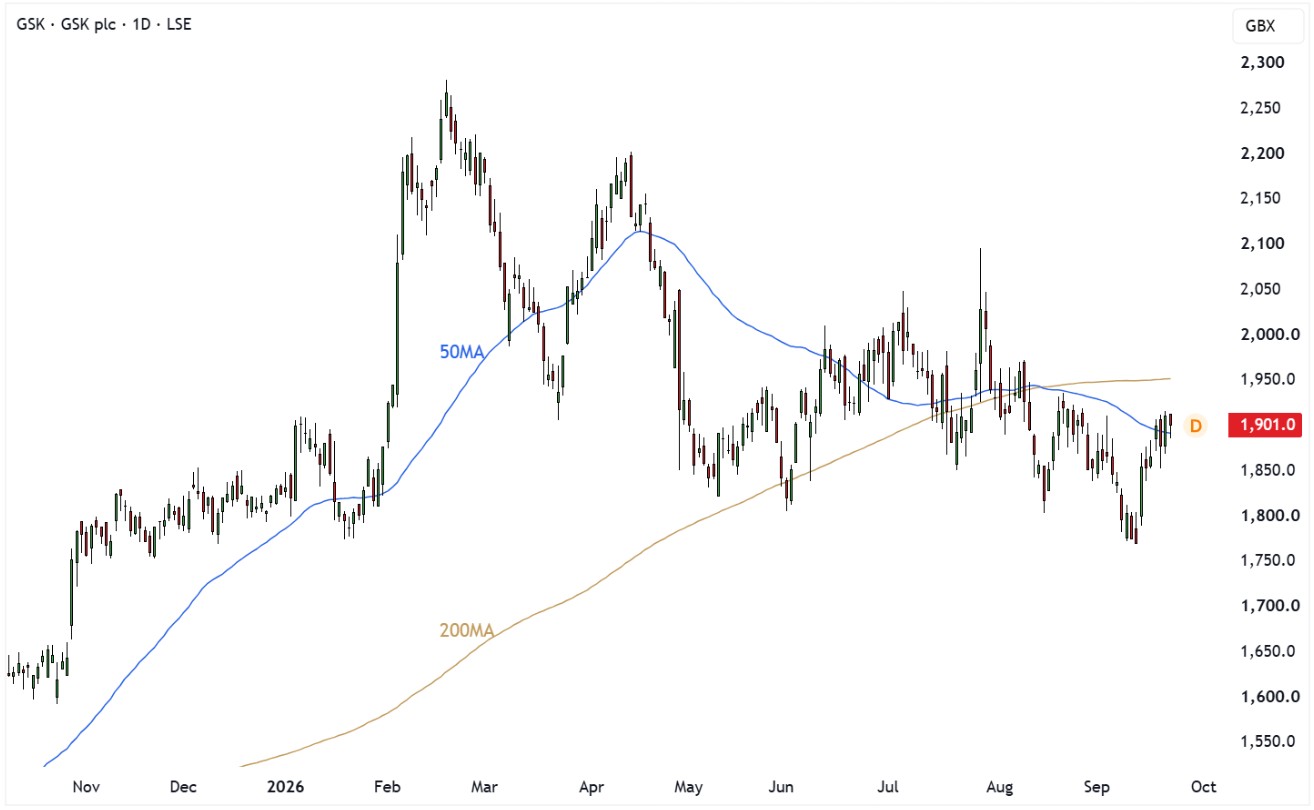
GSK Daily Candle Chart
Investec: Steady Progress, With the UK Lagging Behind
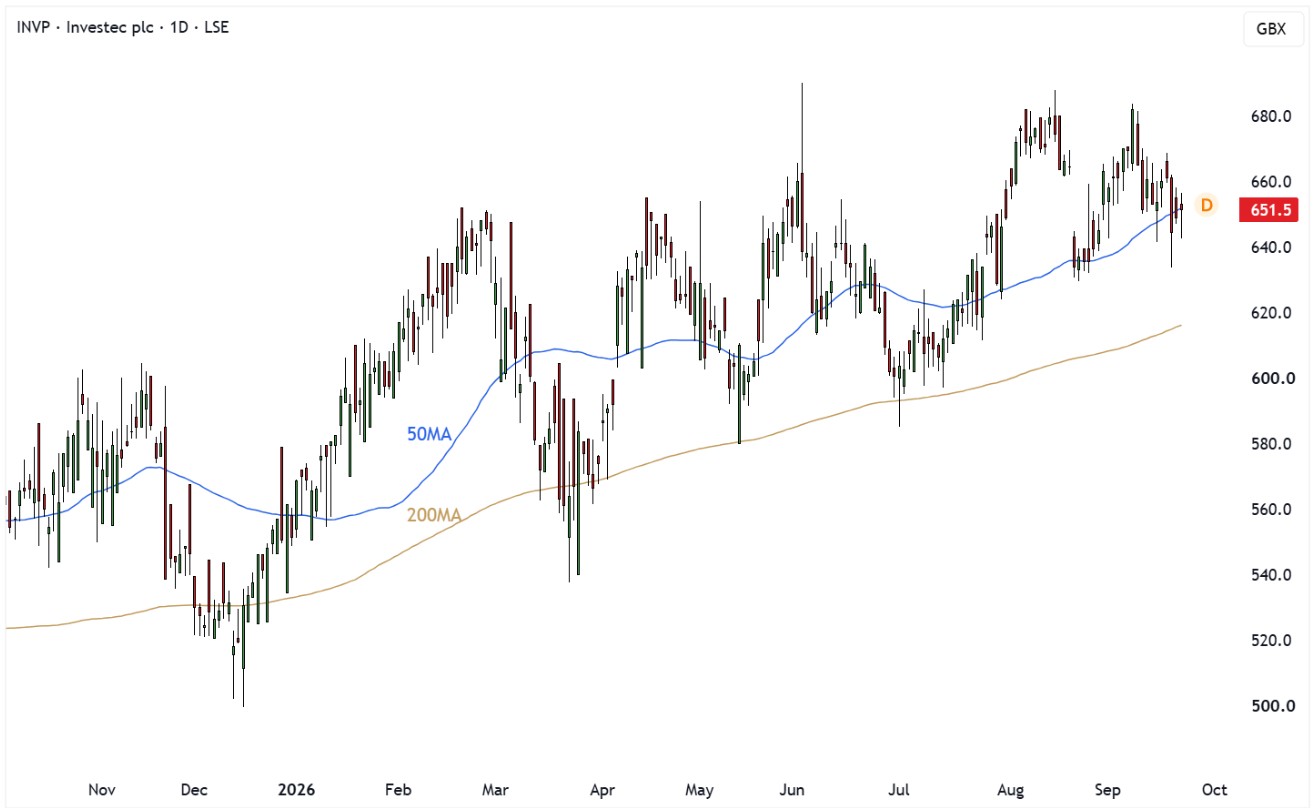
There were few fireworks in Investec’s (INVP) pre-close trading update, which probably explains the relatively muted share-price response. Management expects first-half adjusted earnings per share of between 41.7p and 43.3p, representing growth of 3% to 7%, while adjusted operating profit before tax is expected to reach £479.2m to £496.2m. Credit quality remains sound at group level and both return on equity and return on tangible equity are expected to remain within their guided ranges.
The geographical split was less even. Southern Africa continues to perform strongly, with adjusted operating profit expected to be up as much as 6% in rand terms and 14% in sterling. The UK business, including Investec’s interest in Rathbones, is expected to report adjusted operating profit between 2% and 6% below last year, while the UK Specialist Bank is expected to be down between 3% and 7%. Lower interest rates and competitive pricing are putting pressure on margins, while the UK credit loss ratio is expected to sit around the upper end of its normal range.

There is still plenty of evidence that the underlying franchises are moving forward. Core loans increased at a 6.3% annualised rate in neutral currency during the five months to August, customer deposits grew and Investec’s Southern African wealth business recorded strong inflows. This was a steady rather than spectacular update, but that is not necessarily a bad thing for a bank. The more important question is whether the UK business can regain momentum while the group continues pushing returns towards the upper end of its longer-term targets.
What we are watching next: Interim results on 19 November, with particular attention on UK profitability, credit losses and the effect of lower interest rates on margins.
Themes: Banking | Returns | Credit
INVP Daily Candle Chart
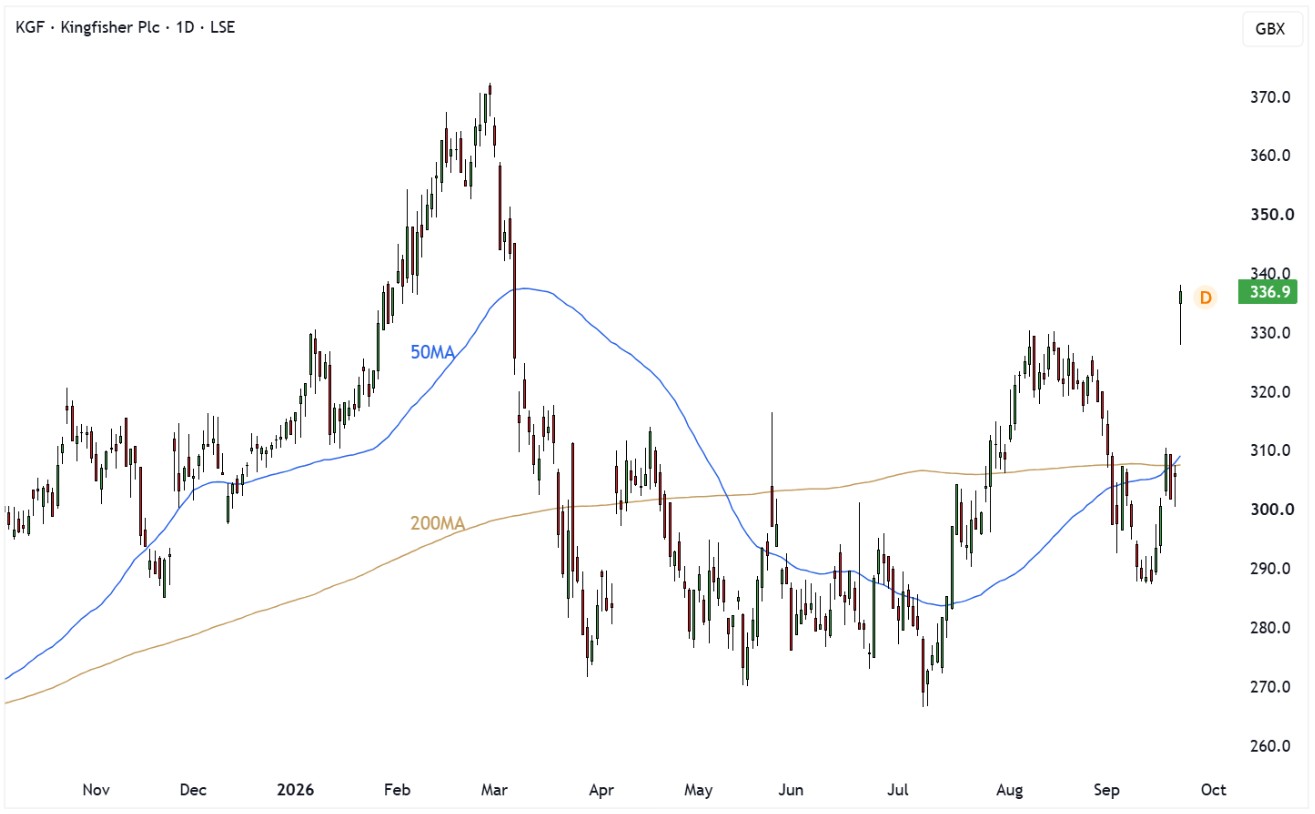
Kingfisher: Better Margins Earn an Upgrade
Kingfisher (KGF) shares jumped after half-year results showed that the home improvement retailer is finding ways to grow profits despite a fairly subdued consumer backdrop. Adjusted pre-tax profit increased by 9.9% to £404m, or 6.1% excluding a £14m one-off business rates refund, while adjusted earnings per share rose 16.1%. Management responded by raising its full-year adjusted pre-tax profit guidance from £565m to £625m previously to a new range of £595m to £635m.
Sales themselves remain fairly pedestrian, with group like-for-like growth of just 0.1% during the half, but there is much more happening underneath. Screwfix remains the standout performer with like-for-like sales up 5.6%, while Poland and Iberia also performed well. Trade penetration reached 31% of group sales and e-commerce penetration increased to 22%, while marketplace GMV jumped 42% to £372m. Gross margin expanded by 70 basis points to 38.4%, demonstrating why profit growth is currently running well ahead of sales.

France remains the obvious weak spot and B&Q like-for-like sales also declined, so this is not yet a story of broad-based demand recovery. What is encouraging is Kingfisher’s ability to improve the economics of the business without waiting for the consumer environment to bail it out. Trade, digital, marketplace and sourcing initiatives are all making a greater contribution, while the ongoing £300m buyback provides another route for surplus capital to reach shareholders. If end markets eventually become more helpful, Kingfisher should be entering that recovery from a considerably stronger position.
What we are watching next: Whether Screwfix can maintain its momentum, signs of improvement at B&Q and in France, and continued progress towards making digital and marketplace a larger contributor to group profits.
Themes: Margins | Trade | Digital
KGF Daily Candle Chart
Kier: The Balance Sheet Transformation Moves Up a Gear
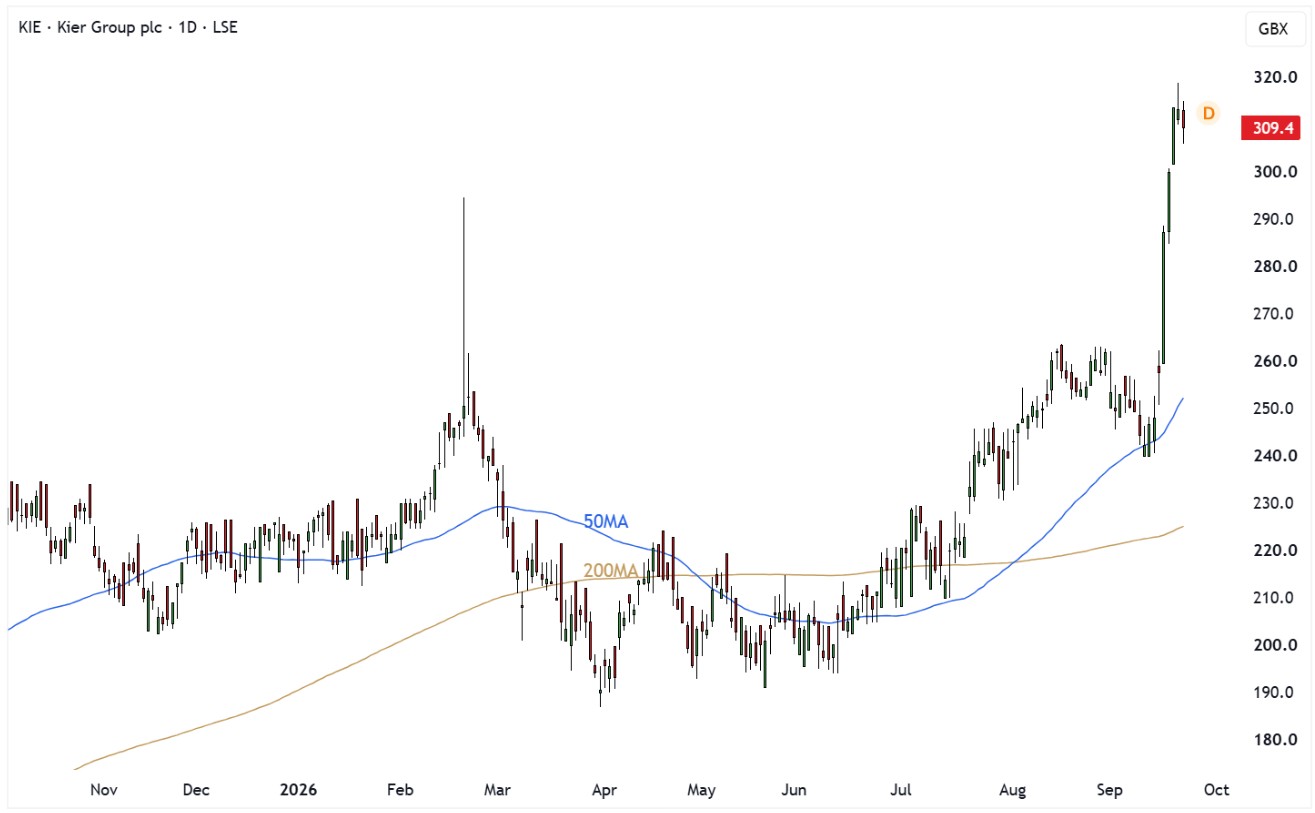
Kier (KIE) has pushed to new trend highs after full-year results provided further evidence of just how far the business has come. Revenue increased 7.5% to £4.39bn and adjusted operating profit rose 6.7% to £169.8m, while operating free cash flow reached £206m. More significantly, Kier achieved average net cash of £10.7m for the year, compared with average net debt of £49.2m last year, marking the first time in more than a decade that the group has achieved an average net cash position.
The forward picture is equally encouraging. Kier’s order book increased 8% to a record £11.9bn, with more than 95% of expected FY27 revenue and more than 70% of FY28 revenue already secured. Infrastructure remains the engine room, with divisional revenue up 10%, adjusted operating profit up 16% and its order book increasing 14% to £7.4bn. Management now expects FY27 earnings to reach the top end of its previous expectations, supported by recent contract wins across healthcare, rail and other infrastructure markets.

There is also a meaningful strategic shift underway. Kier will stop investing in new Property developments from FY27 and redirect capital towards its core Infrastructure and Construction businesses and further balance-sheet improvement. Medium-term targets now include a 4% to 4.5% adjusted operating margin, double-digit adjusted EPS growth and more than £200m of average net cash by FY29. That combination of a record order book, much stronger finances and greater focus on the core business helps explain why the market has responded so positively.
What we are watching next: Delivery against the record order book, further improvement in average net cash and whether the decision to step away from new Property investment helps Kier lift margins and earnings quality as planned.
Themes: Infrastructure | Cash Flow | Growth
KIE Daily Candle Chart
Disclaimer:
All content is provided for general information only and should not be construed as any form of advice or personal recommendation. The provision of this content is not regulated by the Financial Conduct Authority.