


28th Aug 2026. 10.30am
Weekly Briefing Friday 28th August
| Market | Movement this week (%)* |
|---|---|
| FTSE 100 | +0.02% |
| FTSE 250 | +0.92% |
| FTSE All-Share | +0.12% |
| AIM 100 | -0.03% |
| AIM All-Share | +0.09% |
* Price movement from Monday's open at 8am

Regency View:
Weekly Briefing Friday 28th August
Market Overview
Dear Investor,
Nvidia has become one of those companies whose results tell us almost as much about the wider market as they do about the company itself. This week’s numbers certainly gave investors plenty to think about, with another sizeable earnings beat and, more importantly, a forecast suggesting that the AI spending boom still has considerably further to run.
Revenue reached $96.2 billion during the latest quarter, while Nvidia expects around $108 billion in the current quarter. But the number that really caught the market’s attention was its outlook for next year. Management expects sales to grow by around 70%, well ahead of what investors had been expecting, with demand apparently strong enough that supply rather than customers could become the limiting factor. Amazon’s agreement to deploy another two million of Nvidia’s latest GPUs added further weight to that message.
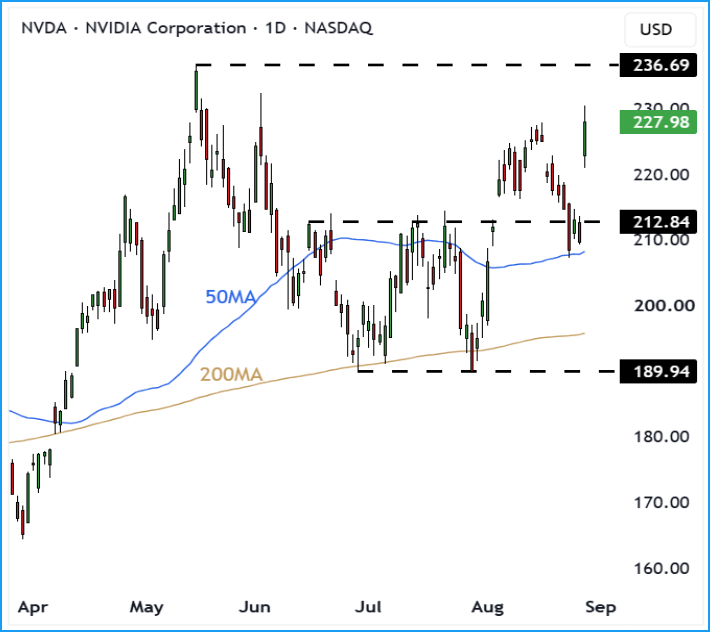
That matters well beyond Nvidia. One of the questions hanging over markets this year has been whether the enormous sums being spent on AI infrastructure can continue to justify the valuations attached to the companies supplying it. Nvidia’s data-centre revenue increased 117% year-on-year to $89 billion, while demand is also broadening beyond the handful of technology giants that initially drove the boom. For now at least, there is little evidence that the investment cycle is running out of steam.
There are, however, some details worth keeping an eye on. Nvidia is increasingly using its enormous balance sheet to support the companies buying its chips, something critics have described as circular financing. Accounts receivable have also risen sharply, free cash flow fell during the quarter and gross margins are expected to decline as shortages push up the cost of memory. None of that overshadowed the strength of the results, but as the numbers involved get larger, investors are quite reasonably asking more questions about how the next phase of growth is being financed.
The shares jumped following the results and are once again approaching their previous highs. For investors on this side of the Atlantic, Nvidia may feel a long way removed from the FTSE, but the read-across is difficult to ignore. AI investment now reaches semiconductor equipment, data centres, power generation, cooling, engineering and infrastructure, and increasingly touches companies listed in London too. Nvidia’s results suggest that particular spending cycle remains very much alive, but with expectations this high, the market will continue demanding evidence that the billions being poured into AI ultimately produce equally impressive returns.
Wishing you a great weekend,
Tom
Thomas Light – Chartered FCSI
Director of Research

Market Movers
On the rise: Halfords (LSE: HFD) +17.3% on the week
Halfords jumped after upgrading its full-year profit guidance following a stronger-than-expected start to the year, helped by good underlying momentum and a particularly strong summer trading period.
The group now expects underlying profit before tax of between £55 million and £65 million for FY27, ahead of previous market expectations of around £52.6 million. Management said trading had continued to outperform in recent months, with the business benefiting from progress against its strategic priorities as well as unusually warm weather, which boosted demand across seasonal categories. Halfords estimates that the weather alone added a mid-single digit millions contribution to profit.

The key point is that the upgrade doesn’t appear to be purely weather-driven. Halfords entered the year with improving momentum, while its wider financial profile has also strengthened, with free cash flow remaining healthy and net debt continuing to fall. The shares have already had a very strong run, so expectations are now much higher than they were a few months ago, but this latest update gives investors further evidence that the recovery is gaining traction.
Regency View: The warm weather has undoubtedly helped, but the more encouraging takeaway is that the underlying business appears to be improving at the same time. After such a strong run in the shares, the easy re-rating phase may be behind us, so the next leg higher will need to be backed by continued earnings delivery rather than sentiment alone.
Empire Metals came under pressure following its interim results, despite another update highlighting substantial progress at the Pitfield titanium project in Western Australia.
The company reported a first-half loss of £1.88 million, compared with £1.70 million a year earlier, reflecting the fact that Empire remains a pre-revenue exploration and development business. That headline loss was accompanied by a much stronger cash position of £12.4 million following an £8 million institutional fundraise in May, giving the group more room to progress drilling, metallurgical work and feasibility studies without an immediate funding squeeze.

Operationally, the story remains much stronger than the income statement suggests. Pitfield’s resource has now been upgraded to 8.16 billion tonnes at 4.3% TiO₂, including its first Measured Resource, while management has also completed an integrated processing flowsheet capable of producing high-purity titanium products. The challenge for investors is that Empire is now moving from proving scale towards proving economics, and that is usually the stage where the market becomes more demanding.
Regency View: The fall looks less like a rejection of Pitfield’s potential and more like a reminder that exploration success still has to be converted into commercial returns. Empire has made impressive progress, but with the shares carrying a substantial valuation for a pre-revenue business, the next phase needs to show that the project’s scale can translate into attractive economics.
Looking for your next UK stock idea?
FTSE Investor and AIM Investor members receive our latest stock recommendations, in-depth company research and regular updates as the investment case develops, including when we believe it’s time to take profits.
Sector Snapshot
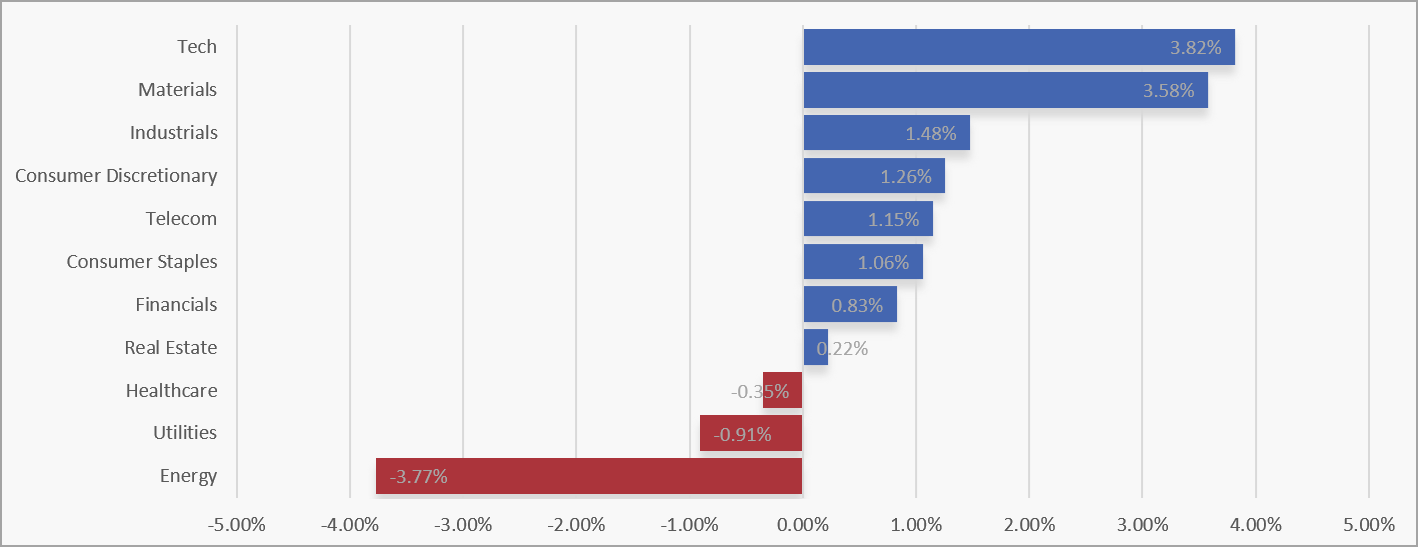
Technology led the UK market this week with a 3.82% gain, closely followed by Materials at 3.58%. Industrials and Consumer Discretionary also performed well, with gains spread across much of the market as eight of the eleven sectors finished the week in positive territory.
Energy was the clear outlier, falling 3.77% and reversing much of the strength seen in the previous week. Utilities and Healthcare also slipped, but the broader sector picture was relatively firm, with the mix of Technology, Materials and Industrials at the top of the rankings pointing to healthier participation across the market.
UK Sector Performance (7-Days)
UK Price Action
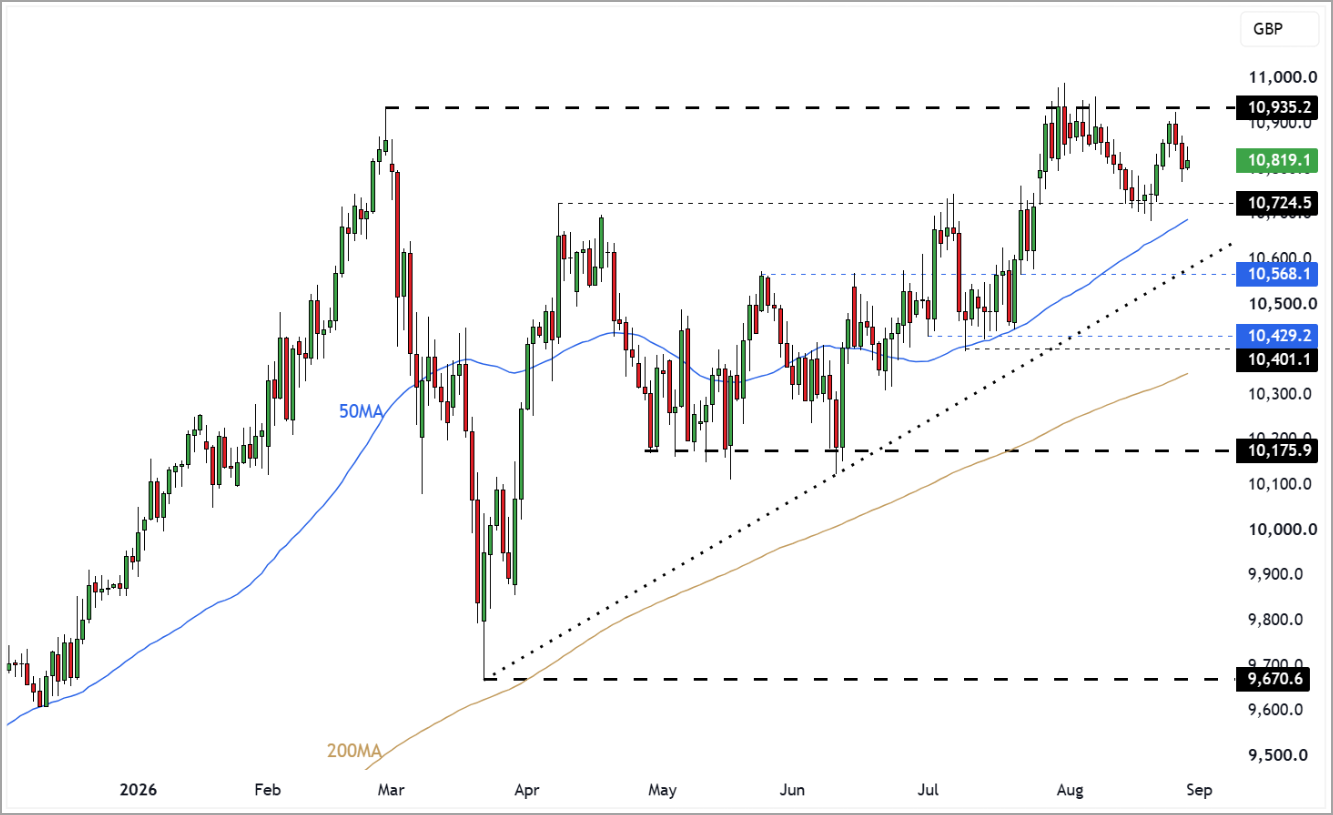
The FTSE started the week strongly, but once again the February highs just above 10,900 proved a step too far. What stands out is how clearly this area is now defining the upper boundary of the market. We have seen several attempts to push through it this month, yet each has attracted sellers and so far there has been no real acceptance above the old highs. That doesn’t necessarily spell trouble while the FTSE continues to hold comfortably above the 10,725 breakout zone, but after such a strong recovery, the repeated failure to clear 10,900 is becoming increasingly difficult to ignore.
UK100 Daily Candle Chart
Take your research further
From growth and value opportunities to income stocks and companies positioned to benefit from major investment themes, our research is designed to help you find attractive UK stock ideas and follow them from initial recommendation through to exit.
Disclaimer:
All content is provided for general information only and should not be construed as any form of advice or personal recommendation. The provision of this content is not regulated by the Financial Conduct Authority.