


5th Jun 2026. 10.56am

Weekly Briefing – Friday 5th June
| Market | Movement this week (%)* |
|---|---|
| FTSE 100 | -0.09% |
| FTSE 250 | -0.34% |
| FTSE All-Share | -0.13% |
| AIM 100 | -1.99% |
| AIM All-Share | -1.38% |
* Price movement from Monday's open at 8am
Regency View:
Weekly Briefing – Friday 5th June
Market Overview
Dear Investor,
This week, the OECD provided a useful reminder that while the global economy faces plenty of challenges, there remains a meaningful difference between a slowdown and a crisis.
In its latest outlook, the organisation highlighted the growing risks posed by the ongoing conflict in the Middle East, warning that a prolonged disruption to energy markets could have serious consequences for growth, inflation and interest rates. However, its central forecast remains far more measured, with the global economy expected to slow rather than contract.

Closer to home, the UK economy continues to send mixed signals. The OECD now expects growth of 0.9% this year, slightly ahead of its previous forecast, but it also believes Britain will experience one of the largest rises in unemployment across the G7 as businesses adapt to rising employment costs and a more challenging economic backdrop.
Perhaps the most important takeaway for investors is that the base case remains largely unchanged. Inflation remains uncomfortable, growth is expected to slow and geopolitical risks continue to cast a shadow over the outlook. Yet despite the headlines, the OECD is not forecasting a recession. Instead, it sees an economy that is proving more resilient than many had feared, even if the road ahead remains far from smooth.
For investors, that distinction matters. Markets are constantly trying to assess whether the next move is towards recovery or recession. For now, the evidence continues to suggest that while growth may be slowing, the global economy is still moving forward.
Wishing you a great weekend,
Tom
Thomas Light – Chartered FCSI
Director of Research

Market Movers
On the rise: B&M European Value Retail (LSE:BME) +23.7% on the week
B&M moved higher this week after investors welcomed a better-than-feared set of full year results and signs that management is taking decisive action to address some of the issues that have weighed on performance over the past year. While the shares remain well below their highs, the market appeared encouraged that trading has stabilised and that a clear recovery plan is now in place.
The numbers themselves were mixed. Revenue increased 3.6% to £5.8bn, supported largely by new store openings, but profits came under pressure as higher wage costs, increased employer taxes and rising operating expenses weighed on margins. UK like-for-like sales were broadly flat, reflecting what management described as execution issues across parts of the business, while adjusted EBITDA fell 26% during the year.

However, investors seemed more focused on what comes next. Management unveiled its new “Back to B&M Basics” strategy, designed to sharpen pricing, improve product availability and enhance store execution. Encouragingly, profitability came in ahead of analyst expectations and management believes it can offset rising energy and freight costs during the year ahead. The group’s French business also continued to perform strongly, helping to offset weaker trading elsewhere and demonstrating that the wider business still has attractive growth opportunities.
Regency View: B&M is no longer the market darling it was a few years ago, but the valuation already reflects a lot of bad news. With the shares trading on around 9 times forward earnings and yielding more than 5%, investors appear increasingly willing to back management’s turnaround plan if execution starts to improve
Pan African Resources slipped this week despite reporting record annual gold production and another year of strong operational progress. The South African miner expects to produce around 275,000 ounces of gold during FY26, representing growth of roughly 40% compared to last year. Management also highlighted record operating cash generation, a move into a net cash position and continued strong performances from several of its core operations.
The market, however, appeared more focused on the outlook than the record production figures. While Pan African expects production to increase again next year to between 280,000 and 302,000 ounces, the pace of growth is set to slow significantly compared to this year’s exceptional performance. Investors were also digesting guidance for higher operating costs as inflation continues to filter through the business, with all-in sustaining costs expected to rise across key inputs including energy, electricity and reagents.

The backdrop for gold miners has also become slightly less supportive in recent weeks. As concerns surrounding the conflict in the Middle East have eased, the gold price has retreated from its highs, reducing some of the safe-haven demand that helped drive the sector higher earlier in the year. Management also noted that contingency measures remain in place to protect fuel and reagent supplies from any further disruption linked to the conflict, underlining that geopolitical risks have not disappeared entirely.
Regency View: Pan African remains one of the strongest operators in the sector, with excellent production growth, a healthy balance sheet and a clear pipeline of future projects. After nearly doubling over the past year, the shares may simply be taking a well-earned breather while investors assess how much of the good news is already reflected in the price.
Sector Snapshot
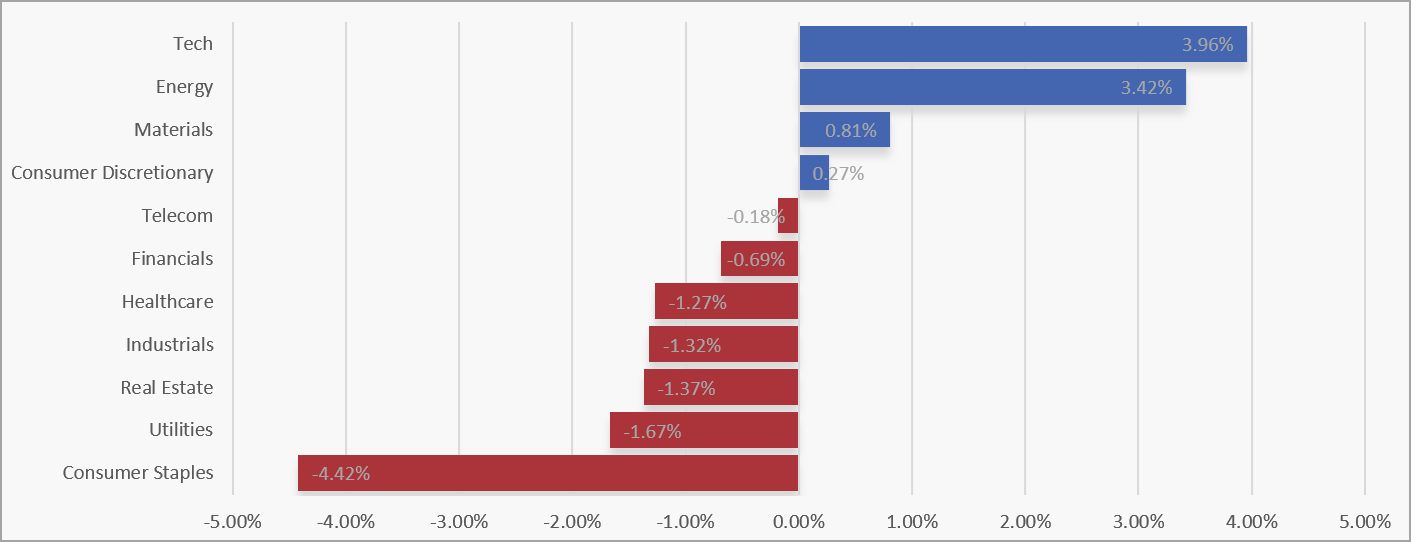
Tech returned to the top of the leaderboard this week, comfortably outperforming the rest of the market as investors rotated back into growth-focused names. Energy also delivered a strong performance, while Materials managed modest gains, suggesting support from both technology and commodity-related themes. Consumer Discretionary edged higher too, although the strength was far less pronounced than in the market’s leading sectors.
At the weaker end, Consumer Staples endured a difficult week, finishing well behind the pack. Utilities, Real Estate, Industrials and Healthcare also slipped lower, while Financials and Telecoms drifted into negative territory. The pattern points to a market becoming increasingly selective, with investors favouring sectors offering stronger growth prospects while reducing exposure to more defensive areas.
UK Sector Performance (7-Days)
UK Price Action
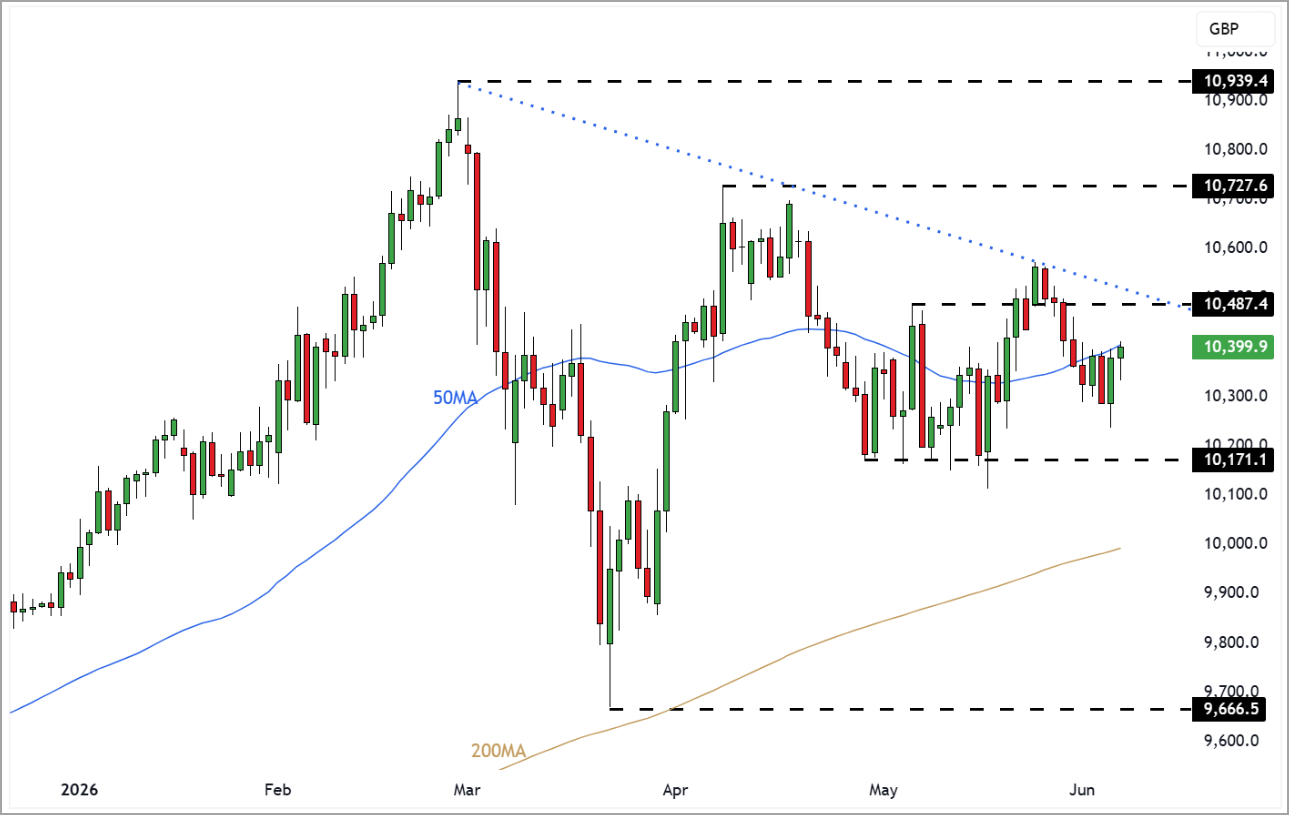
It’s been a relatively quiet week for the FTSE, with very little changing from a technical perspective. The market remains trapped between well-defined support and resistance levels, and despite plenty of macro headlines, neither the bulls nor the bears have managed to land a decisive blow. Sometimes the most important message from the market is that nothing has changed, and for now that appears to be the case.
That said, yesterday’s reversal does offer a small reason for optimism. The bounce has the potential to form a higher swing low, which would be the first building block of a more constructive short term trend. Buyers will now be looking for the FTSE to push back towards resistance and challenge the descending trendline that has capped rallies since March. Until then, this still looks like a market in consolidation mode rather than one ready to launch into its next major move.
UK100 Daily Candle chart
Disclaimer:
All content is provided for general information only and should not be construed as any form of advice or personal recommendation. The provision of this content is not regulated by the Financial Conduct Authority.