


19th Dec 2025. 10.16am

Weekly Briefing – Friday 19th December
| Market | Movement this week (%)* |
|---|---|
| FTSE 100 | +1.83% |
| FTSE 250 | +1.89% |
| FTSE All-Share | +1.88% |
| AIM 100 | +0.80% |
| AIM All-Share | +0.57% |
* Price movement from Monday's open at 8am
Regency View:
Weekly Briefing – Friday 19th December
Market Overview
Dear Investor,
Silver continued to steal the spotlight this week as prices surged above $60 per ounce for the first time, extending a rally that has now seen the metal more than double since January. Tight supply conditions, strong investor demand and growing industrial use have combined to create a powerful upward trend. A 4% jump to $60.4 per ounce underlined just how stretched the market has become, with precious metals once again attracting attention as monetary policy edges looser.
This move is being driven by fundamentals rather than short term enthusiasm. Years of undersupply have left the silver market structurally tight, while demand from electronics and solar manufacturing continues to grow. Although a large stockpile built up in the US earlier this year, inventories remain elevated and regional shortages persist, particularly in Asia. Expectations of easier global monetary policy have added another tailwind, reinforcing silver’s role as both an industrial and financial asset.

At the other end of the commodity spectrum, Brent crude has moved sharply lower. Oil prices fell below $60 a barrel for the first time since early 2021, driven by hopes of progress towards a Russia Ukraine peace deal and growing confidence that global supply will remain ample. Any easing of sanctions or normalisation of trade routes could release oil currently tied up in long shipping chains, effectively increasing available supply. While analysts caution that optimism may be premature, sentiment has clearly shifted.
The supply backdrop reinforces that pressure. Global oil production has risen by close to 3 million barrels a day this year, with output growth coming from both Opec and non Opec producers. Even with recent geopolitical disruptions, the International Energy Agency expects a sizeable surplus to persist into 2026. Brent has now fallen for five consecutive months, its longest losing streak in more than a decade, as concerns about oversupply outweigh demand growth.
For UK investors, the week was rounded off by a long anticipated move from the Bank of England. The MPC voted five to four to cut rates by 0.25 percentage points to 3.75%, marking the sixth cut since the summer of 2024. Governor Andrew Bailey struck a cautious tone, signalling that further easing is possible but far from guaranteed as inflation approaches target. With precious metals surging, energy markets resetting and interest rates edging lower, divergence across asset classes is becoming more pronounced. These shifts tend to create clear winners and losers at the stock level, making selectivity increasingly important as we head into the new year.
With best wishes for Christmas and the New Year,
Tom
Thomas Light – Chartered FCSI
Director of Research

Market Movers
On the rise: Whitbread (LSE:WTB) +9.3% on the week
Whitbread moved higher this week after activist investor Corvex Management disclosed a 6% stake in the Premier Inn owner and called for a review of the company’s capital allocation strategy. The US based hedge fund urged Whitbread to reassess its £3.5bn five year investment plan, arguing that recent policy changes have widened the gap between the group’s share price and underlying value. Corvex also confirmed it intends to seek board representation.
The intervention follows Whitbread’s recent warning that measures in the latest UK Budget are expected to increase costs by £40m to £50m in the next financial year. That impact had been described by analysts as a significant challenge to the group’s medium term plans, particularly given the scale of planned capital investment. Corvex said all strategic options should be reviewed with the aim of maximising value for shareholders.

Whitbread has not yet formally responded to the activist’s proposals. The company continues to operate a predominantly UK focused hotel estate with a growing presence in Germany, where investment remains a core part of its long term strategy. The stock had been under pressure over recent months, leaving valuation metrics more subdued relative to history, with a forward price to earnings ratio of 12.1 and a forecast dividend yield of 4.25%.
Regency View: We have previously highlighted Whitbread as a high quality operator facing a temporary policy headwind rather than a broken business. Constructive activist pressure could act as a catalyst to sharpen capital discipline and unlock value that we believe already exists within the group.
Time Out Group came under pressure after publishing its preliminary results alongside the announcement of an £8m equity placing. The company reported full year revenue of £73.2m and adjusted EBITDA of £7.1m, showing continued operational progress as it expands its global food and cultural media footprint. However, the funding announcement quickly became the dominant focus for investors.
The group confirmed a conditional retail offer at an issue price of 8p per share, representing a 30.4% discount to the prior closing price of 11.5p. The placing is open to UK retail investors via RetailBook, with a minimum subscription of £250 and access through ISAs, SIPPs and general investment accounts. The discount level highlighted the balance the company is striking between raising growth capital and near term shareholder dilution.

Time Out said the proceeds will be used to support future growth, though the announcement arrives at a time when investor sentiment towards dilution has been fragile, particularly among small and mid cap growth stocks. The combination of a discounted placing and the reminder that additional capital is still required to fund expansion weighed on the shares despite the improvement in underlying financial performance.
Regency View: Capital raises are rarely welcomed, especially when delivered at a meaningful discount. While Time Out’s growth ambitions are clear, dilution risk remains front and centre, which is why we continue to watch from the sidelines rather than get involved at this stage.
Sector Snapshot
Financials took the top spot this week, supported by strong earnings momentum and improving sentiment around global rate expectations. Consumer Discretionary and Industrials followed closely behind, while Materials and Utilities also performed well, giving the rally a healthy mix of cyclical and defensive participation.
Real Estate and Telecom added to the gains, while Tech and Consumer Staples were largely flat. Energy was the clear laggard, reversing sharply after recent strength, as investors took profits and rotated back into sectors with more consistent earnings visibility.
UK Sector Performance (7-Days)

UK Price Action
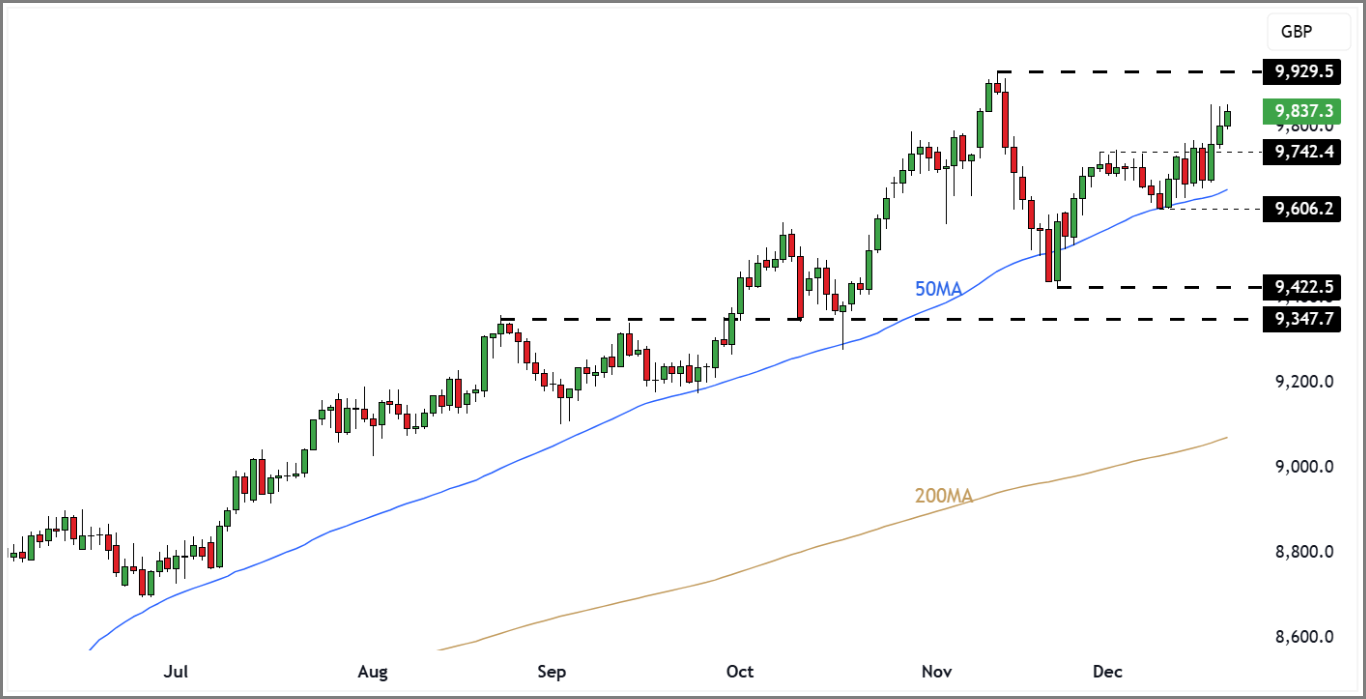
As we head into Friday, the FTSE is finishing the week on a positive note, breaking higher from the consolidation range that has been forming above the 50 day moving average. Buyers have continued to absorb weakness around 9,600 and the index has pushed steadily into the upper end of this week’s structure.
This week’s price action has strengthened the short term outlook, with momentum improving while the broader trend remains firmly bullish. A weekly close above 9,742 would put the market in a strong position for a run towards the 9,929 highs.
FTSE 100 Rolling Futures (Daily Candle Chart)
Disclaimer:
All content is provided for general information only and should not be construed as any form of advice or personal recommendation. The provision of this content is not regulated by the Financial Conduct Authority.